
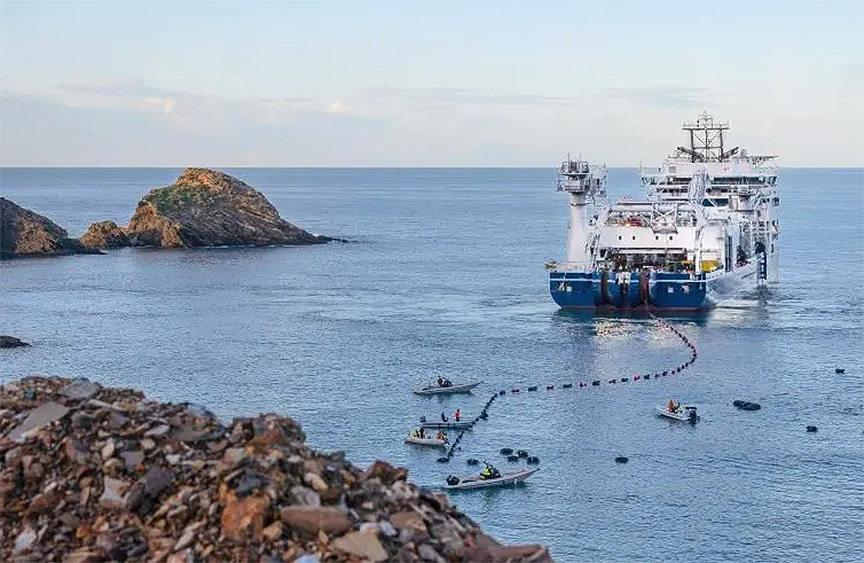
The future of the Great Sea Interconnector (GSI), which, if completed, will link the energy grids of Cyprus, Greece, and Israel, is “being handled away from the public eye”, President Nikos Christodoulides said on Thursday, with it yet to be confirmed as and when seabed surveys for the project’s construction will begin.
“Everything which needs to be done regarding this specific matter, in terms of the Republic of Cyprus exercising its sovereign rights, is being handled away from the public eye and without excessive public statements,” he said on the sidelines of a parade to mark ‘Ochi Day’, the anniversary of Greece’s entry into the Second World War.
It is widely expected that a navtex, a message used to transmit information to seaborne vessels, regarding planned seabed surveys for the laying of cables for the GSI project, will be issued in the coming weeks, though matters have been complicated by the fact that part of the interconnector’s planned route passes through seas which are claimed by both Greece and Turkey.
Of this, Turkish Foreign Minister Hakan Fidan had stressed last week that his country will not “raise any objections” to the interconnector’s construction, provided that it is given prior warning ahead of the navtex by the governments of Greece and France, the country in which the project’s majority stakeholder, asset management firm Meridiam, is based.
“What we are asking is that when a ship conducts research at sea, it send us a written notification, not just an oral one, stating, ‘we are going to undertake specific actions in this area, here are the coordinates’. That is all we are asking for. Nothing more,” he said.
On this front, Cypriot Energy Minister Michael Damianos had said two weeks ago that the navtex for the seabed surveys will be issued before the end of this month, with the Greek coastguard having said that French-flagged research ship the Abeille Marengo will be the ship conducting the surveys.
Damianos said last week that “if the project progresses”, it is believed that it will be fully completed by 2031.
Turkey’s claim to regional seas may be strengthened by Libya deal
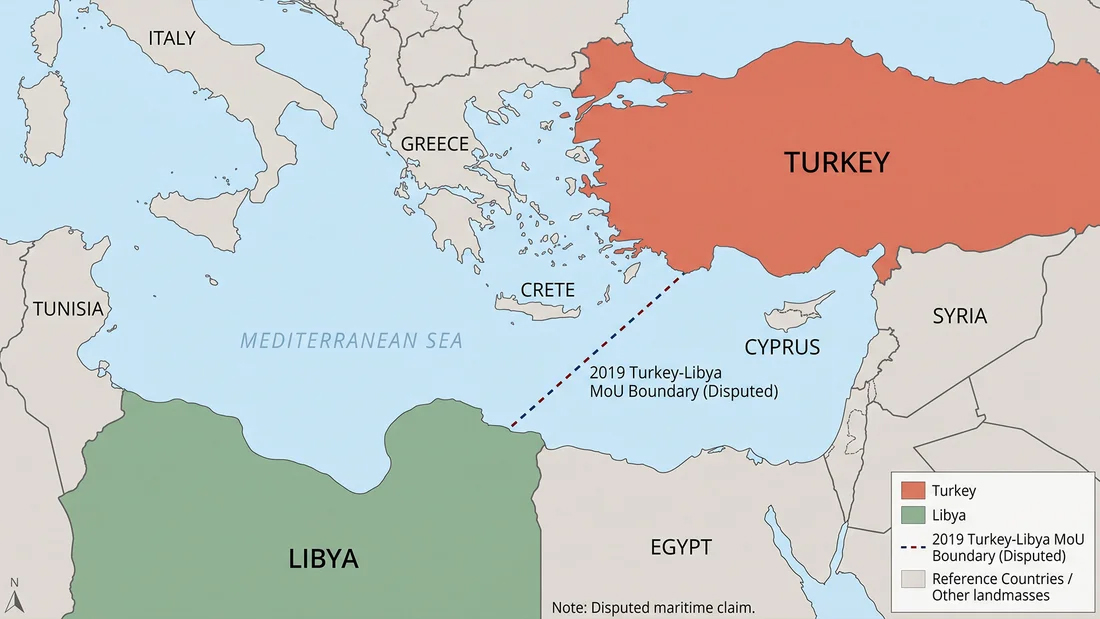
However, Turkey’s claim to the seas through which the interconnector may pass appears to have been strengthened in recent weeks, with Libya’s parliament last week having unanimously ratified a maritime boundary agreement its government had signed with Turkey in 2019.
That agreement saw Turkey and Libya define where the two countries’ exclusive economic zones (EEZ) border one another in the eastern Mediterranean, with that border, according to the agreement, falling between two points southeast of the Greek island of Crete, where the interconnector cable will connect to Greece.
Greece and the Republic of Cyprus object to the deal, saying that Turkey and Libya do not share a maritime border because islands are each entitled to a full EEZ, and that therefore, the sea in question belongs to Cyprus and Crete. Turkey’s position is that islands are not entitled to a full EEZ.
That agreement has received international pushback, with the European Union’s foreign policy chief Kaja Kallas having told Fidan that the deal “infringes upon the sovereign rights of third states”, while European Council President Antonio Costa and European Commission President Ursula von der Leyen had said that they “deeply regret” it.
“We reaffirm our solidarity with Greece and Cyprus. We reiterate the EU’s well-known position against any outside interference in Libya,” they said.
In response, Turkish President Recep Tayyip Erdogan said that “we are not, so to speak, trying to score a goal against anyone in the eastern Mediterranean”, but that “we are only concerned with protecting our maritime jurisdiction areas, rights, and interests”.




Click here to change your cookie preferences