
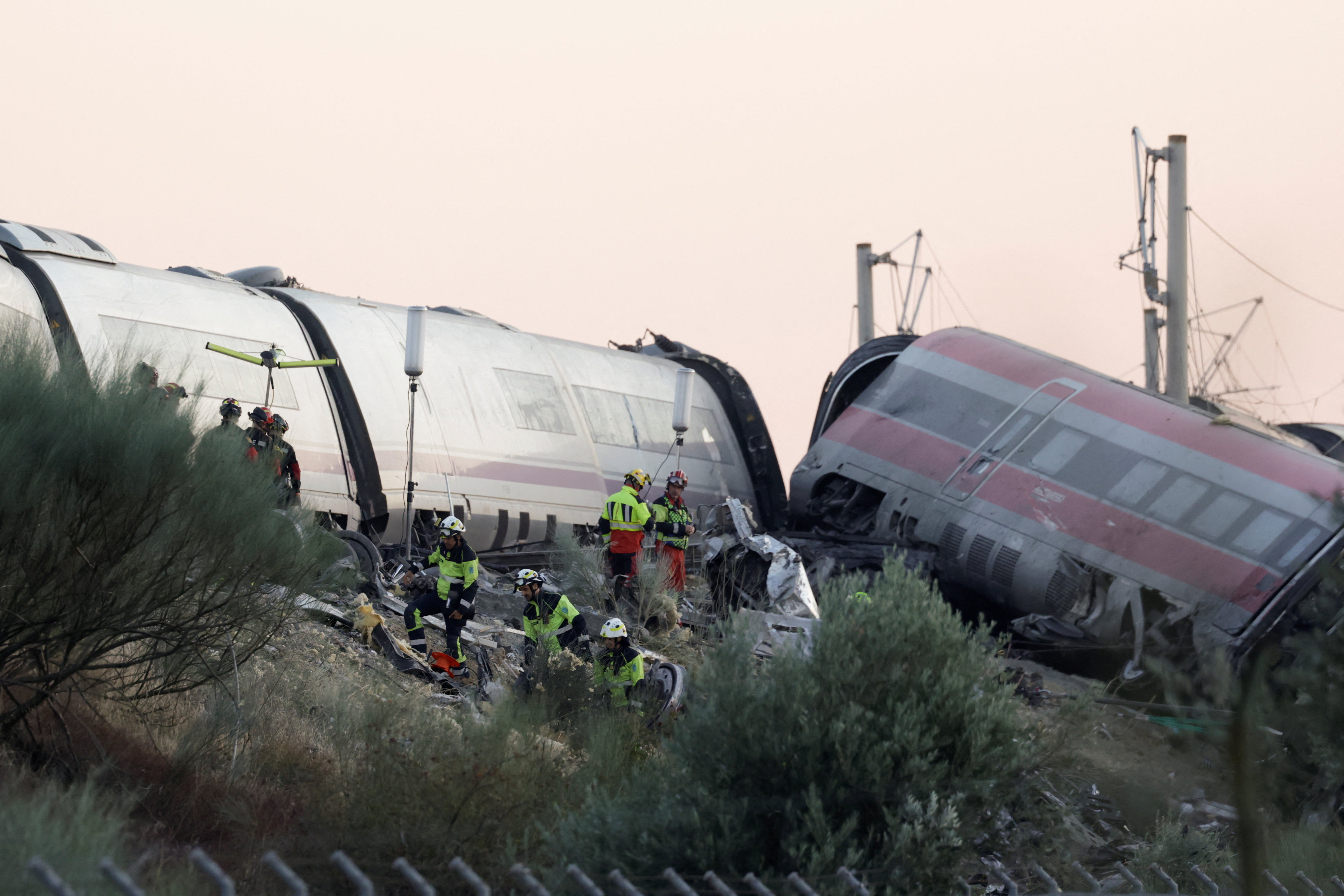
Residents describe harrowing scenes as families desperately search for missing loved ones.
Shocked residents of Urda swung into action to help as soon as they heard of Wednesday’s deadly train crash on the railway line a few kilometres from the normally sleepy Spanish town.
Urda’s 78-year-old pharmacist said he was one of the first on the scene, jumping into his car to try to help after his daughter told him of the crash involving two high-speed trains.
Antonio Garcia said that as he approached, the scale of the accident that has so far left at least 68 people dead became clear, with one carriage wedged inside another and scores of bodies.
“Just imagine what was inside,” said Garcia, who brought first aid materials, painkillers and tranquillisers from his pharmacy as well as blankets to help treat the injured.
Garcia described how one passenger who had lost an arm in the crash was calmly asking for an ambulance, while another was saying his final goodbyes to his family.
Spain’s deadliest train disasters
ADAMUZ (2026)
Forty six people died and more than 120 were injured in southern Spain after a high-speed train derailed and collided with an oncoming one on January 18 near Adamuz, in the province of Cordoba.
The accident is still under investigation. A preliminary report by Spain’s Civil Guard in February pointed to defects in the track, rail or weld between two sections of track as the main hypothesis for the accident, but kept seven other theories open.
SANTIAGO DE COMPOSTELA (2013)
A railway accident in the summer of 2013 left 80 people dead and 145 injured when an eight-carriage high-speed train veered off the track on a sharp bend near the northwestern city of Santiago de Compostela, slamming into a concrete wall and bursting into flames.
A Transport Ministry commission concluded that the accident was caused by speeding and the driver being distracted by a call from a superior, but a victims’ association blamed the accident not only on human error but also on the railway’s security systems.
MADRID COMMUTER TRAIN BOMBINGS (2004)
On March 11, 2004, 10 backpack bombs detonated on four Cercanias commuter trains, killing 193 people and injuring thousands of others during Madrid’s rush hour. The attacks were carried out by Islamists opposing Spain’s participation in the Iraq war.
EL CUERVO (1972)
An accident caused by a head-on collision between two trains on the Cadiz-Seville route left 86 people dead and more than 150 injured near the southern town of El Cuervo in 1972. The accident was caused by a driver’s failure to stop at a red light at El Cuervo station, according to an investigation by state-owned rail operator Renfe.
URDULIZ (1970)
A head-on collision of two trains killed 33 people in the town of Urduliz, near the northern city of Bilbao, in the summer of 1970. A stationmaster was initially blamed for the accident, but it later emerged that he had been working 16-hour shifts for the previous four days.
GRISEN (1965)
A train on the Madrid-Barcelona route caught fire in 1965 in the town of Grisen, near northeastern Zaragoza, killing dozens of passengers. Though the train operator said at the time that 30 people died, later reports have said the real death toll was up to 80 and that the Francoist leadership tried to play it down.
TORRE DEL BIERZO (1944)
The 1944 crash of three trains in the El Bierzo region of León province is considered one of the deadliest railway disasters in Spain, with the estimated death toll of 78 still being debated due to censorship under Francisco Franco.
A train travelling from Madrid to A Coruña suffered a brake failure and collided with a locomotive inside a tunnel, just before a third train entered the same gallery and crashed into the wreckage.
“His last words were ‘God is good’. For those of us who are believers, these are very beautiful words,” said Garcia.
Other locals brought bottles of water to give to passengers who were evacuated from the two trains.
A community mobilises to help survivors
A few hours later, Urda was brimming with police, firefighters and emergency workers from across the region and its local sports hall was converted into a centre for survivors.
The local primary school was reserved for relatives of the victims, where a volunteer psychologist from Madrid called Carmen said she had been helping out since the morning.
“There were many mothers who found out their children had been killed. That was the worst of today. Telling a mother that her child has died in a train crash is devastating,” she said.
Families face an agonising search
Some relatives made the two-hour trip from the Spanish capital Madrid to search for family members.
A woman who gave her name as Ana said she had travelled to Urda after a call from environmental police who had found their dog, Trece, who was on board a train with her husband Pepe.
Ana fought back tears as she described searching for her husband at the crash site, Urda’s sports hall and the primary school, adding that his name was not on any list.


Click here to change your cookie preferences