
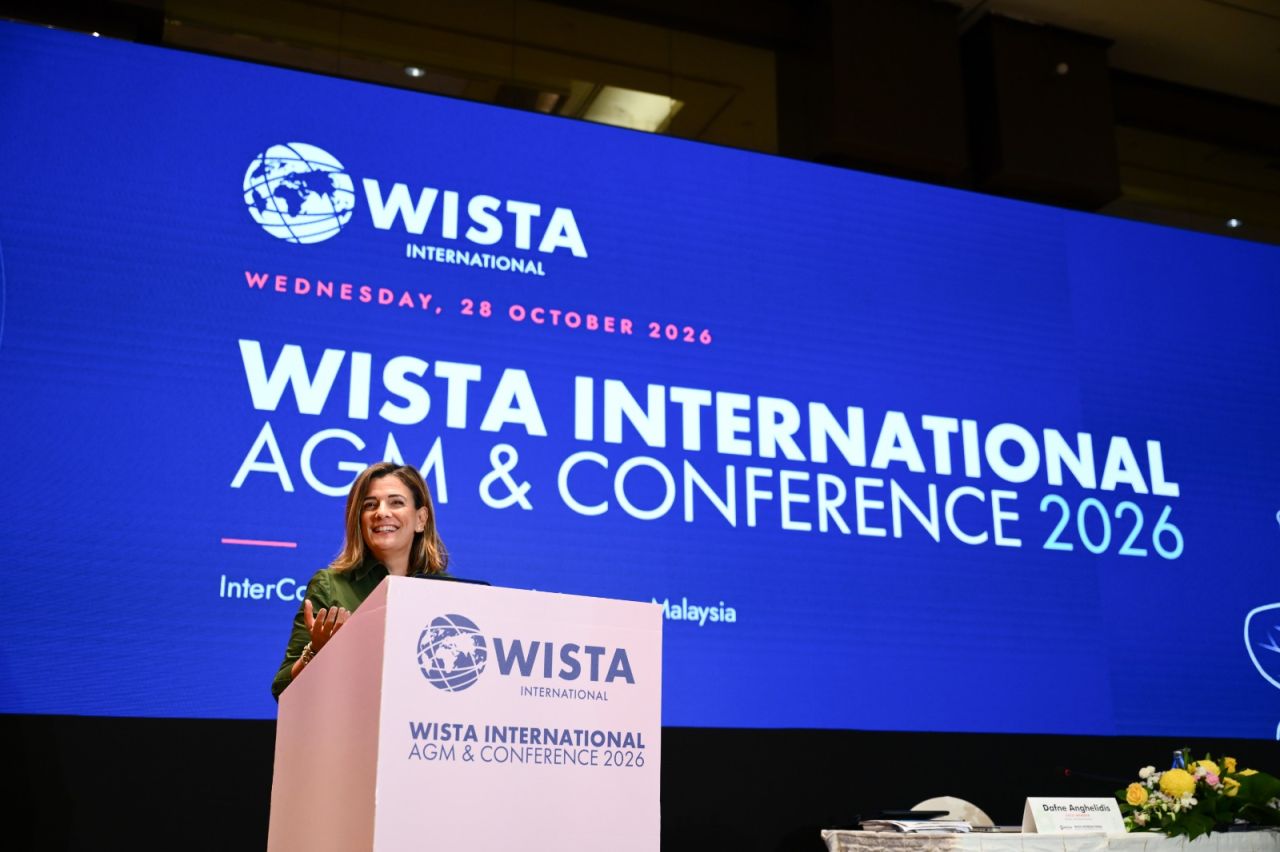
WISTA International has grown beyond 6,500 members, extending its influence across global shipping as it looks to bring more women into an industry where senior positions and careers at sea remain overwhelmingly male-dominated.
President Elpi Petraki outlined the association’s achievements over the past year at its Annual General Meeting in Kuala Lumpur this week, emphasising growing membership, closer ties with international maritime organisations and new opportunities for companies to become involved.
The meeting formed part of the WISTA International AGM and Conference 2026, taking place from October 28 to 30 under the theme ‘Bridging Borders, Driving Change: Asia Shaping the Future of Maritime and Trade’.
Co-hosted by WISTA Malaysia, WISTA Singapore and WISTA Hong Kong SAR China, the gathering brings together shipping executives, policymakers and industry professionals to examine the future of maritime trade, technology, sustainability and leadership.
For Petraki, the past 12 months have been particularly busy, with WISTA strengthening its relationships with the International Maritime Organisation (IMO), International Chamber of Shipping (ICS) and the United Nations, while taking a more active role in initiatives affecting the industry’s workforce.
Among those emphasised in her annual report were the Women in Transport EU Platform for Change, the UN Maritime Just Transition Task Force and UN Trade and Development’s TrainForTrade Port Management Programme.
WISTA has also continued working alongside the IMO on projects designed to improve opportunities for women across the maritime sector, from education and professional development to participation in industry decision-making.
Training has remained a particularly important part of that work. Through its partnership with the Institute of Chartered Shipbrokers, WISTA continues to offer scholarships that help members develop specialist shipping knowledge and commercial skills.
The arrangement, established in 2017, provides for five scholarships annually towards the Institute’s Foundation Diploma, covering subjects ranging from chartering and ship operations to maritime finance and port management.
Another programme has already delivered results this year. The IMO-WISTA-World Maritime University Gender-inclusive Leadership in Maritime Programme brought together 23 maritime professionals from 18 countries in 2026, combining online training with a residential course in Malmo, Sweden.
WISTA sponsored four participants, with the programme concentrating on leadership, project management, communication and the practical challenges of improving gender equality in maritime workplaces.
Meanwhile, the association has taken another step towards widening its membership by introducing a new category for businesses and institutions.
The associate membership scheme, formally launched in September, allows organisations involved in shipping, ports, logistics, transport, trading and energy to join WISTA’s international network even where they cannot become members through a national association.
Eligible organisations must operate in at least two countries and can nominate up to three representatives to participate in national WISTA activities.
To encourage participation, WISTA is offering complimentary membership until the end of 2026 to eligible organisations applying before December 31.
Petraki also reported the approval of two new members during the AGM.
Speaking when the new membership scheme was launched in September, she explained that interest from companies wishing to support WISTA had been increasing, although the existing structure had not always provided a suitable route.
“Broader collaboration with those sharing our vision is critical when tackling diversity and inclusion, as there is no one size fits all approach,” Petraki said.
The expansion comes as the maritime industry continues to face uncomfortable questions about how effectively it is attracting and retaining women.
According to the latest IMO-WISTA survey, published in May 2025, women accounted for just under 19 per cent of the maritime workforce surveyed, falling to 16 per cent in the private sector, excluding seafarers.
The situation at sea was considerably worse, with women representing just 1 per cent of seafarers employed by the organisations surveyed.
Those figures help explain why WISTA is putting so much effort into education, recruitment and leadership development, rather than relying on greater visibility alone.
Petraki herself addressed the wider challenge in an article published earlier this month, arguing that “inclusion is not about replacing men with women”, but about recognising the skills and experience available throughout the workforce.
The Kuala Lumpur conference is also examining these questions from a commercial perspective, with ICS Secretary General Thomas Kazakos among the leading speakers.
The programme includes discussions on building a future-ready maritime workforce, linking ships and ports with international trade and strengthening cooperation across the industry.
IMO programme officer Mariana Noceti and ICS director of employment affairs Helio Vicente are among those contributing to the workforce discussions, while a dedicated Women at Sea session gives female seafarers an opportunity to share their experiences and examine the obstacles that remain.
Cyprus has its own strong connection to WISTA’s international development. The island hosted the association’s 50th anniversary AGM and Conference in Limassol in October 2024, welcoming more than 350 delegates from the shipping, trading and logistics industries.
Petraki was re-elected president during that gathering, continuing a leadership history that includes former international president Despina Panayiotou Theodosiou of WISTA Cyprus.
The Cypriot association, currently led by Anna Pittalis, has remained active in promoting professional development, mentoring and greater female participation across the island’s maritime businesses.

Click here to change your cookie preferences