
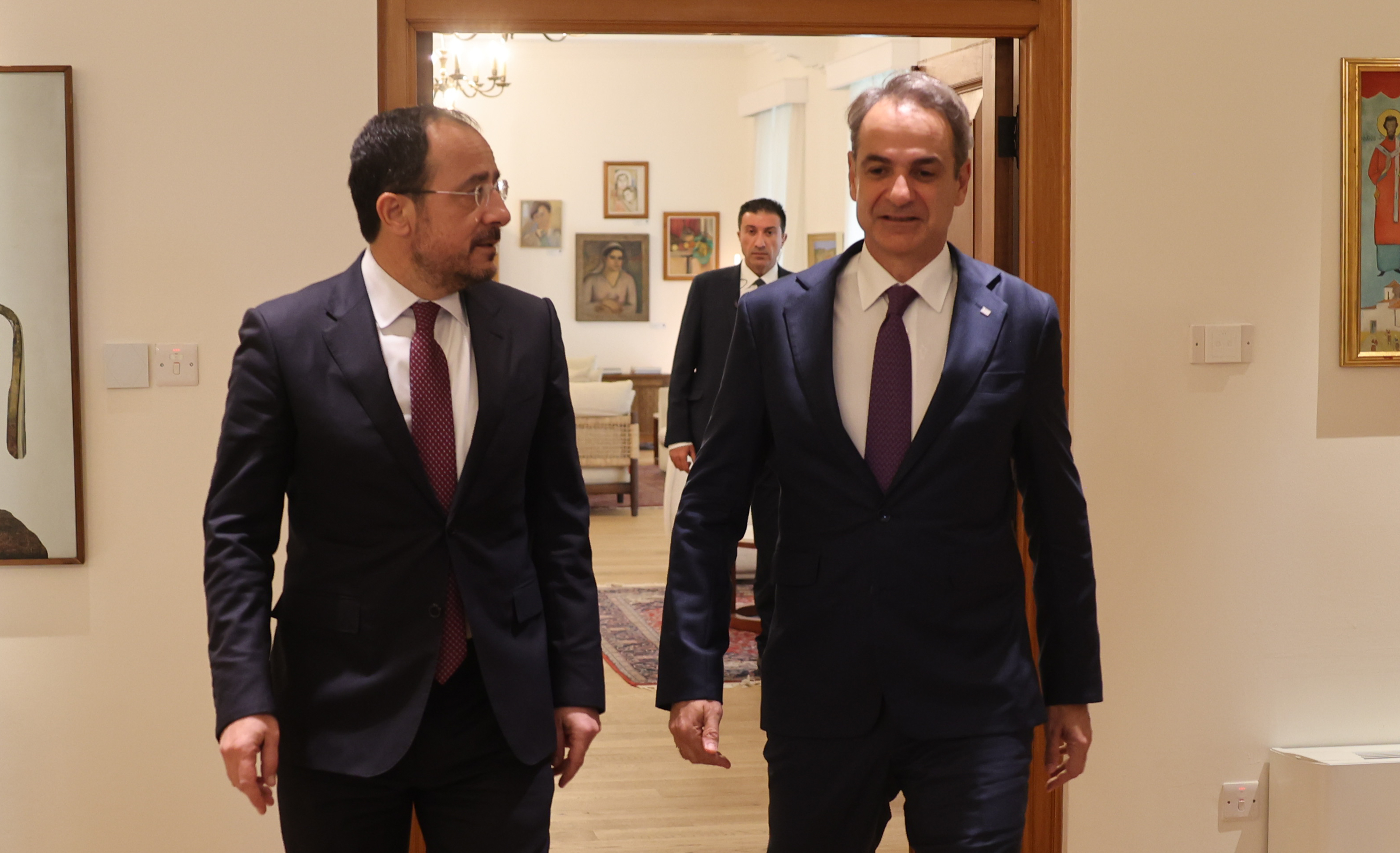
It was reassuring to see that the governments of Greece and Cyprus are finally on the same page regarding the Great Sea Interconnector (GSI) and all the differences that appeared earlier in the year, which prompted some harsh public exchanges, have been overcome. This was evident after the Fourth Intergovernmental Convention between the two countries that was held in Nicosia on Wednesday.
Prime Minister Kyriakos Mitsotakis said that the surveys of the seabed began last week. “It is a project of European interest, and it is progressing smoothly, without hindrance, and in accordance with the original plan,” he said. It was “a strategic project that was moving ahead, bypassing the problems we encountered in the course,” he added. President Nikos Christodoulides said the work on the cable was part of the broader cooperation between the governments, saying there was continuous communication and coordination with the Greek PM and the French president.
Finance Minister Makis Keravnos, who was publicly expressing strong reservations about the GSI, arguing that it could be unviable and had the potential of causing big harm to public finances, has kept silent recently. We have heard nothing about the study about the viability of GSI that Keravnos, said would determine whether the project would go ahead. Perhaps, once the big French infrastructure investment firm Meridiam bought 66 per cent of GSI, the minister’s reservations ceased to exist.
It was interesting that neither the prime minister nor the president made any reference to Turkey or to the squabbling about the issuing of the Navtex and the counter-Navtex. There were reports last week that a frigate from the Turkish navy was monitoring the movements of the French survey ship Abeille Marengo, but there was no incident. The involvement of a big French company in the project has probably played a big part in ensuring things going smoothly, as has the toning down of the rhetoric about the Navtex.
These intergovernmental conventions have given some structure to the cooperation of the two governments on issues of common interest, and it is a plus that defence has been left out. We should not expect too much from the cooperation “on artificial intelligence,” which was “one of the basic axes” of Wednesday’s discussions. Chjristodoulides said that Cyprus was seeking, together with Greece, to play an active role in the digital transition, with the aim of improving “both competitiveness and productivity.” There was also talk about the relevant ministries undertaking “horizontal coordination of common actions.”
We doubt this will amount to very much as each country has its own agenda regarding AI, but even the occasional exchanges between ministries about how each is proceeding would be very useful.




Click here to change your cookie preferences