
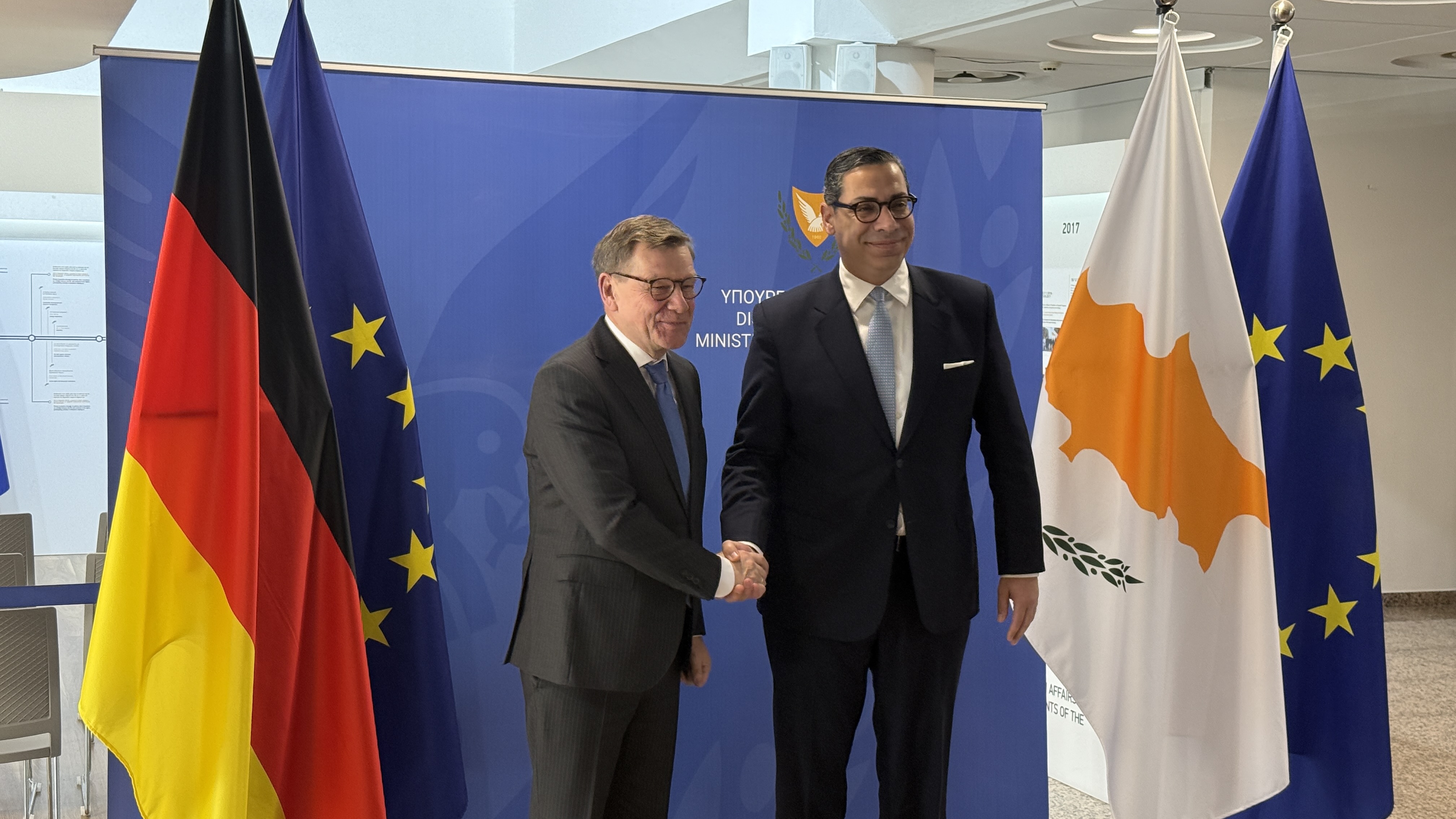
German Foreign Minister Johann Wadephul on Tuesday said that his country is “committed to peace and to a strong Europe”, as he visited Cyprus amid a deepening conflict in the Middle East.
He was welcomed at the Cypriot foreign ministry by his counterpart Constantinos Kombos, and wrote in the ministry’s visitors’ book that “in these challenging times, it is good to have Cyprus, a good friend and partner with shared values, by our side”.
“We stand together and are committed to peace and to a strong Europe,” he added, before thanking Cyprus for the country’s “commitment as a bridge to the Middle East” and for its role as the current holder of the Council of the European Union’s rotating presidency.
His visit comes days after the German frigate FGS Nordrhein-Westfalen arrived at the port of Limassol, joining a growing fleet of international military vessels which have deployed to Cyprus amid an ongoing conflict in the Middle East.
The ship’s arrival comes after Cypriot government spokesman Konstantinos Letymbiotis had said last week that Germany was to assist in “preventative measures” being taken to protect the island after it was hit by an Iranian-made drone.
Germany’s sending of a frigate comes after numerous other Nato and European Union member states have sent military assets to the island and its vicinity.

The Netherlands is the latest country to do so, with a Dutch frigate set to deploy to Cyprus as part of the french aircraft carrier the Charles de Gaulle’s carrier strike group. The Charles de Gaulle itself is currently located off the Greek island of Crete.
It was visited by French President Emmanuel Macron on Monday, with Macron having earlier paid a joint visit to Cyprus alongside Greek Prime Minister Kyriakos Mitsotakis.
Macron said during his visit to Cyprus that the Charles de Gaulle is “now close to Cyprus to contribute to the overall defence picture, and to ensure it in the long term”.
Earlier, Italy had announced its intention to send the Federico Martinego frigate to Cyprus, while Spain is to send the Cristobal Colon frigate.
Greece, meanwhile, deployed four F-16 fighter jets to the island last Monday, as well as two frigates, including the Kimon, which was described by Mitsotakis during his visit to the island as the “pride of the Greek fleet”.
Following the deployment of Greek F-16s, Turkey then deployed six F-16s of its own, which arrived on the island on Monday morning.
The United Kingdom, meanwhile, which operates and holds sovereignty over the Akrotiri air force base, which was hit by last week’s drone, has sent multiple AW159 Wildcat helicopters, armed with anti-drone missiles, to Cyprus, while the HMS Dragon Type 45 destroyer warship also expected to depart from Portsmouth within the coming days.
Additionally, last week British Prime Minister Sir Keir Starmer has confirmed that Cyprus, and more specifically Akrotiri, has been used as the launchpad for missions aimed at engaging and shooting down drones fired from Iran.
Those operations are being led by F-35 fighter jets, which have been stationed in Cyprus since last month.




Click here to change your cookie preferences