
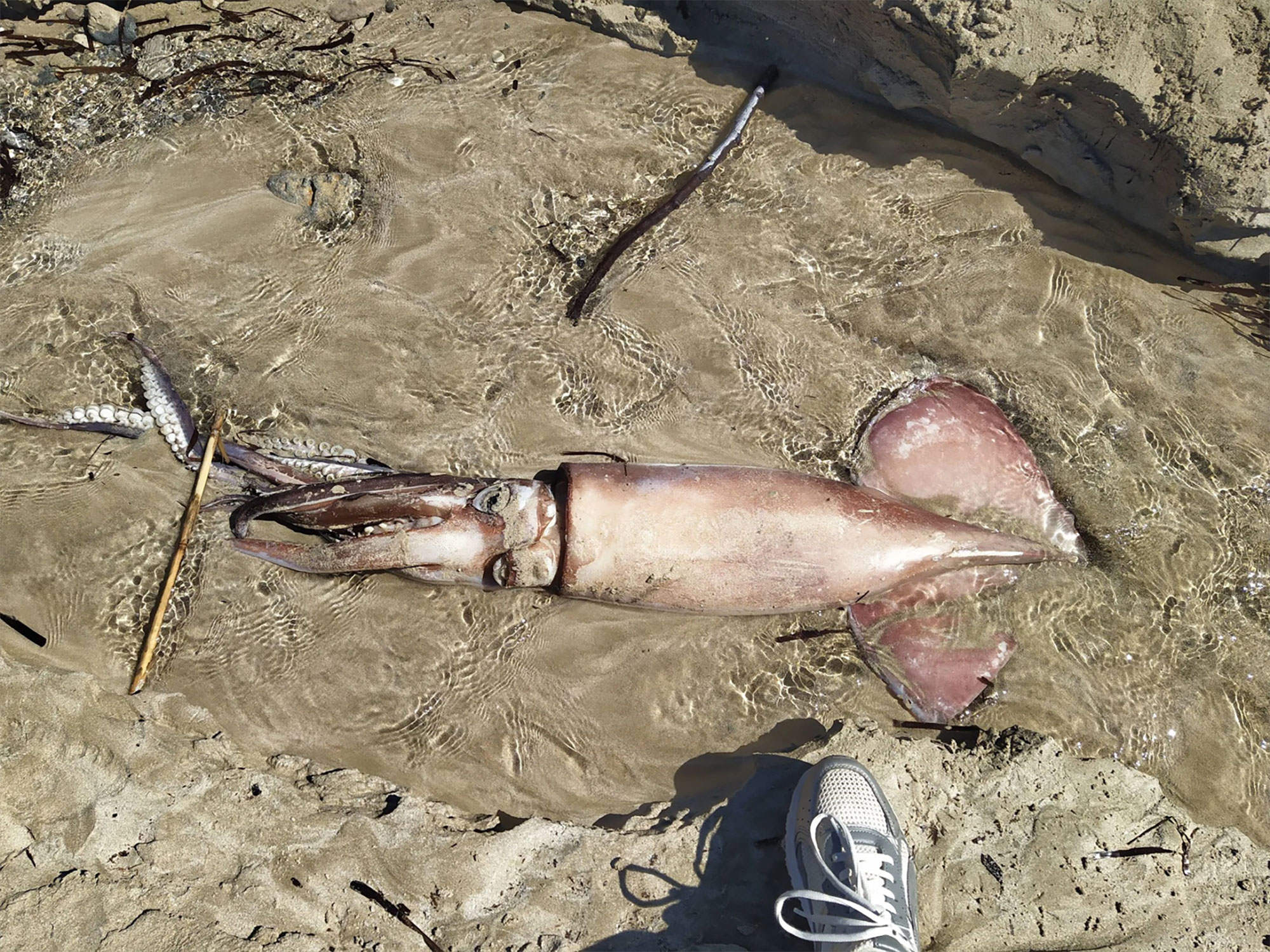
Beachgoers in Paphos got more than they bargained for this week after a giant squid was found washed up on the shore near the lighthouse.
The unusual discovery was made by a passerby out for a walk, who stumbled across the motionless creature on the sand and quickly shared photos to a social media group.
To give a sense of scale, the person placed their foot – size 38 – next to the squid, highlighting just how large the animal was.
The images quickly made waves on social media, with many users stunned by the size of the creature and others joking that this was Cyprus’ Loch Ness monster whilst some exchanged scientific trivia.
Some said the find appeared unusually large, with some suggesting it could be a giant squid (Architeuthis dux), a deep-sea species rarely seen near the surface. Others were more cautious, however, arguing it is more likely a European flying squid (Todarodes sagittatus), which can grow up to about one metre in length and weigh over 10 kilos.
It is worth noting that the largest squid in the world by mass and the heaviest known invertebrate is the Colossal squid, capable of weighing at least 495kg and possibly more than 600kg. It can reach lengths of around 4–7 metres, with some estimates extending beyond 10 metres when its feeding tentacles are included, and it also boasts the largest eyes of any animal ever recorded, measuring up to 40cm across. Native to the deep Southern Ocean around Antarctica, it is an elusive predator rarely seen alive, with most knowledge coming from specimens found in the stomachs of sperm whales or caught by deep-sea fishing vessels
While sightings like the one in Paphos are rare along Cyprus’ coastline, the island’s waters are home to a wide range of marine life, and unusual strandings do occasionally occur.
Such incidents are often linked to natural causes, disorientation, or environmental factors.
However the discovery also comes amid growing awareness around marine protection. Earlier this year, stricter rules were introduced in Cyprus to safeguard marine species, with fines of up to €20,000 and possible imprisonment of up to one year for offences involving protected marine species.





Click here to change your cookie preferences