
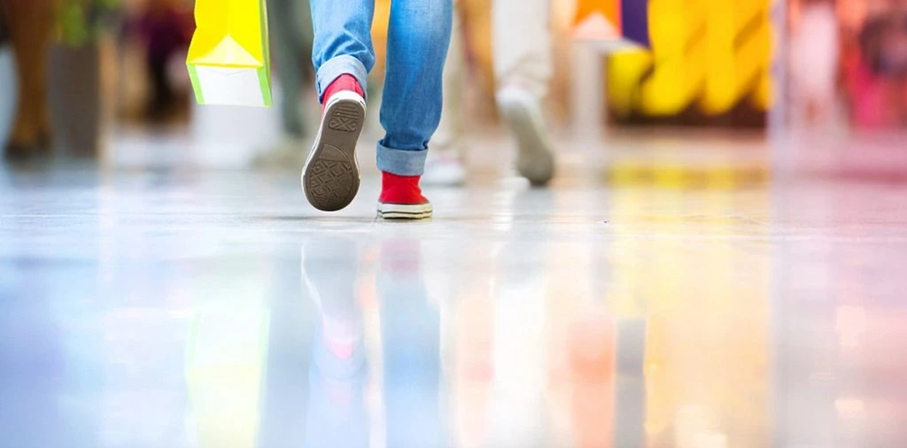
In a busy retail store, trade show hall, airport corridor, hospital lobby, or franchise location, the floor is usually treated as dead space. Customers walk across it, wait on it, follow it, and stand on it while deciding what to buy, scan, download, or ask about.
That makes adhesive floor signs and temporary floor graphic film more than a visual product. Used correctly, they become part of a measurable marketing system — one that connects physical movement with digital action.
For facilities directors, property managers, franchise operators, and retail operations leaders, the question is no longer whether floor graphics look attractive. The real question is whether a floor campaign can guide people, support safety, promote offers, generate social content, and move offline traffic into online channels without disrupting operations.
This article explains how durable floor graphic film, removable floor graphics, and floor signage film can work as practical B2B marketing assets across stores, events, campuses, and multi-location environments.
The Industry Landscape: Why Floor Graphics Matter in US B2B Marketing
Across the US, brands are under pressure to make physical spaces work harder. Retailers need stores to support online campaigns. Event teams need faster lead capture. Property managers need clearer wayfinding. Franchise systems need campaign consistency across dozens or hundreds of locations.
That is where adhesive floor graphics fit into the larger omnichannel strategy. A wall sign is seen. A banner is noticed. But a floor graphic sits directly in the customer’s path.
A customer waiting in line can scan a QR code. A trade show visitor can follow branded floor prompts to a demo zone. A shopper can discover a seasonal offer before reaching the shelf. A visitor looking for the second floor can follow 2nd floor signage built directly into the walking route.
The strongest use cases are not decorative. They are behavioral.
Floor graphics work because they appear where decisions already happen: entrances, checkout lines, product aisles, elevators, escalators, reception areas, event booths, parking walkways, and lobby corridors.
Key trends in durable floor graphic film and Omnichannel campaigns
Durable floor graphic film as a physical marketing channel
Durable floor graphic film is designed for commercial spaces where foot traffic, cleaning, and campaign visibility matter. It usually combines printed adhesive vinyl with a protective textured laminate.
For B2B users, durability is not only about material strength. It is about campaign reliability. A national retailer cannot afford graphics peeling up during a product launch. A property manager cannot place weak decals in a high-traffic lobby. A trade show sponsor cannot use graphics that fade, tear, or create trip hazards.
The strategic value is simple: a campaign printed on the floor can stay visible throughout the customer journey.
Adhesive floor signs for offline traffic → online engagement
The strongest omnichannel use case for adhesive floor signs is conversion from physical attention to digital action.
This turns foot traffic into trackable engagement.
For example, a floor graphic near a checkout line can say: “Scan for 10% off your next order.” At a B2B trade show, a “Scan here for the product demo” graphic can support lead capture without relying only on booth staff.
The floor becomes a conversion surface.
Removable floor graphics for temporary campaigns
Many businesses do not need permanent signage. They need flexible campaign media.
Removable floor graphics, removable floor decals, and removable floor graphic materials are useful when campaigns change by season, event, launch cycle, or location.
The advantage is operational flexibility. A retailer can refresh the customer path without repainting, rebuilding, or permanently altering the floor.
For property managers, removable graphics can also support temporary tenant communication, event traffic, or construction-phase wayfinding.
Floor signage film for retail stores as marketing media
Retailers already measure shelf position, endcap performance, checkout traffic, and aisle movement. But the floor is often ignored.
Floor signage film helps turn that unused surface into advertising real estate.
This is especially useful in big-box retail, grocery, fitness centers, automotive showrooms, furniture stores, and multi-location franchise environments.
The goal is not to cover the floor with messages. The goal is to place the right message where the customer already slows down, waits, turns, or decides.
Outdoor floor graphics and exterior floor graphics
Not every campaign happens indoors. Outdoor floor graphics, outdoor floor signs, and exterior floor graphics are useful for sidewalks, event entrances, parking areas, stadium approaches, and outdoor queues.
These applications need stronger attention to material selection. The surface, weather, cleaning schedule, UV exposure, moisture, and expected duration all affect performance.
A heavy-use exterior floor graphic needs more than strong design. It needs the correct film, adhesive, laminate, and installation method.
Social media moments built into physical spaces
The most modern use of floor graphics is not only directional. It is participatory.
A branded floor graphic can create a content moment. Customers may photograph it, stand on it, record it, or use it as part of a social media post.
For marketing teams, this connects physical design with earned social visibility. For operations teams, it creates a campaign asset that does not require screens, fixtures, or permanent construction.
Pricing and cost factors for floor graphic campaigns
Pricing for floor graphics varies because the final cost depends on material, size, print method, laminate, contour cutting, installation, location, and surface preparation.
For B2B buyers, the cheapest square-foot price is rarely the best decision. A failed floor installation can create reprint costs, operational disruption, safety concerns, and brand damage.
The practical buying question should be: What is the total installed cost of a floor campaign that performs safely for the required campaign period?
How B2B teams should choose and implement floor graphics
Facilities directors, retail operators, and property managers should treat floor graphics as operational signage, not only marketing decoration.
The decision should begin with five questions.
1. What action should the graphic create?
A floor graphic should have a job. It may guide, stop, warn, promote, convert, or create a photo moment.
Weak objective: “Make the entrance look branded.”
Strong objective: “Move visitors from registration to booth C12 and capture QR scans for demo booking.”
2. Where does the customer naturally slow down?
The best locations are decision points:
- Entrances
- Checkout lines
- Elevator banks
- Escalator landings
- Product aisles
- Reception areas
- Event queues
- Booth entrances
- Parking-to-store paths
Floor signs placed in random open space usually underperform. Floor signs placed in natural traffic zones can influence behavior.
3. Does the material match the surface?
Not every adhesive floor sign works on every surface. Smooth sealed floors, tile, polished concrete, carpet, asphalt, and textured exterior surfaces all require different thinking.
For heavy duty floor stickers, the question is not only whether they stick. It is whether they stay flat, remain readable, and remove cleanly at the end of the campaign.
4. Is the campaign temporary or recurring?
If the message changes often, removable floor decals or temporary floor graphic film may be the right choice. If the campaign is part of a long-term wayfinding system, more durable materials and a stronger installation process may be required.
This is where floor signage becomes part of the marketing analytics system.
DISCLAIMER – “Views Expressed Disclaimer – The information provided in this content is intended for general informational purposes only and should not be considered financial, investment, legal, tax, or health advice, nor relied upon as a substitute for professional guidance tailored to your personal circumstances. The opinions expressed are solely those of the author and do not necessarily represent the views of any other individual, organization, agency, employer, or company, including NEO CYMED PUBLISHING LIMITED (operating under the name Cyprus-Mail).





Click here to change your cookie preferences