
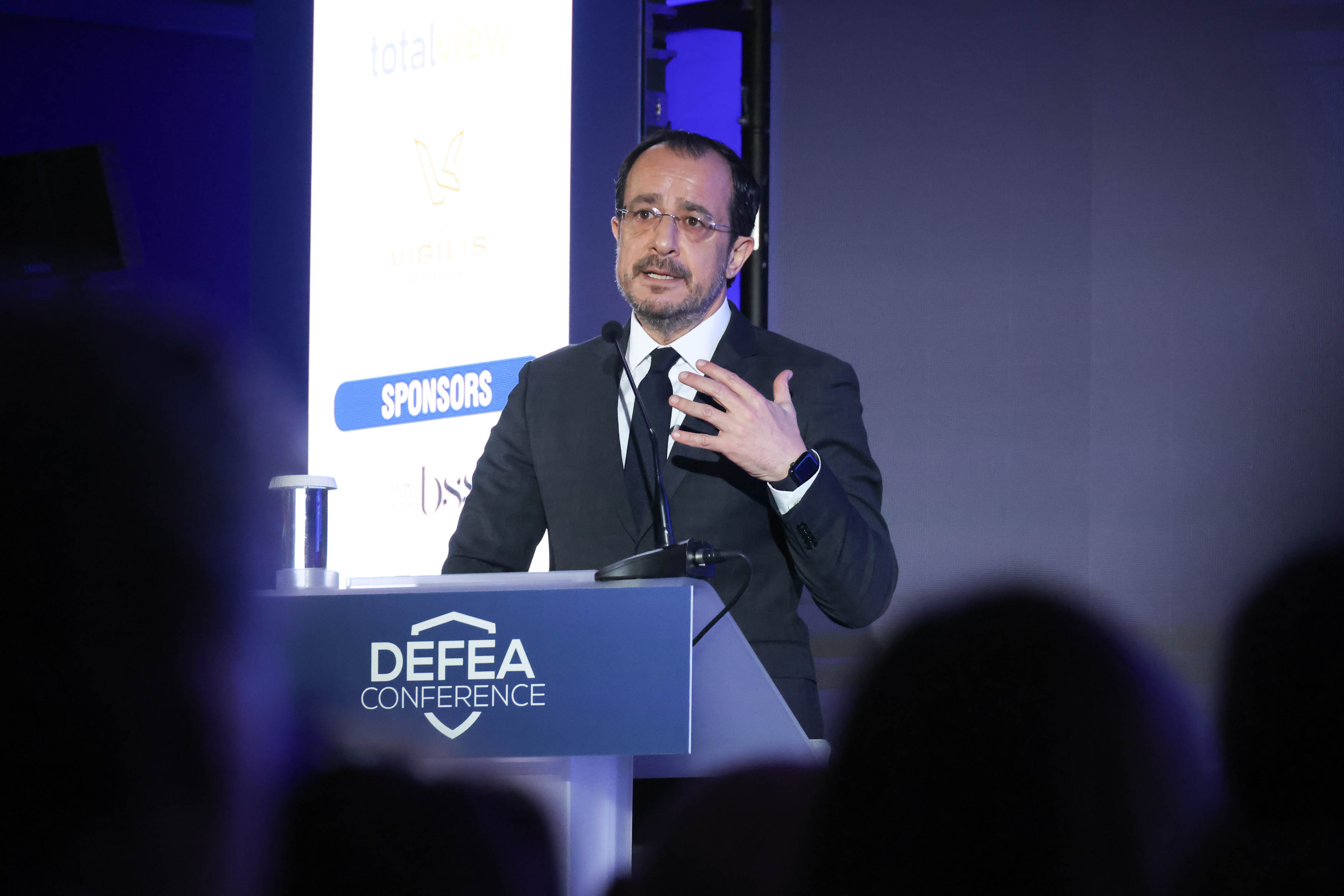
The EU can advance on defence and security without the United States, President Nikos Christodoulides said on Tuesday highlighting Europe’s relationship with Nato.
A stronger and more strategically autonomous EU, he said, would be a more capable partner for Nato in addressing shared challenges.
Cyprus, he added, is ready to become a member of Nato “when political conditions allow”.
Addressing the DEFEA 2026 defence exhibition in Athens, he also called for the European Union’s mutual defence clause under Article 42.7 to become fully operational, stressing that it “cannot remain theoretical” but must evolve into a concrete and functional mechanism for member states.
He added that work has already begun in Brussels to prepare a clear blueprint for its immediate and effective activation. Christodoulides had earlier met European Commissioner for Defence Andrius Kubilius.
The president highlighted the Security Action for Europe (SAFE) instrument as one of the EU’s most ambitious initiatives, allowing for up to €150 billion in defence investments, with Cyprus expected to access approximately €1.2 billion.
Planning for the utilisation of these funds is already underway, he added, stressing that enhancing defence, upgrading deterrence capabilities and supporting the Cypriot defence industry are top priorities for the government.
Referring to the broader international environment, Christodoulides said the world is currently characterised by uncertainty and unpredictability, pointing to the war in Ukraine and conflicts in the wider Middle East as clear indications of how fragile peace remains.
He underlined that security and stability are closely linked not only to defence but also to economic growth, investment and governance, adding that “Cyprus, as a country still under Turkish military occupation, has a direct understanding of what is at stake”.
At the same time, he highlighted the growing range of modern threats, including hybrid threats, cyberattacks, competition in space and the rapid use of artificial intelligence in defence, stressing the need to make Europe more resilient, independent and competitive.
He noted that the conference comes at a time when Cyprus holds the presidency of the EU council, adding that for the first time in years, Europe has moved beyond discussions to concrete decisions on defence and security.
“A Europe that does not invest in its defence and security is a Europe that remains dependent,” he said, adding that dependency cannot be a strategic choice for a geopolitically strong union.
Christodoulides also referred to efforts to promote military mobility within the EU, aiming to remove obstacles and accelerate the movement of forces, as well as to simplify procedures to enhance defence readiness.
He also praised the progress of the Cypriot defence industry, noting that around 30 high-tech companies are active in the sector, developing and exporting products ranging from unmanned systems and counter-drone technologies to cybersecurity and electronic warfare solutions.
Over the past five years, he said, 18 Cypriot companies have participated in 70 projects under the European Defence Fund and the European Defence Industrial Development Programme, with a total budget exceeding €600 million and securing approximately €65 million in direct funding.
In the 2025 European Defence Fund, Cypriot small and medium-sized enterprises are involved in 16 out of 57 selected projects, with 10 entities securing around €14 million in funding.
“These are not just numbers,” the president said, adding that they demonstrate the ability of Cypriot companies to innovate, collaborate and deliver results, while also creating well-paid jobs and showcasing the country’s skilled workforce.




Click here to change your cookie preferences