
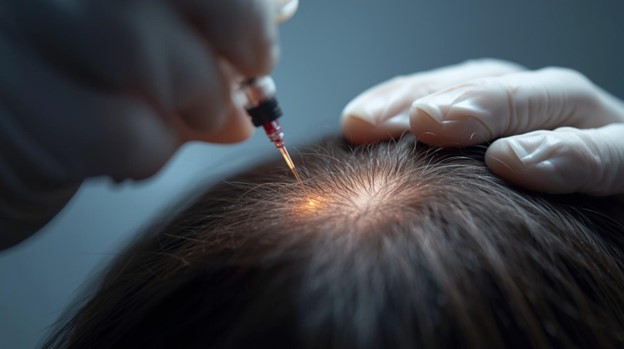
Most people dealing with hair loss spend months trying different shampoos, oils, and supplements before realizing none of it is actually working. That’s not a personal failure — it’s a system problem. Hair loss is rarely one thing, and most treatments target the symptom rather than what’s driving it. Here’s what the science actually says about what works, and more importantly, why.
Why most hair treatments fail
The shelves are full of products promising thicker, fuller hair within weeks. But hair biology doesn’t work on marketing timelines. Hair grows in cycles — anagen (growth), catagen (transition), and telogen (rest). Disrupting any phase, whether through hormonal shifts, nutrient deficiencies, or chronic stress, can tip the balance toward shedding.
When you apply a random hair serum without knowing why your hair is falling out, you’re essentially guessing. Sometimes you get lucky. More often, you don’t. Understanding the mechanism behind your specific type of hair loss is what separates treatment from trial and error.
The treatments that have real evidence
Not everything marketed as a hair growth solution is backed by credible research. A few treatments, however, have earned consistent support from clinical studies:
- Minoxidil remains one of the most studied topical treatments for androgenetic alopecia. It works by prolonging the anagen phase and increasing blood flow to follicles. It doesn’t stop DHT but keeps follicles active longer.
- Finasteride (for men) reduces DHT production at the source. Studies show measurable regrowth in a significant percentage of users, though it comes with side effects worth discussing with a doctor.
- Low-level laser therapy (LLLT) has emerging evidence for stimulating follicular activity at a cellular level, particularly for early-stage loss.
- Nutritional correction — specifically addressing deficiencies in iron, ferritin, zinc, vitamin D, and B12 — can have a meaningful impact when those deficiencies are the actual cause.
For a more detailed breakdown of how these treatments are assessed clinically, the Mayo Clinic’s guide on Hair Regrowth is a useful reference point.
What doesn’t work (despite the yype)
It’s worth being direct about the things that rarely move the needle on their own:
- Biotin supplements, unless you’re actually deficient, have limited evidence for reducing shedding
- Caffeine shampoos and keratin treatments improve how hair looks and feels but don’t address follicle health
- Scalp massages may help marginally with circulation but won’t reverse hormone-driven loss
- Most “hair growth oils” work as moisturizers at best — they don’t penetrate the follicle
The issue isn’t that these things are useless across the board. It’s that they’re often positioned as solutions when they’re at best supportive add-ons.
The root cause problem nobody talks about
Here’s what most online advice misses: the same symptom — hair fall — can have very different causes in different people. Androgenetic alopecia (genetic, DHT-driven) needs a different approach than telogen effluvium (stress or illness-triggered) or alopecia areata (autoimmune). Treating one as though it were the other leads nowhere.
This is why some people respond to minoxidil and others don’t. It’s why someone can take every supplement in the book and still see thinning. Root cause diagnosis — looking at hormones, bloodwork, scalp health, and lifestyle factors together — is what makes treatment coherent instead of random.
Some approaches, like the one behind the traya hair growth review model, are built specifically around identifying what’s actually driving the loss before prescribing any treatment path. That shift in thinking — diagnosis first, treatment second — is what tends to separate outcomes that stick from those that don’t.
Final thoughts
Hair loss is complicated, but it’s not unsolvable. The mistake most people make is reaching for a product before understanding the problem. Start with the right questions: Is this hormonal? Nutritional? Stress-related? Scalp-related? The answer shapes everything that follows.
Evidence-based treatments exist and they work — but they work best when matched to the actual cause. In 2026, the most useful thing you can do for your hair isn’t finding the best product. It’s finding the right diagnosis.
DISCLAIMER – “Views Expressed Disclaimer – The information provided in this content is intended for general informational purposes only and should not be considered financial, investment, legal, tax, or health advice, nor relied upon as a substitute for professional guidance tailored to your personal circumstances. The opinions expressed are solely those of the author and do not necessarily represent the views of any other individual, organization, agency, employer, or company, including NEO CYMED PUBLISHING LIMITED (operating under the name Cyprus-Mail).





Click here to change your cookie preferences