
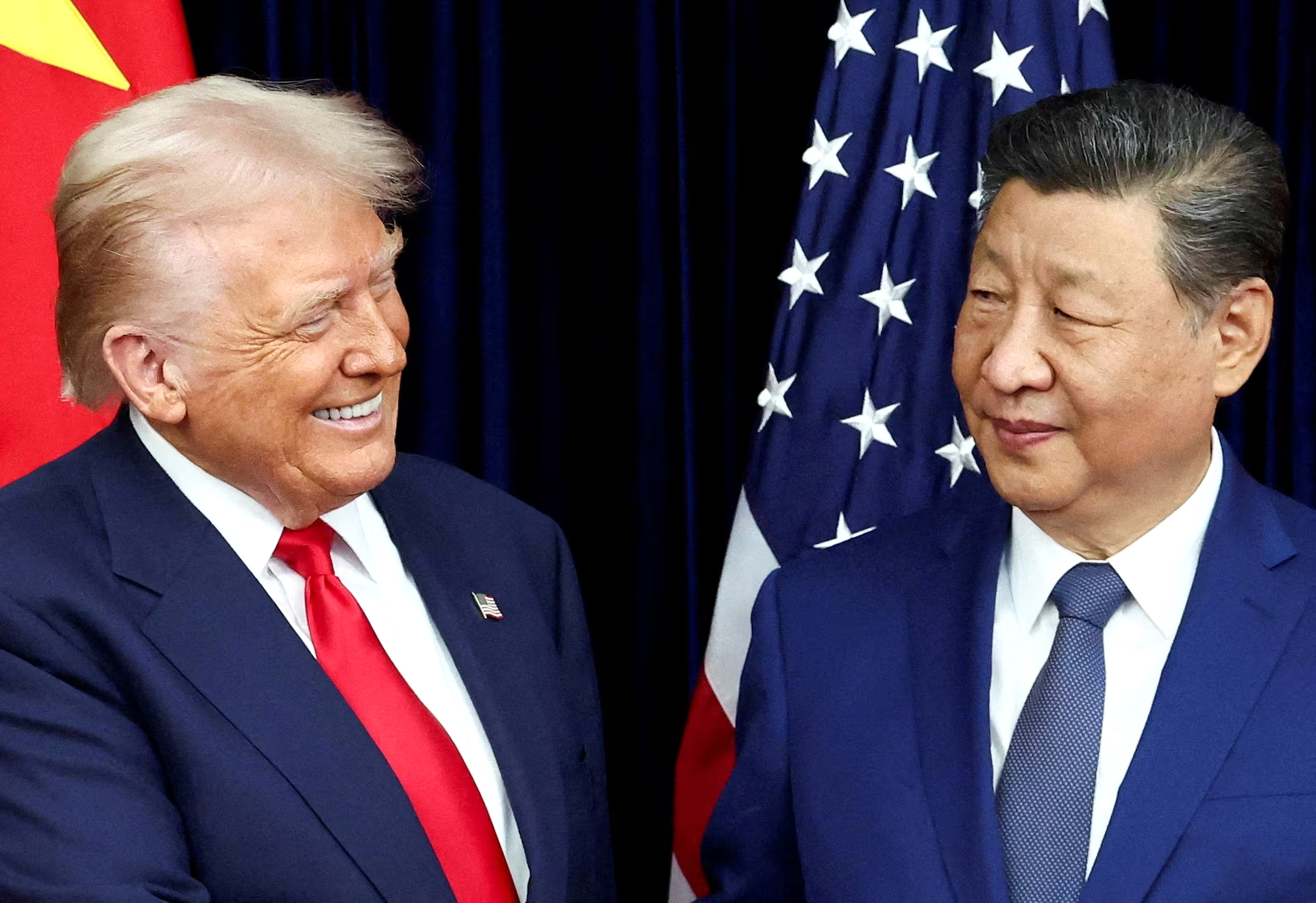
The recent meeting between the presidents of the United States and China marks a phase of “managed stability,” in which competition continues but with mechanisms designed to prevent escalation. For Europe, this gives rise to both opportunities and significant challenges.
The main outcomes of the meeting include: China’s commitment to purchase agricultural products and 200 Boeing aircrafts and the US intention to selectively encourage exports in certain cutting‑edge technologies. At the same time, Taiwan was highlighted by Xi as “the most important issue” in bilateral relations.
The agreement to strengthen communication channels and trade facilitation reduces the risk of sudden geopolitical shocks. However, the US-China technological confrontation is becoming more entrenched.
The US maintains restrictions on exports of advanced chips, while China plans to invest more than $1.4 trillion in domestic technologies by 2030. JP Morgan believes that technological “decoupling” is now irreversible.
For Europe, which produces only 9 per cent of global semiconductors and depends on Asia for roughly 70 per cent of its imports, the pressure is intensifying: it risks finding itself between two incompatible technological ecosystems, without sufficient industrial power to influence the rules of the game.
In parallel, the joint Trump-Xi position that “Iran must never acquire a nuclear weapon” and “the Strait of Hormuz must remain open” reduces the risk of instability in energy markets. Europe, which imports more than 55 per cent of its energy, benefits from this stability but does not participate in shaping regional security and remains outside the core of strategic decisions.
What may prove even more critical for Europe is the structural slowdown of the Chinese economy. China is expected to grow at an annual rate of 3-4 per cent over the next decade, compared with 10 per cent between 2000 and 2010.
The working-age population is shrinking by about five million per year, while the real-estate sector, accounting for 25 per cent of China’s GDP, is in prolonged crisis.
These trends translate into reduced demand for German motor vehicles (China absorbs in excess of 30 per cent of German auto exports), lower consumption of European luxury goods (China represents approximately 35 per cent of the global luxury goods market) and limited Chinese investment in the EU, which has fallen by roughly 58 per cent since 2016.
In this environment, Europe’s ambition for “strategic autonomy” becomes difficult to attain. The US does not seek European participation in the Indo‑Pacific agreement, while Beijing offers selective concessions to Washington, with the aim of avoiding the more substantial reforms to global trade that Europe desires.
Europe’s absence from the negotiation table reflects a deeper strategic imbalance. Over the past decade, the US and China have institutionalised high‑level dialogues covering defence, technology and macroeconomic coordination, while Europe has struggled to maintain unified positions, even on issues directly affecting its long‑term competitiveness.
The lack of a coherent European stance on trade, investment screening and critical raw materials policy weakens its leverage in global negotiations.
Furthermore, the global race for clean-energy leadership is accelerating. China controls more than 80 per cent of global solar‑panel production and over 70 per cent of battery manufacturing capacity, while the US has mobilised more than $110 billion in clean‑tech investments through the Inflation Reduction Act.
Europe, by contrast, faces higher energy costs and slower permitting processes, which risk driving industrial activity (especially in chemicals, steel and automotive) toward more competitive jurisdictions.
The security dimension is equally important. Nato’s focus on Russia leaves limited bandwidth for Indo‑Pacific engagement, yet the region is becoming the epicentre of global economic and technological competition, currently representing almost two thirds of global GDP growth.
Without a credible European presence in maritime security, digital‑standards setting and supply‑chain resilience initiatives, the EU risks being sidelined in the formation of new geopolitical alignments.
Finally, demographic pressures and declining productivity compound Europe’s strategic challenges. The EU’s working‑age population is projected to fall by 35 million by 2050, while research and development spending remains below 3 per cent of GDP in most member states.
Unless Europe accelerates investment in artificial intelligence, quantum technologies and advanced manufacturing, it will increasingly depend on external innovation ecosystems at a time when global competition is intensifying.
In conclusion, the Trump-Xi meeting offers Europe short‑term stability while highlighting its technological dependence, energy vulnerability and commercial exposure to China, as well as its geopolitical marginalisation.
Europe must upgrade its participation in shaping global rules in critical areas such as technology, trade and security.
Within this framework, a diversification of its strategy is required, with emphasis on industrial restructuring, supply‑chain diversification and strengthening relations with India, ASEAN and Africa.






Click here to change your cookie preferences