

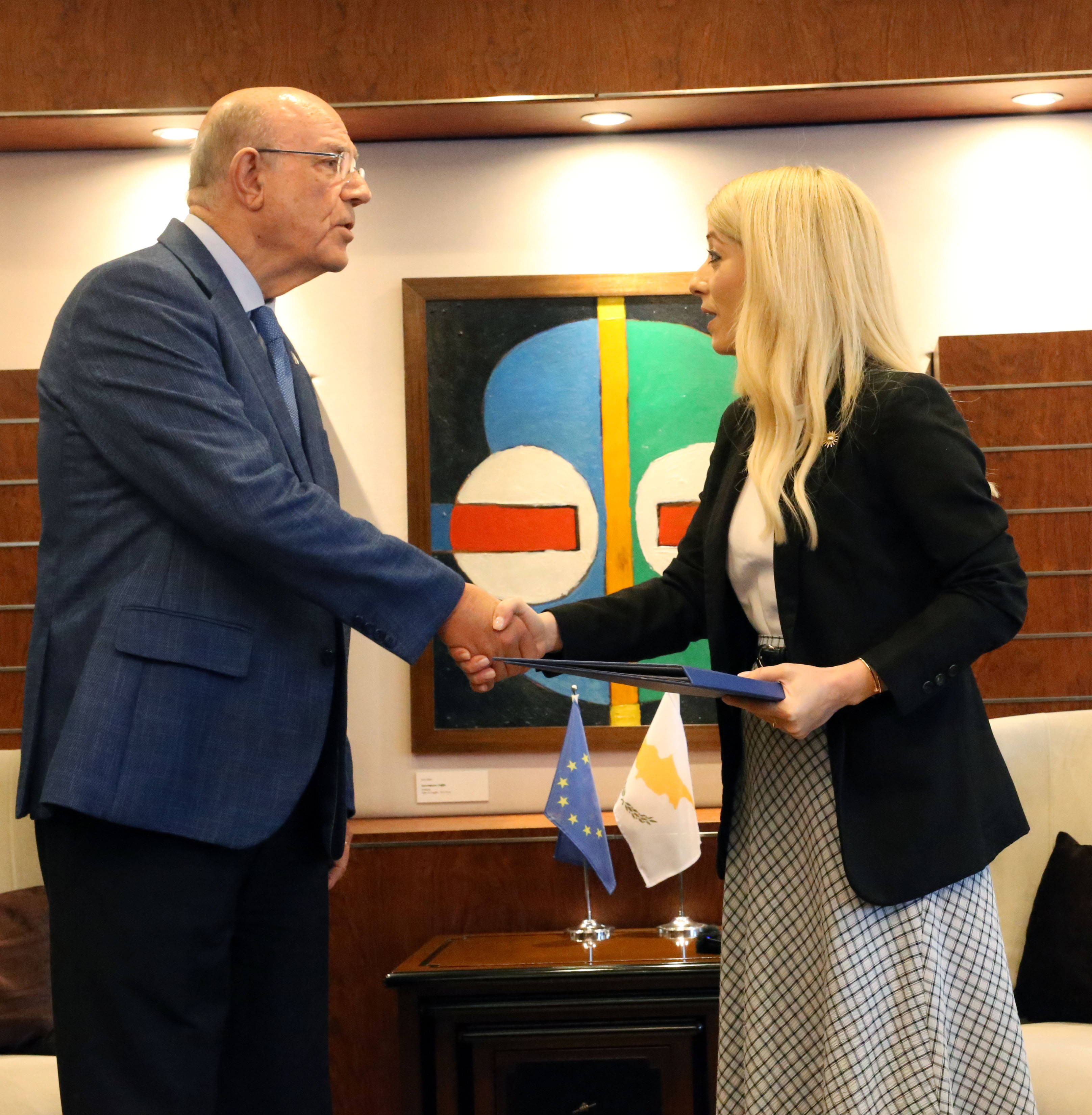
Finance Minister Makis Keravnos on Thursday said that the state will operate with a budget surplus “for the third consecutive year” next year, as he presented next year’s state budget to House President Annita Demetriou.
“For the third consecutive year, it has a fiscal surplus, which is expected to reach around four per cent of gross domestic product in 2027, while public debt continues to decline and is expected to be limited to 45.2 per cent of GDP by the end of 2027,” he said.
He added that the island’s economy is “expected to grow by 2.9 per cent” over the course of next year, and that its unemployment rate will “hover around 3.8 per cent”, while inflation will “decline to 2.5 per cent”.
“These results reflect the consistency with which the Christodoulides government manages public finances. On this solid basis, we can support households and businesses where there is a real need,” he said.
On this front, he described the budget as “balanced and human-centred”, before saying that the state budget “constitutes the most important tool of economic policy and the basis upon which the state operates”.
This, he said, is especially true “today, when our country needs stability and clear direction more than ever”.
He added that the budget was “prepared amid intense and particularly negative geopolitical developments both in our region and internationally”, and said that for this reason, “in such times, fiscal stability acts as the shield of the country and its citizens”.
The reference to negative geopolitical developments impacting the economy comes with the price of diesel reaching €2 per litre this week, and the price of petrol hovering at around €1.68 per litre, following an expansion of Yemen’s Iran-backed Shia militant Houthi movement’s control and actions in the country.
Strait of Hormuz, Bab al-Mandab strait accessibility puts pressure on economy
The Houthis now control almost the entire western coast of Yemen, including the eastern half of the Bab al-Mandab strait, a crucial chokepoint between the Gulf of Aden and the Red Sea, and have also attacked Saudi Arabia’s east-west oil pipeline.
Around five per cent of global oil supplies passed through the Bab al-Mandab strait in February, typically passing northwards towards the Suez Canal and the Mediterranean beyond.
These issues have caused the price of oil to rise, adding pressure to the economy and onto people’s household expenses.
Despite these problems, Keravnos on Thursday said he looks forward to a “fruitful dialogue” with parliament on the state budget, so that it is “voted upon on time and its fiscal balance is maintained”.
“Timely voting ensures the smooth functioning of the state, gives certainty to households and businesses, and even allows projects and programmes to proceed without delays, strengthening the country’s credibility with partners and markets,” he said.




Click here to change your cookie preferences