
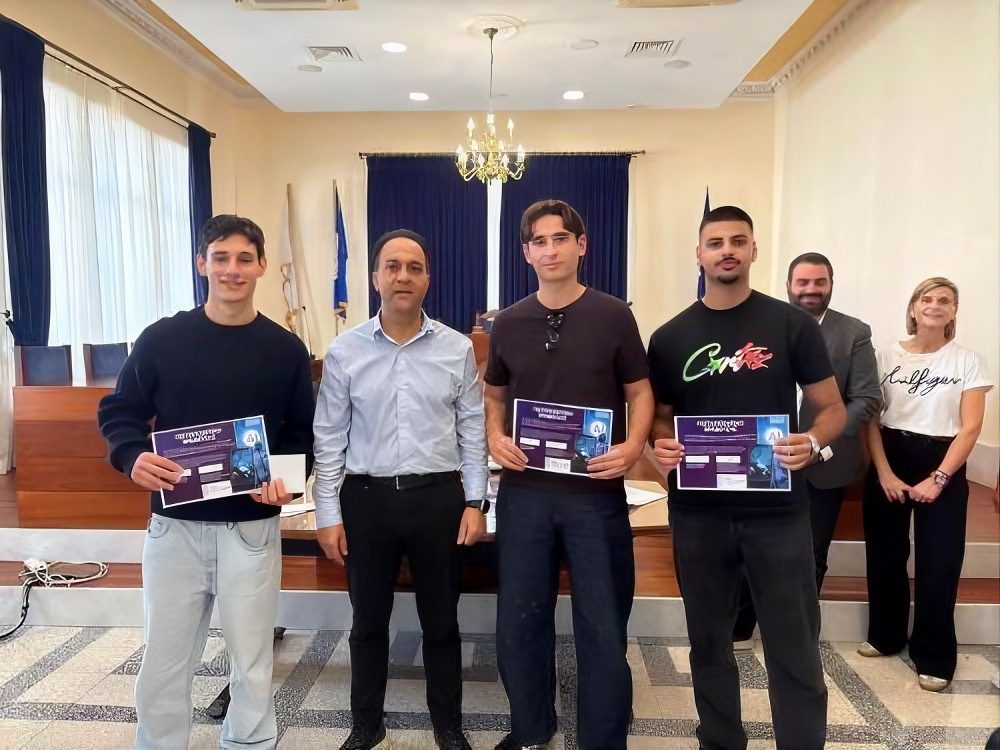
Students and university teams presented technology-driven ideas for improving urban life in Paphos, as the municipality awarded the winners of its ‘Paphos 2.0 – Young people design the next version of the city’ innovation competition on Tuesday.
The awards ceremony took place at Paphos municipal hall, bringing together representatives of the municipality, its youth council and the competition’s participants, with projects focusing on artificial intelligence (AI), sustainability, culture and urban mobility.
According to a municipality announcement, the ceremony was attended by acting mayor Angelos Onisiforou, Paphos Municipal Youth Council president Antonis Christodoulou and Sports and Youth Committee chairwoman Anthi Leonidou Stroppou.
The competition was organised by the Paphos Municipal Youth Council as part of Erasmus Days 2026, with sponsorship from the Foundation for the Management of European Lifelong Learning Programmes (IDEP).
Its objective was to give school pupils and university students an opportunity to demonstrate their creativity and develop innovative proposals using emerging technologies and artificial intelligence.
Participants were invited to present original solutions to contemporary challenges, with an emphasis on ideas capable of improving everyday life and quality of life in Paphos.
The competition was divided into school and university categories, with several teams recognised for their proposals.
In the school category, first place went to Nature Rewards, from Agios Neophytos Lyceum, which scored 74 points.
The second position was secured by Report 2 Resolve, representing Agios Charalambos Lyceum and Technical School of Education and Training (TESEK) in Emba, with 67 points.
Third place was shared by two teams, each scoring 61 points.
These were Interactive Cultural Route of Paphos, from Polemi Gymnasium, and Smart Traffic Jam System, from Agios Charalambos Lyceum and TESEK in Emba.
In the university category, Akti̱na, from AUB Mediterraneo University, took first place with 86 points, achieving the highest score across the entire competition.
Two other teams from the same university shared second place, with Anamoni and HydroIntelligence each receiving 83 points.
Third place went to Access Pafos AI, a joint entry involving the University of Crete and Neapolis University Pafos, which scored 78 points.
The projects demonstrated the range of approaches young people can bring to urban development, from environmental initiatives and water-related technology to cultural experiences, accessibility and traffic management.
During the ceremony, acting mayor Angelos Onisiforou and youth council president Antonis Christodoulou congratulated all participants on the quality of their proposals.
They also stressed the importance of young people’s active involvement in shaping the city’s future, highlighting the role that innovation, technology and creative thinking can play in addressing modern urban challenges.
The municipality said the Paphos 2.0 initiative had demonstrated the potential of the younger generation and the importance of collaboration in developing a modern and sustainable city.
Through the competition, participants were given an opportunity to move beyond simply submitting ideas and take part in the wider discussion about the future development of Paphos.
The initiative sought to demonstrate that the next stage of the city’s development could be shaped by the imagination, knowledge and creativity of its younger residents.


Click here to change your cookie preferences