
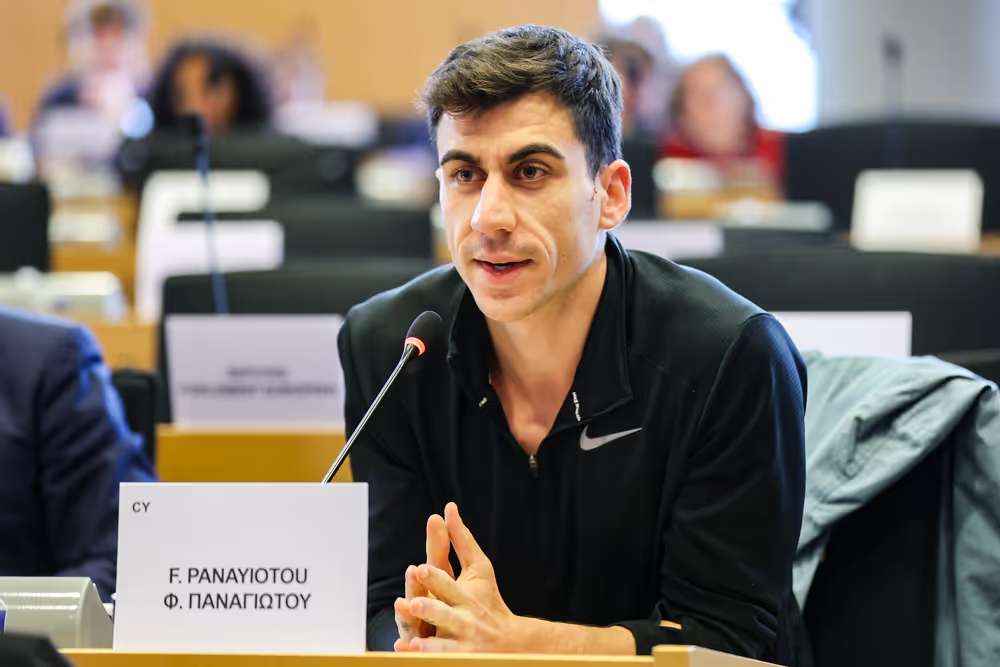
The European Union does not seem committed to a diplomatic settlement on the conflict in Ukraine, instead playing second fiddle to the United States, Cypriot MEP Fidias Panayiotou said in an interview with Russian news network RT that aired on Sunday.
In it, Panayiotou also refuted accusations that he is a purveyor of Russian propaganda.
Shortly after Russia’s invasion of Ukraine in February 2022, the EU banned RT from operating in its 27 member states.
Panayiotou told RT that in his view the EU should appoint a small, credible negotiating team to engage directly with Russia and Ukraine, rather than allow the United States to dominate the diplomatic process.
President of the European Council Antonio Costa could be the bloc’s lead envoy in the talks, he suggested.
“We should sit down and negotiate. I believe without the United States. I think with the United States, it will overcomplicate things. We should sit down and negotiate with Russia and with Ukraine and with the European Union to decide the future of our continent. The United States is not here in Europe. Why the hell should they decide the future of our continent?”
Panayiotou said Washington appears more willing than Brussels to negotiate an end to the Russia-Ukraine war, and insisted the EU must change its own conduct.
EU funding for Ukraine
On the EU’s latest €45 billion financial support package for Ukraine, Panayiotou argued it will eventually fall on European taxpayers while doing little to improve real prospects for peace.
And he rejected the argument that more funding now would improve Kiev’s leverage later.
“I’m a big fan of pushing for a diplomatic solution, not pushing for war. So, they say here in the European Parliament we want to have better terms at the negotiation table. That’s why we want to keep pushing and keep funding Ukraine so they can win territory back and then we can have better terms on the negotiating table.
“Sadly, that’s not the reality on the ground, where the best time to negotiate was when it started, the second best time was yesterday, and the third best time would be today to negotiate because tomorrow, it will be probably worse for the Ukrainian side.”
In the wide-ranging interview, the MEP also addressed the criticism he frequently faces in Brussels and elsewhere, where his calls for talks with Moscow often lead opponents to brand him a Russian sympathizer.
Regarding his recent naming on the Myrotvorets website as an enemy of Ukraine, Panayiotou said he only learned about it after the fact.
According to him, the list describes him as such because he visited Moscow and allegedly spreads Russian propaganda.
Panayiotou does not see himself as pro-Russian MEP
That label, he said, has become routine in the European Parliament: “This is what I’m accused of often in the European Parliament. There is a famous question that they ask me: ‘Who is paying you? Are you doing this for free? Are you pushing this Russian propaganda for free or Russia is paying you?’”
Responding to these accusations, Panayiotou said he doesn’t see himself as a pro-Russian MEP.
“I think it’s a pro-Ukrainian interest to end this war. I think it’s a pro-European interest to end this war. We are suffering from the economic sanctions that we are putting out. We need to stop this madness. People are dying. So if you want to label me a Russian puppet, if you want to, whatever you want to label me, so be it. We’ll continue to push for what we believe is right.”
The MEP went on to describe the political atmosphere in Strasbourg and Brussels as immature and unserious: “I’m the youngest man in the European Parliament, and I feel like I’m with children here. They cannot argue. They just label you, oh, you’re a Russian puppet. I don’t think this is what democracy should be. We should be giving arguments. I give my argument, we campaign on these issues. You say your opinion, I say my opinion.”
Panayiotou also revealed that he is part of a drive to build a new political bloc inside the European Parliament that is centred on peace and diplomacy.
“Some members of the European Parliament will have the duty to stand up on this and, in a way, bring the party of peace in the European Parliament. But it’s very difficult for us to do this because we are now 17, 18 members of the European Parliament and we need 21 members, and they need to be from seven different countries.”
The MEP pointed to what, in his opinion, are double standards within the European Parliament – for example a singular focus on supporting Ukraine while largely ignoring what he referred to as the genocide in Gaza.
“We don’t have a moral compass here in the European Parliament, a consistent moral compass.”
Click here to change your cookie preferences