
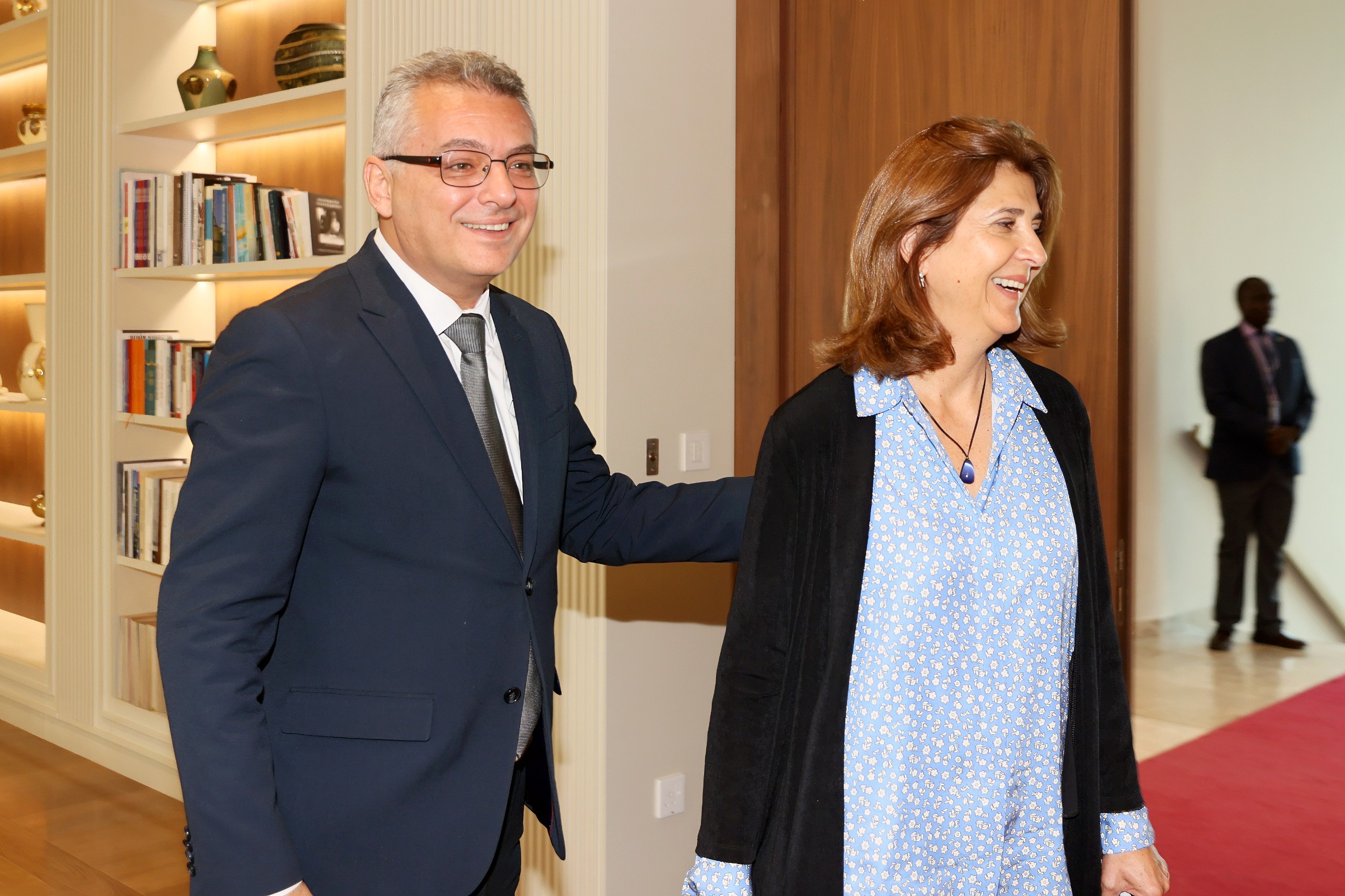
UN Secretary-General’s Personal Envoy Maria Angela Holguin met Turkish Cypriot leader Tufan Erhurman on Wednesday, amid renewed diplomatic activity on the Cyprus problem and reports that Turkish Foreign Minister Hakan Fidan is expected to visit the occupied north on Friday.
The anticipated visit comes at a significant point in the ongoing diplomatic contacts, given Ankara’s role in the Cyprus negotiations and efforts to create the conditions for further steps in the process.
Wednesday’s meeting, held at the Turkish Cypriot leader’s office, began at noon and concluded at 12.35pm, lasting 35 minutes.
Holguin was welcomed on arrival by Mehmet Dana, undersecretary at the Turkish Cypriot leader’s office.
Her meeting followed a series of diplomatic contacts, including separate discussions with President Nikos Christodoulides and Erhurman.
Following Wednesday’s meeting with Erhurman, Holguin confirmed that she had met Turkey’s ‘ambassador’ to the north, Ali Murat Basceri, the previous day to receive a message from Ankara. She said Turkey’s deputy foreign minister had informed her that a message had been sent through that channel.
“That is why I went to meet him, simply to receive that message, which I also explained to Mr Christodoulides,” she said. Regarding her meeting with Erhurman, Holguin said they had discussed how to proceed ahead of Monday’s joint meeting between the two leaders.
Holguin met Christodoulides on Friday and Erhurman on Monday, before holding an unexpected meeting on Tuesday with Turkey’s ‘ambassador’ to northern Nicosia, Ali Murat Basceri. She subsequently met Christodoulides again.
The meeting with the Turkish ‘ambassador’ prompted differing reactions on the Greek Cypriot side.
Government spokesman Konstantinos Letymbiotis expressed discomfort over the meeting, saying it had taken place following a message that Turkey’s deputy foreign minister wished to convey.
Christodoulides also said the meeting concerned a message Ankara wanted to communicate.
Speaking on an online programme hosted by Ozgur on Tuesday, Erhurman said his priority was to address proposals already on the table before introducing new ones.
“We are ready to discuss everything. For example, I said I would not discuss Kokkina. The reason is that there are four points on the map that came from New York. I am not bringing anything new. Let us settle those first and then discuss anything else we may bring forward,” he said.
Regarding crossing points, he said four options remained under consideration based on maps presented in New York: Louroujina, Pyroi, Aglantzia and Mia Milia.
“There are two maps with blue markings and two with red markings. Athienou and Mia Milia are marked in red, while the other two are blue. Kokkina is not on that map,” he said.
Erhurman acknowledged that, had he been in the position of his predecessor Ersin Tatar, he might have made different choices.
“If I had been in Mr Ersin Tatar’s position, I am not sure I would have chosen Mia Milia as the second vehicle crossing point in New York. I might have chosen Kaimakli or Famagusta Gate instead,” he said.
“However, my task now is not to undo what has been agreed, but to negotiate it. I am not proposing a new crossing point. Let us resolve this first, and then the more crossings we can open and the more people can meet, the better.”
He argued that the proposed crossings at Mia Milia and Athienou would benefit both communities, while the other two would primarily make travel easier for Greek Cypriots travelling from Larnaca to Nicosia.
“They are not particularly important for Turkish Cypriots. Why should I oppose something that makes life easier for Greek Cypriots? Mia Milia and Athienou are two crossings that will serve both communities,” he said.
Erhurman also stressed that consultations with Ankara were ongoing and that there were no difficulties in communication with Turkey.
He pointed out that no previous Turkish Cypriot leader had conducted negotiations without consulting Turkey, reiterating that he wanted “negotiations not for the sake of negotiations, but to achieve a solution”.
He described Holguin’s approach as facilitating discussions with Christodoulides and said her continued optimism was important.
Referring again to the UN secretary-general’s seven points, he welcomed the inclusion of issues concerning Republic of Cyprus citizenship for children of mixed marriages and sporting activities, including football matches between children under the age of 15.
He maintained that citizenship was a human rights issue, already addressed in UN and EU reports, and should not be treated as a bargaining chip in negotiations.
Turning to the 19 proposals verbally presented by Christodoulides to him and to the UN secretary-general in New York, Erhurman said some, including visits to technical committees and Pyla, had already been implemented.
He added that his own proposal for informal social meetings between the two leaders before formal negotiations began had been rejected by the Greek Cypriot side, which cited previous examples.
Erhurman also questioned the timing and scope of Christodoulides’ proposals, noting that they had been presented only months before the end of the UN Secretary-General’s term, while the seven existing points remained unresolved.
He said the proposals, which he did not himself count as 19 separate items, included longstanding issues such as Varosha and Famagusta port, which had remained unresolved for 25 years.
Regarding Famagusta port, Erhurman argued that its legal status allowed vessels from other countries to dock there and that the central issue was the implementation of the EU’s Direct Trade Regulation.
He referred to statements made by former Turkish Cypriot leader Mehmet Ali Talat in 2005 to the Finnish EU presidency, rejecting the suggestion that management of the port should be transferred to the European Union as a precondition for trade.

Click here to change your cookie preferences