
Building approvals in Limassol are on course for their highest level in years, and more than 3,000 apartments under construction are still unsold. Data presented to agents this week suggests the first casualties are not new projects, but older homes.*
For most of the past four years, almost anything with a key and a balcony sold or let in Limassol.
That is changing, and the change is showing up first at the older end of the market.
At a SquareOne agents’ event in Limassol on November 5, 2026, Pavlos Loizou, CEO of the property data firm Ask Wire, set out the numbers behind the shift. His view is that the market began to turn about a year and a half ago, and that the effect will become far more visible over the next year.
“Everything happened in one go,” he told the audience. “People moved in, rents rose, prices rose and supply was held back. Now the market is taking its time to respond.”
A pipeline released all at once
Between 2020 and the second quarter of 2026, the number of people employed in Cyprus rose by 91,047 to 520,763, according to the Statistical Service. Much of that growth came from the technology sector, which accounted for about a quarter of real GDP growth between 2020 and 2025.
Demand arrived quickly. New supply did not.
Loizou pointed to the July 2024 local government reform, when municipalities and the new district planning bodies paused new applications while the system changed hands. The backlog is now being cleared.
The effect is clear in building permits. On Statistical Service figures, the number of dwellings authorised in the first half of 2026, doubled to give an annual rate, comes to 22,200 across Cyprus, against 16,171 in 2025 and 9,842 in 2022. In Limassol district the annualised figure is 7,054, up from 4,745. Limassol accounts for 38 per cent of the national increase.
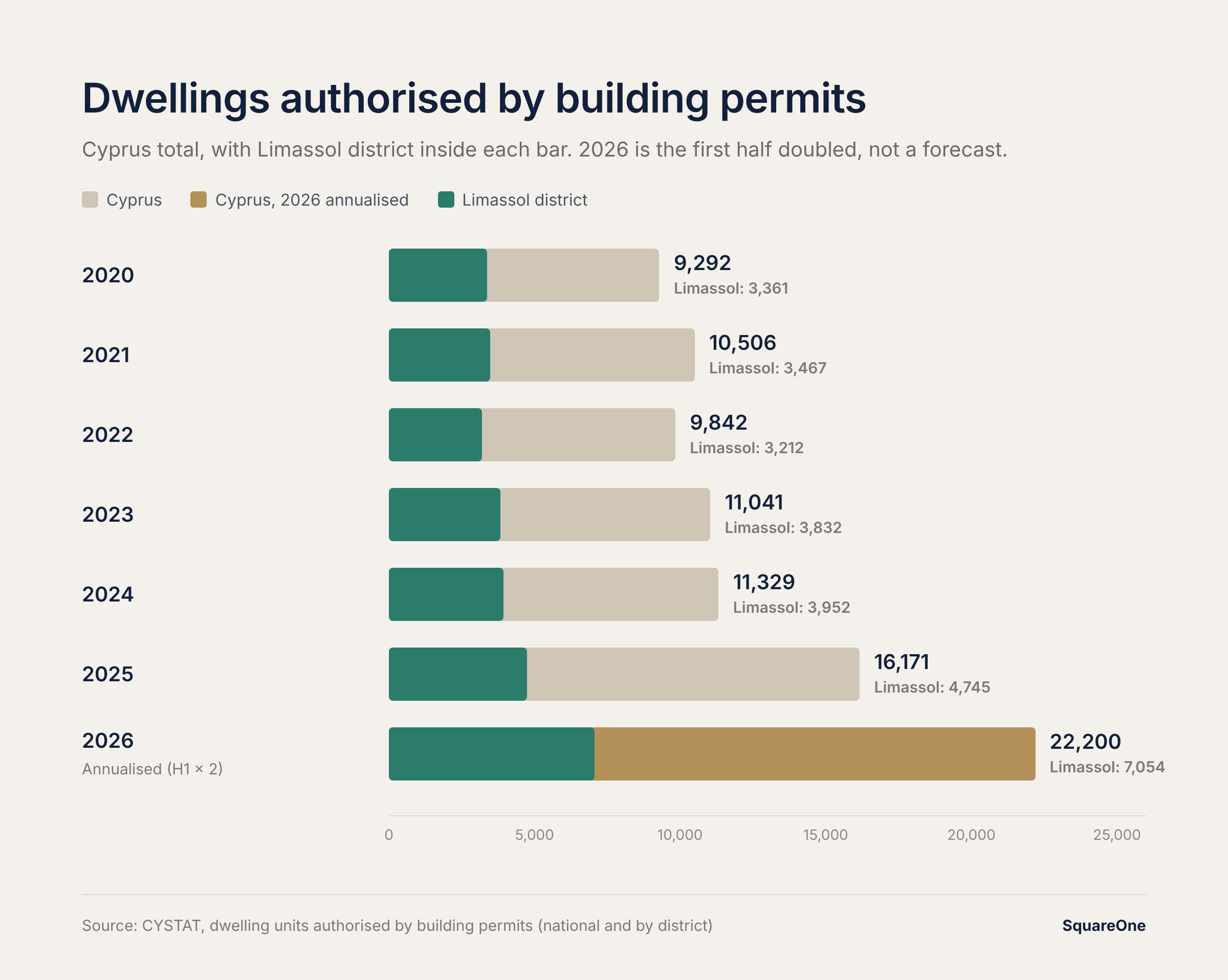
Annualising is not a forecast, and a permit is not a finished home. But a permit is usually the last step before construction begins.
A year of stock already for sale
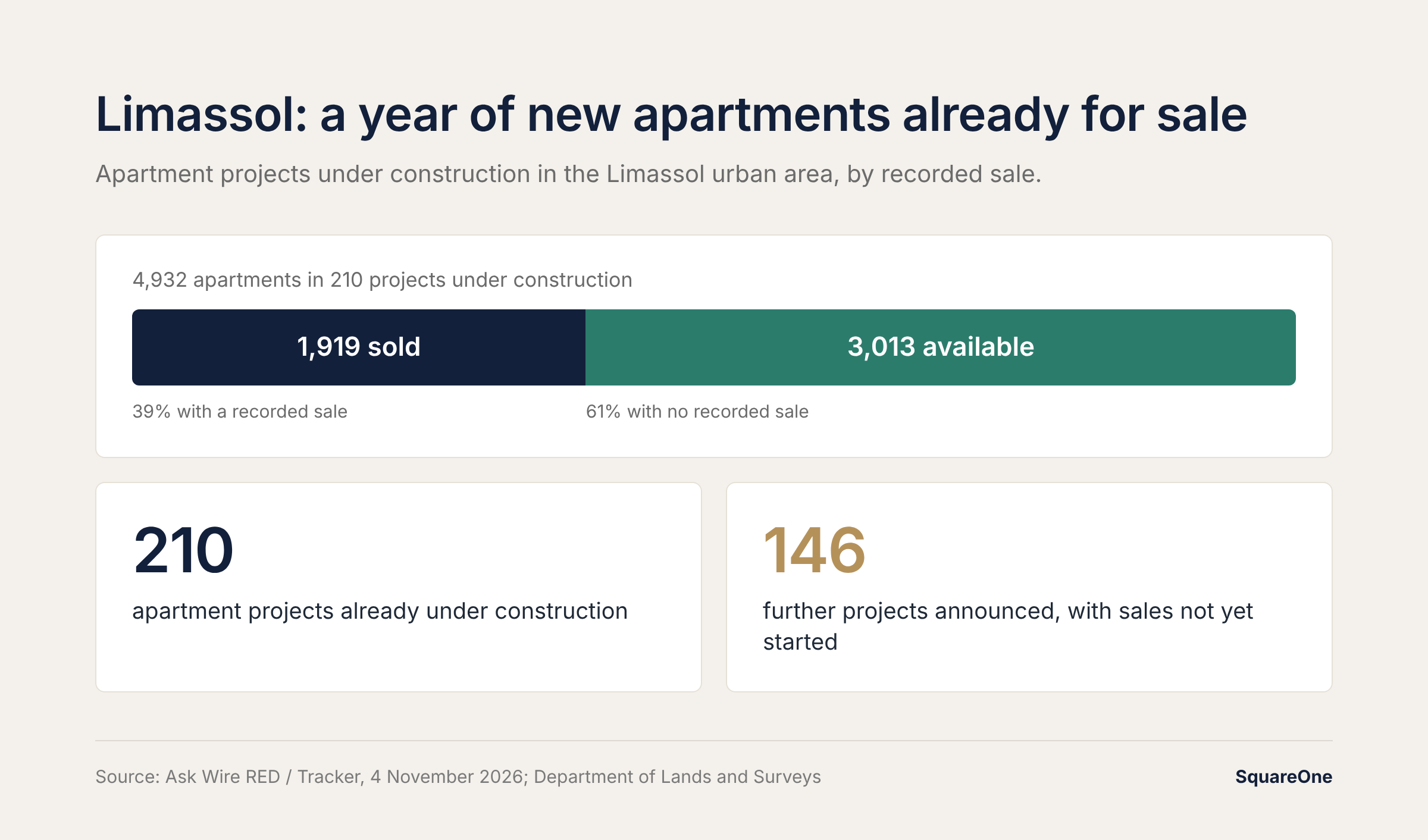
Ask Wire tracks the websites of around 700 developers and matches them against sales deposited at the Land Registry. In the Limassol urban area it has mapped 210 apartment projects under construction, with 4,932 units between them. Only 1,919, or 39 per cent, have a recorded sale.
That leaves 3,013 apartments available in buildings already going up. Loizou put that at roughly a year of apartment sales in Limassol. A further 146 projects have been announced, but have not yet started selling.
“Buyers will have more projects to compare,” he said. “New launches compete with stock already under construction, as well as everything announced behind it.”
Older homes feel it first
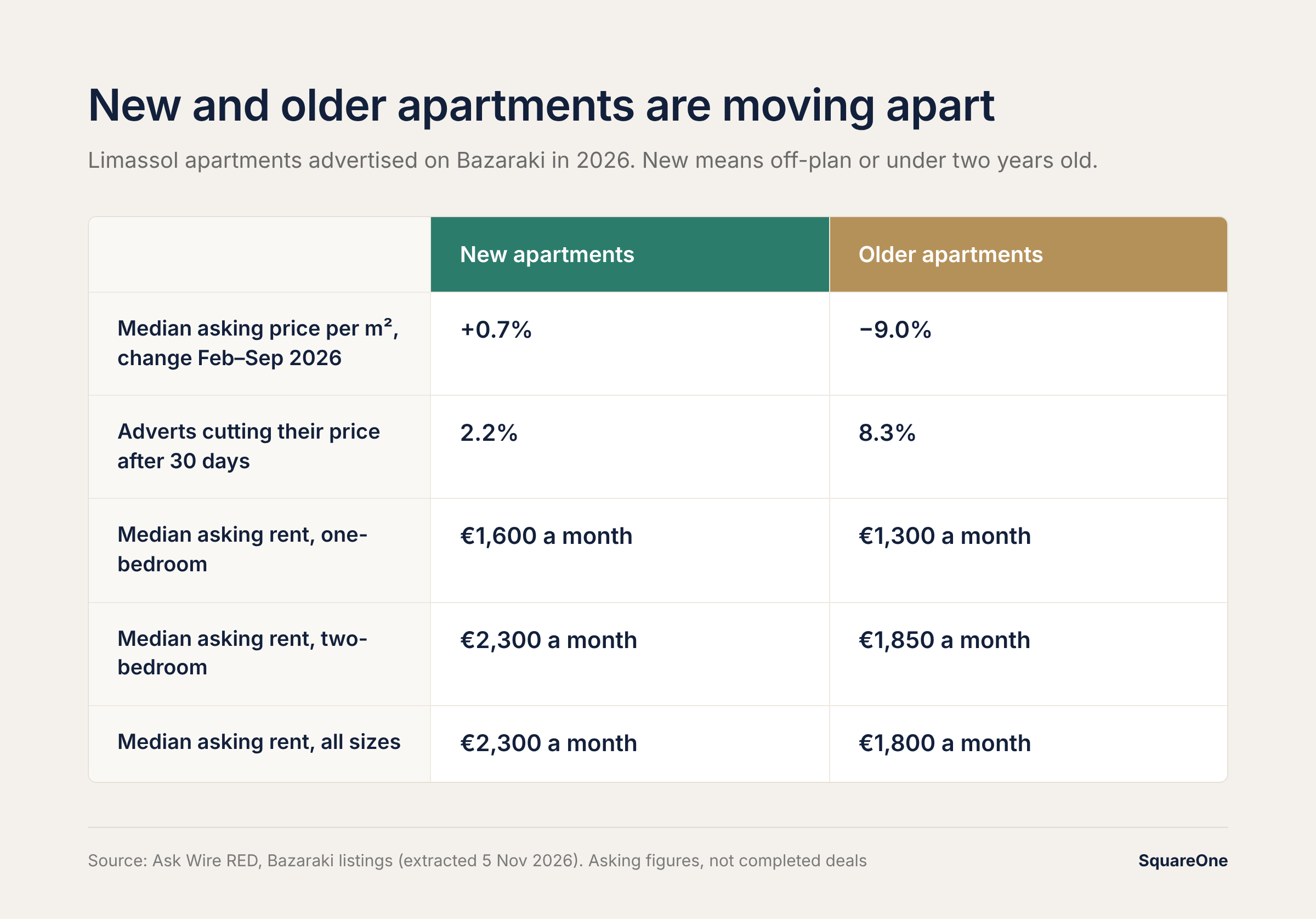
The clearest sign of pressure is in asking prices on Bazaraki, which Ask Wire tracks daily. Between February and September 2026, the median asking price per square metre for older Limassol apartments fell 9.0 per cent. For new apartments it was flat, up 0.7 per cent.
Owners of older homes are also more likely to cut. After 30 days on the market, 8.3 per cent of adverts for older apartments had reduced their price, against 2.2 per cent for new ones.
Rents show the same gap. The median asking rent for a new two-bedroom apartment was €2,300 a month, against €1,850 for an older one. Ask Wire defines new as off-plan or under two years old; these are medians from a sample of adverts, not signed leases.
Loizou was careful to say that Limassol apartment prices have not fallen by 20 per cent or 30 per cent. Median sale prices per square metre did fall in four of the six areas Ask Wire compared between the first halves of 2025 and 2026. Much of that reflects a change in what is selling, as cheaper projects open behind the established ones.
He gave a personal example. A Nicosia flat he owns, built in 1989, let within 48 hours two years ago. This autumn it has sat on the market for three weeks. His long-standing tenant has moved into a new apartment he bought.
A large share of Cyprus’ housing was built in the 1980s, Loizou noted, and much of it is due for renovation. Landlords who want to hold their rent will need to invest in the kitchen, bathrooms and finish or accept a lower price.
What tenants and buyers will look for
New stock is not one market either. Loizou expects tenants with higher incomes to ask for a pool, gym and on-site management, and for new projects to divide between those that offer them and those that do not.
Demetris Papadopoulos, CEO of SquareOne, says that is already shaping how projects are planned.
“When buyers and tenants have more choice, the building has to work harder,” he says. “We now add shared facilities to almost every project where the plot allows it, and we price for the range where most people actually buy. A new home still has to compete on location, management and a realistic delivery date.”
Rising costs add pressure on developers. Construction materials cost 32 per cent more than in 2020 and construction labour 25 per cent more, according to the Statistical Service. Loizou argued that developers who bought land at the peak may find their margins squeezed if sale prices hold steady.
What it means if you are buying
For buyers, more supply means more negotiating room, particularly on older resale homes. It also makes the choice between a home that is ready now and one still being built more important.
A ready home can be inspected and let straight away. An off-plan home is usually priced lower and paid for in stages, but comes with a wait and a dependence on the developer.
“The question is not only what a home costs today,” Papadopoulos says. “It is what it will compete with when it is finished, and who will want to live there.”
SquareOne’s guide sets out the trade-offs, tax and legal protections in detail: Off-plan vs ready property in Cyprus: costs, risks and protections.
* Sources: Ask Wire RED and Tracker (November 2026); CYSTAT Labour Force Survey, building permits, construction cost indices.





Click here to change your cookie preferences