
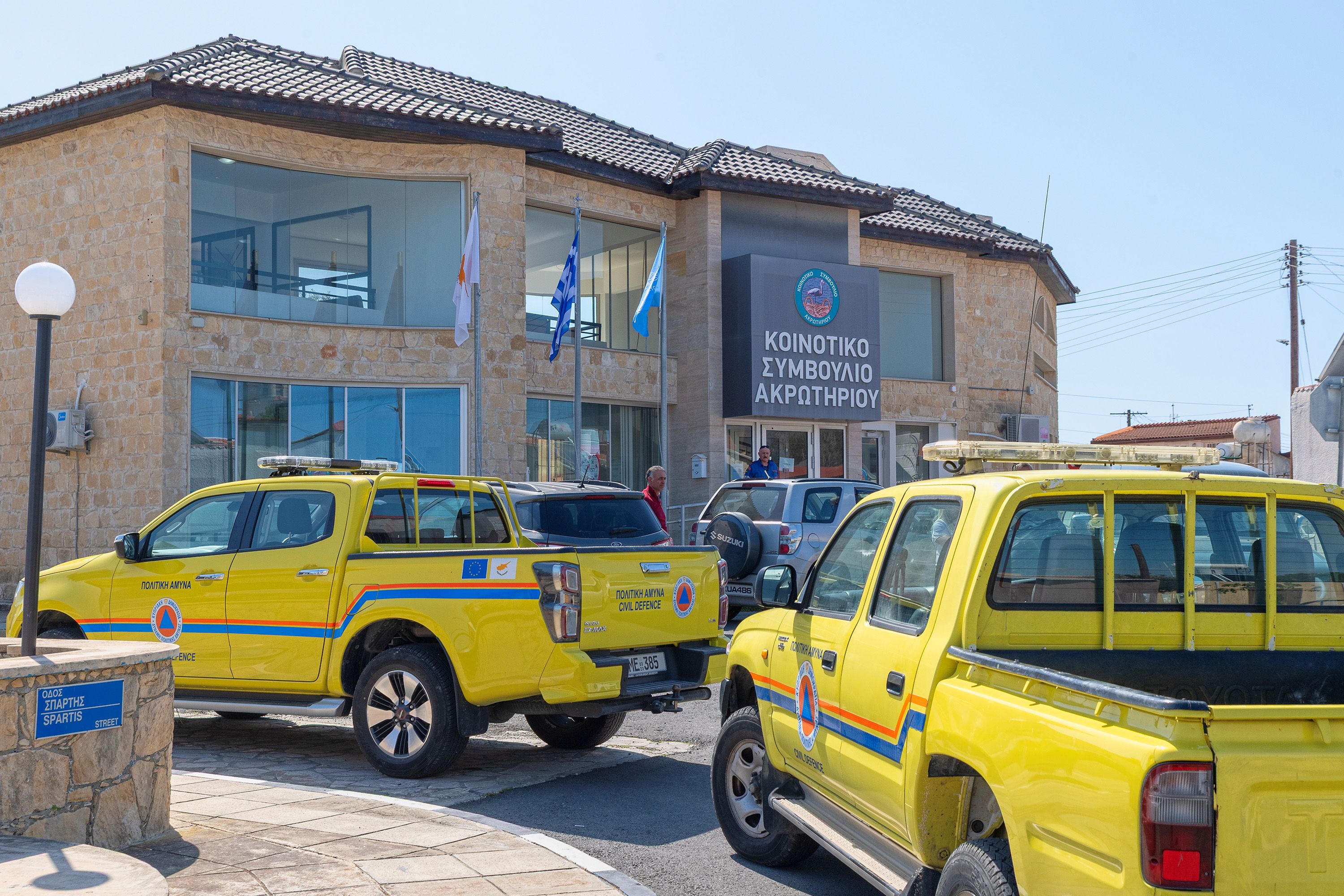
The evacuation order for the village of Akrotiri, which is located within the eponymous British base area and adjacent to the air force base, was suspended on Friday, with the security situation in the village deemed to be adequately safe, frequent alerts regarding “security threats” notwithstanding.
The interior ministry said that it had examined the information available to it, “in consultation with other competent state authorities”, and found that the status quo on the ground “has evolved in recent days” in the aftermath of the base being hit by an Iranian-made drone on March 2.
“Based on the assessment conducted, it was decided that, at this stage, the evacuation order in the Akrotiri area will not be extended,” it said, adding that both Kourion mayor Pantelis Georgiou and Akrotiri deputy mayor George Konstantinou had been informed of the decision.
Nonetheless, it said, “the area remains on heightened alert, and the situation will be continuously reassessed, with the aim of taking timely measures if a new need arises”.
It added that as such, civil defence teams will remain on the ground “on a precautionary basis” and will continue their patrols.
The announcement came hours before another “security threat” message was sent to base personnel and local residents, with the message urging them to “remain indoors and stay in place until further official notice”, and to “move away from windows and take cover behind or beneath substantial, solid furniture”.
The declaration of the threat lasted for around a quarter of an hour before being cancelled.
Asked about the suitability of returning Akrotiri residents to their homes while security threats continue to be declared, interior ministry spokeswoman Margarita Kyriakou told the Cyprus Mail that the government had undertaken a comprehensive assessment of the situation on the ground before coming to a decision.
She also pointed out that since the March 2 drone strike, the vast majority of the “security threat” messages have been swiftly cancelled, while none have resulted in a direct impact on the base or its vicinity.
Additionally, she said that the government had been informed that the messages may continue to be sent for months to come as the conflict in the Middle East develops, and that it would be unrealistic to keep the village in a state of evacuation for months on end on account of the continued sending of “security threat” messages.
She stressed that should the situation on the ground change, “the government will re-examine the situation as and when needs require”, but was keen to state that at present, the information available to the government indicates that it is safe to return to the village.
Earlier, a spokesman for the British defence ministry had explained to the Cyprus Mail that the congested nature of airspace above and around Cyprus is the cause of the repeated messages.
“There is congested airspace in the region at the moment, with a lot of planes, jets, missiles and drones in other parts of the airspace near the island,” he said.
He said that as such, radar systems used to monitor the region by the British military, which are “hyper-aware and sensitive”, are triggered by aircraft, manned and unmanned, which are not necessarily headed in the direction of Cyprus.
“They pick up heat streaks or heat sources which are coming towards the region, but are not, in the end, headed towards Cyprus, but those messages are a safety blanket, a precaution,” he said.
He added that the messages are sent as a first precaution, and that those messages are often cancelled just minutes later “as it quickly becomes apparent that whatever was picked up is not headed for Cyprus”.






Click here to change your cookie preferences