
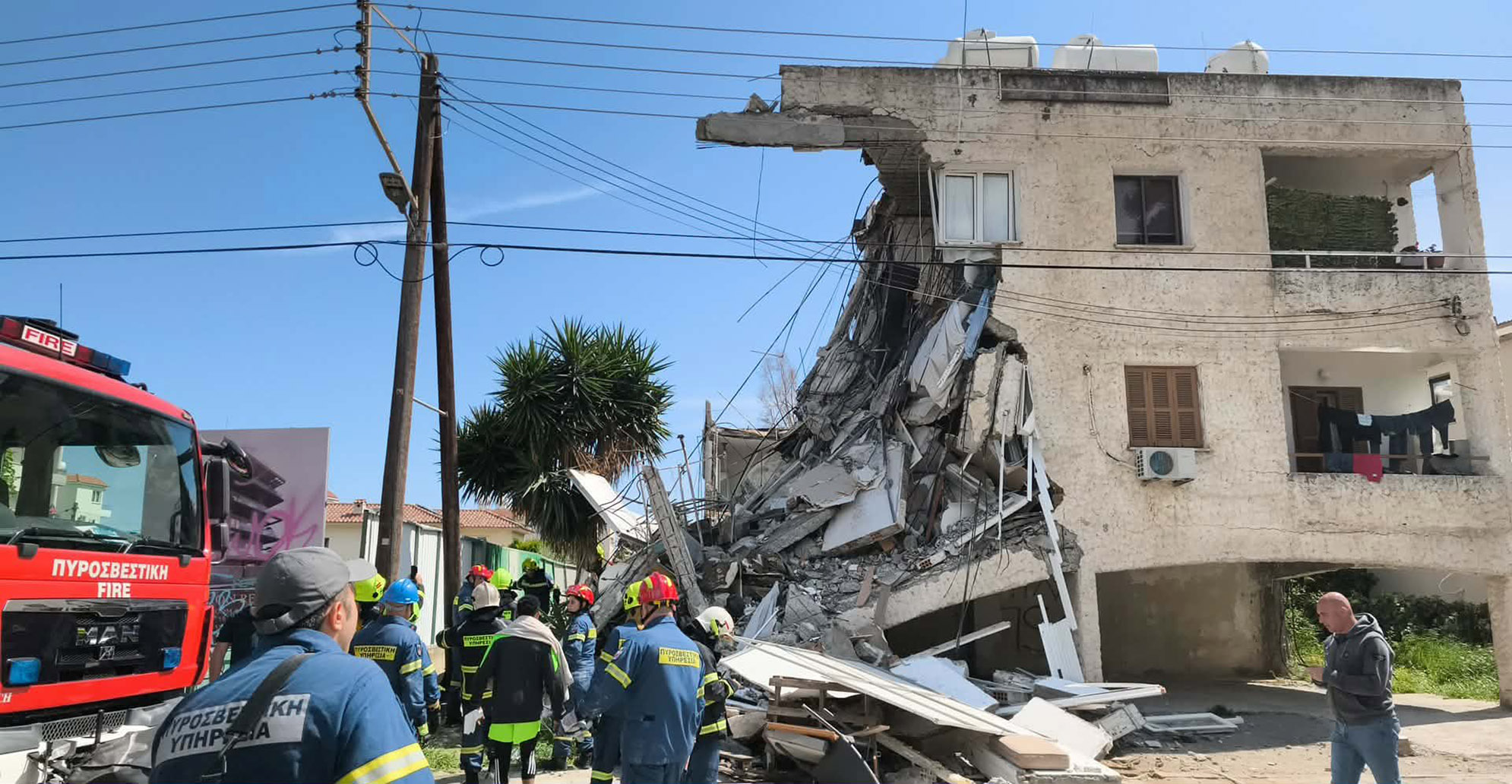
The interior ministry is expected to call a the technical chamber (Etek) and the civil engineers’ association to a meeting on Wednesday to determine immediate steps following the fatal collapse of an apartment block in Yermasogeia.
According to local media, proposals for immediate measures are set to be presented by Interior Minister Constantinos Ioannou, while an update is also expected on pending legislation concerning dangerous buildings, originally proposed by Labour Minister Marinos Mousiouttas and co-drafted with the interior ministry.
Etek has called for immediate and mandatory building inspections, warning that the country’s archaic building stock and weak enforcement system are placing lives at continued risk.
Speaking on Tuesday, Etek president Constantinos Constanti said the tragedy reflects a wider structural problem that authorities have failed to contain despite years of warnings and repeated legislative proposals.
Constanti said the incident highlights that “owners do not take the necessary measures to ensure that their building is in a condition which does not pose a risk to users and passersby”.
He added that under existing legislation, building owners bear full responsibility for the condition of their building and must act when a structure is declared unsafe.
He stressed that it is “unacceptable for buildings which are deemed dangerous to be in use, let alone be put up for rent”.
The comments follow the collapse in Yermasogeia of ablock of flats previously classified as dangerous.
The building had been inspected on February 19 and formally declared dangerous on March 10, according to the Limassol district local government (EOA).
Registered notices were sent to owners on March 26 requiring evacuation and repairs within a three-month deadline, however no remedial works were completed before the collapse.
Etek stressed that the current system is “insufficient to address the problem effectively” and has repeatedly urged the introduction of regular mandatory inspections similar to vehicle roadworthiness tests.
Constanti described the proposal as “the so-called MOT of buildings”, involving periodic checks based on the property’s age and use.
He said such a system would allow early intervention before deterioration becomes critical.
He also called for a national digital registry of buildings to allow authorities to track structural condition and risk levels in real time.
“We should be able to fix iron that is about to rust, not waiting for the balcony to fall because you do not have money,” he said.
Constanti warned that further incidents are likely if reforms are not accelerated.
“We were warned several times, time is up and starting tomorrow we must take measures,” he said.
Official data presented in parliament in November indicated that at least 1,292 buildings across Cyprus are classified as dangerous.
Officials have stressed that these numbers may have increased since the transfer of responsibility for dangerous buildings was formally shifted from municipalities to district EOAs in April 2025 under local government reform.
The change was intended to centralise enforcement and improve consistency, but officials and engineers have since raised concerns that the new structure lacks both funding and operational capacity.
Larnaca EOA chairman Angelos Hadjicharalambous refuted the latest figures as a gross underestimation of the crisis, instead citing “over 500 dangerous buildings in the city and district of Larnaca”.
He said many have been neglected for years and that “no management was carried out for years by the previous authorities”, resulting in accumulated structural risk.
He also said the current framework is “very time consuming” and lacks the flexibility needed for rapid intervention.
He added that the EOAs are now attempting to prioritise cases based on severity, with some buildings expected to be demolished immediately.
In Limassol, EOA chairman Yiannis Tsouloftas said owners of the building that collapsed on Saturday were instructed to appoint engineers and carry out repairs within a set timeframe.
He confirmed that “letters were sent to all owners” and that legal procedures allow authorities to order evacuation, sealing and disconnection of utilities where necessary.
Despite these measures, enforcement remains inconsistent, for legal provisions allow district organisations to issue notices requiring owners to repair or vacate unsafe buildings.
However, officials acknowledge that implementation is often delayed due to administrative constraints and legal challenges.
Authorities can also pursue criminal proceedings where negligence is established, however Etek has argued that the system is reactive rather than preventive.
Constanti also called for stronger legal consequences for owners who knowingly allow unsafe properties to be occupied.
“Some people must finally be brought to justice,” he demanded.
He added owners who continue to collect rent from unsafe buildings demonstrate what he described as “criminal indifference”.
Government spokesman Konstantinos Letymbiotis said a full inquiry is necessary to establish responsibility and prevent similar incidents.




Click here to change your cookie preferences