
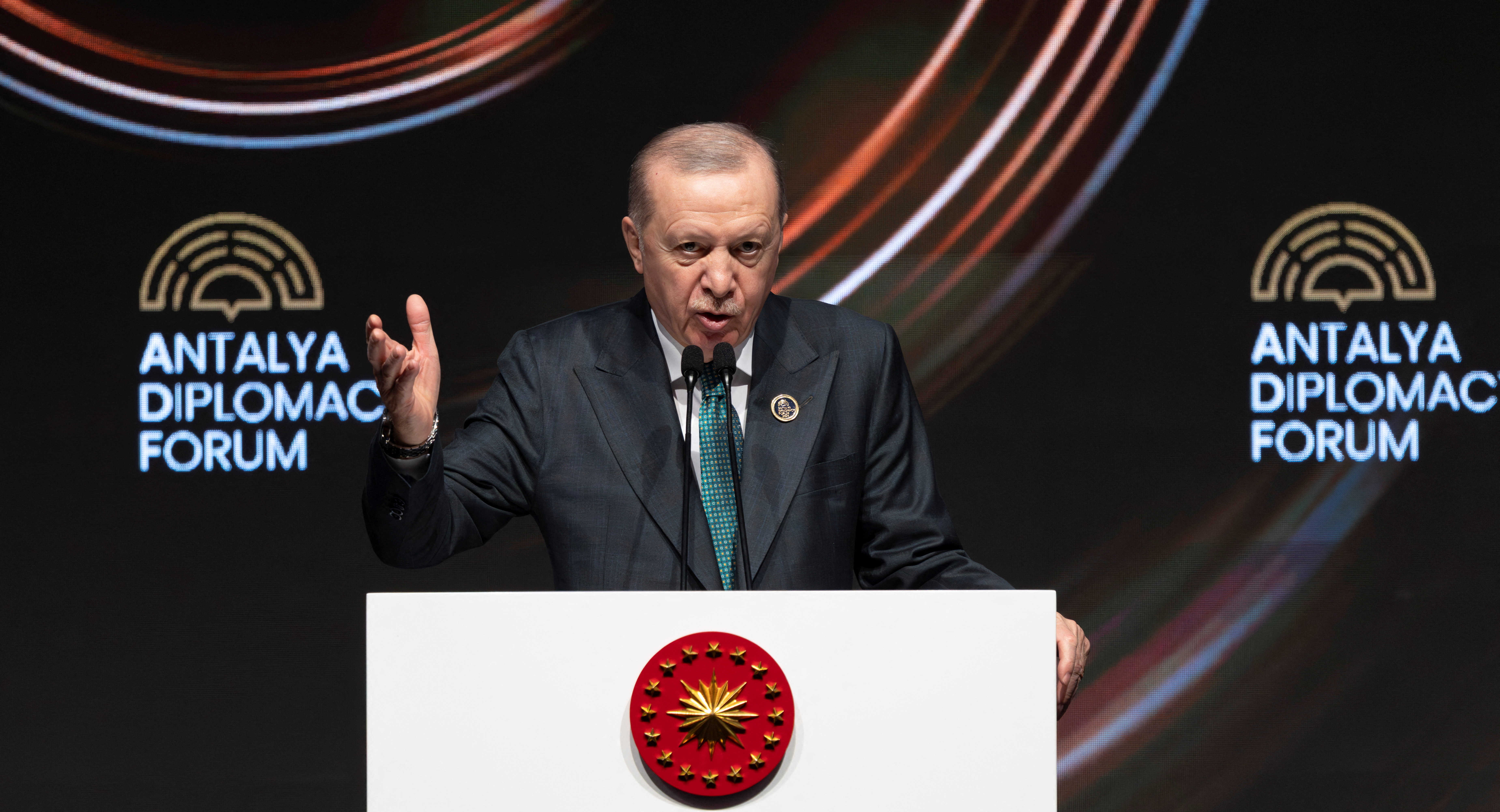
Turkish President Recep Tayyip Erdogan on Friday called for an end to “maximalist approaches which attempt to exclude” both Turkey and the Turkish Cypriots in the eastern Mediterranean, during his address at the Antalya diplomacy forum.
He also called for an end to “futile efforts which seek to create a climate of war”, stressing that “we want to see the Aegean Sea and the eastern Mediterranean as a basin of stability and prosperity”, before delving into specifics regarding his stance on the Cyprus problem and other regional issues.
“The resolute stance of the Turkish Cypriots has now proven to the whole world the reality that there are two separate peoples and two separate states on the island of Cyprus,” he said.
He added that “we believe that the positive atmosphere we have established with our neighbour Greece should contribute not only to the resolution of our bilateral issues but also to the cessation of human rights violations against the Turkish minority in western Thrace”.
The matter of western Thrace’s Turkish minority has been a point of contention between Greece and Turkey in recent weeks, with the Greek government maintaining that the minority’s rights are being respected.
At the centre of the dispute is the appointment of religious leaders, known as muftis. Turkey has complained that Greece did not allow for the direct election of muftis, as was set out in the 1913 Treaty of Athens, while Greece argues that the 1923 Treaty of Lausanne supersedes this and does not require it to hold such elections.
Greece also argues that in light of “judicial and administrative responsibilities” assigned to muftis in western Thrace, it would not be possible to hold direct elections for muftis, and as such, Athens appoints them based on recommendations offered by a committee of local residents for the areas they serve.
Erdogan had met Turkish Cypriot leader Tufan Erhurman prior to the start of the Antalya diplomacy forum on Thursday, with the Turkish presidential communications directorate saying that in that meeting Erdogan had said “the military units sent to the island from some European countries under the pretext of the war in Iran need to not be permanent”.
After Cyprus was hit by an Iranian-made drone last month, Greece, France, Italy, Spain, the Netherlands, Turkey, and the United Kingdom all deployed naval or aerial assets to the island and its vicinity.
While Erhurman was joined at Thursday’s meeting by his undersecretary Mehmet Dana and his chief of staff Mustafa Erguven, Erdogan was joined by Turkey’s National intelligence organisation (Mit) chief Ibrahim Kalin.

Click here to change your cookie preferences