
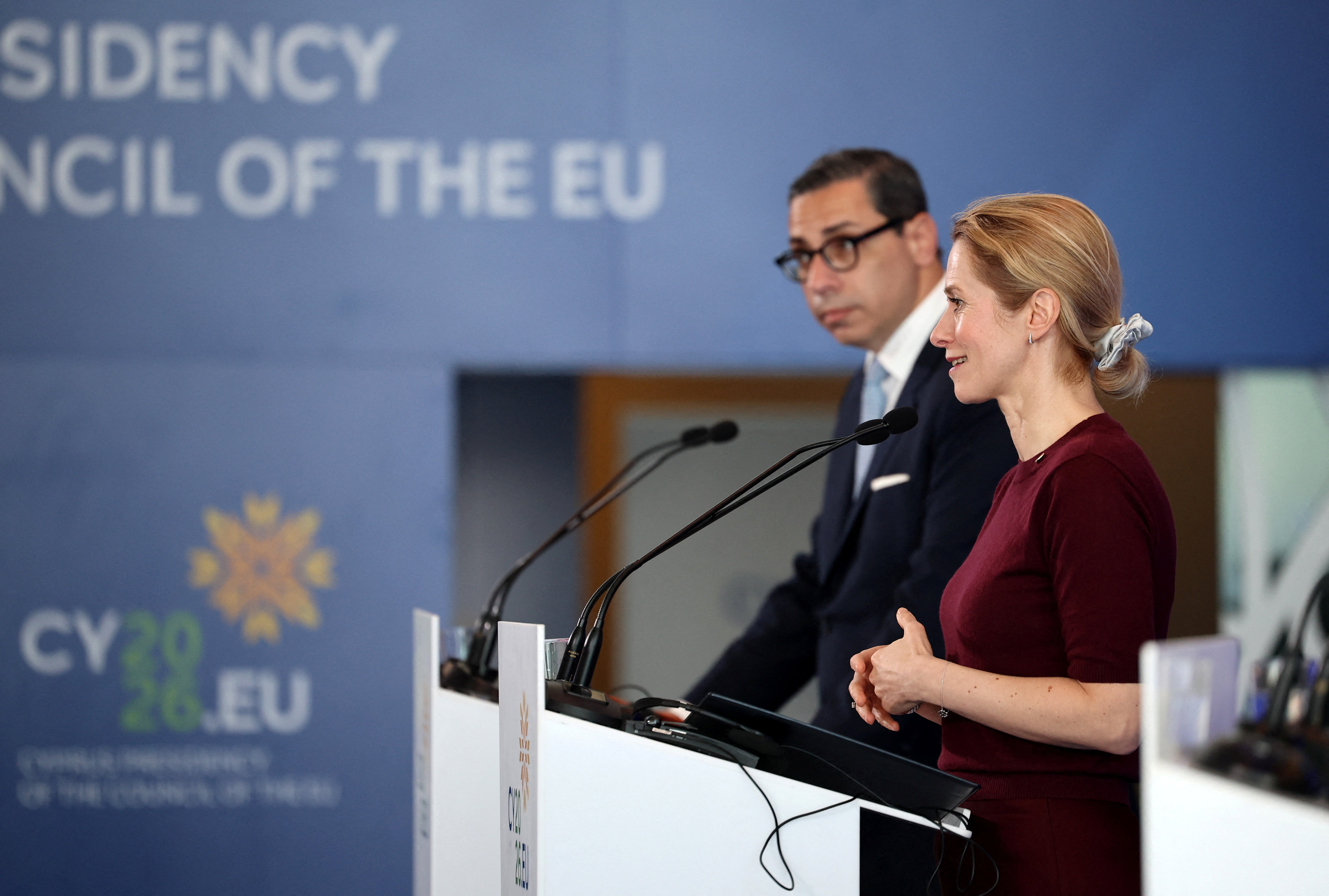
The European Union’s foreign affairs chief Kaja Kallas on Thursday set out her and the bloc’s opposition to the presence of Russian troops in both Georgia and Moldova, at the end of the day’s informal summit of the foreign ministers of the 27 EU member states in Limassol.
“There are broader security concerns when we look at the presence of Russian troops in countries such as Georgia and Moldova. It is clearly in Europe’s interest that these forces are no longer stationed there,” she said, while also outlining the EU’s position on how the war in Ukraine should be brought to an end.
On this matter, she said she had in February put forward a “discussion paper” to the 27 foreign ministers, and that the first point in that paper was that “unconditional ceasefire is a prerequisite for any kind of peace negotiations”, with that position also having been “underlined by ministers” in Limassol on Thursday.
“Russia must stop sabotage operations, cyberattacks, election interference, airspace violations across Europe,” she said, before stressing that “there can be no legal recognition of the occupied Ukrainian territory” annexed by Russia both in 2014 and in the course of the war which has ensued since the full-scale invasion of Ukraine by Russia in 2022.
She added that “Russia must cooperate with the international investigations and should pay for the destruction it has caused”.
“Any peace agreement must fully accept Ukraine’s sovereignty, independence, and the right to choose its own alliances,” she said.
Turning her attention to the more immediate future, she said that ministers present in Limassol had “discussed how to increase the pressure on Russia globally” in terms of sanctions, adding that “too many countries continue to do business with Moscow, while simultaneously enjoying privileged access to European markets and investments”.
“Europe must use its leverage more effectively when it comes to trade, investment, market access, partnerships, and this is why we are preparing new sanctions [on] Russia to really pressure them, so that they would go from pretending to negotiate to actually coming to the negotiating table,” she said.
Kombos, meanwhile, spoke less about the matter of Ukraine, saying that Europe must now display “tangible action” in its continued response to the war.
He also made reference to the fact that Ukrainian Foreign Minister Andrii Sybiha had travelled to Cyprus to attend Wednesday evening’s meal alongside the ministers and Kallas, saying that the ministers “had the opportunity to hear the latest situation on the ground” in Ukraine.
Later, Kallas was asked whether her position regarding the removal of Russian troops from both Georgia and Moldova was shared by the rest of Thursday’s attendees, and said that “nobody was opposing that”.
She had also said that if and when negotiations to bring the war in Ukraine begin, “Europe will never be a neutral mediator between Russia and Ukraine”, because “we are on Ukraine’s side and we are defending our own core security interests”.
Russian troops have been stationed continuously in both Georgia and Moldova since before both states’ independence from the Soviet Union.
In the modern era, Russian soldiers in both countries ensure the continued existence of three unrecognised states – the ‘Republic of Abkhazia’ and the ‘State of Albania’, which is colloquially known as South Ossetia in Georgia, and the ‘Pridnestrovian Moldavian Republic’, colloquially known as Transnistria, in Moldova.




Click here to change your cookie preferences