
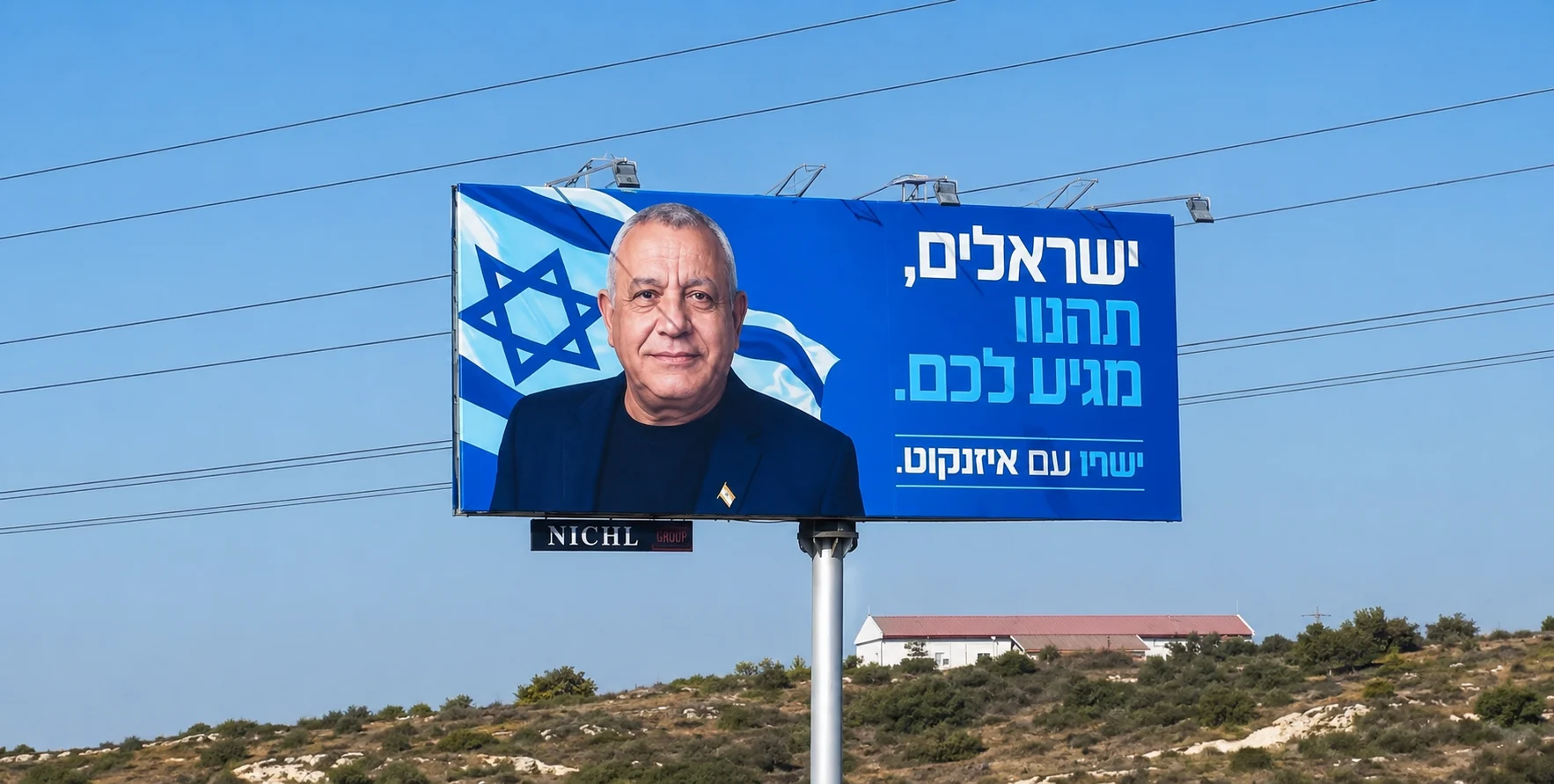
Direct Democracy MP Yiannis Laouris submitted a bill to parliament on Friday seeking to ban outdoor billboards and other advertisements used to campaign for foreign elections, following controversy over roadside billboards promoting Israeli prime ministerial candidate Gadi Eisenkot.
The bill shall be referred to the House interior committee for discussion, which will then decide whether to send it to the plenary.
It seeks to amend the advertisements control law to prohibit outdoor advertising connected to campaigns for elections taking place in other countries.
Laouris said the amendment was necessary to limit “the uncontrolled use of outdoor advertising space for political campaigning and the promotion of candidates taking part, or intending to take part, in foreign elections.”
The proposal follows a controversy that began in late July, when billboards promoting Eisenkot, founder of Israel’s Yashar party and former chief of staff of the Israel Defense Forces (IDF), appeared along highways.
One sign near Larnaca airport read “Israelis, have a good time. You deserve it,” while a second, positioned on the route back to the airport, urged travellers to “Come back and win!”
Eisenkot’s campaign headquarters confirmed the billboards were deliberately strategic in order to reach the large number of Israeli holidaymakers visiting Cyprus, ahead of Israel’s prime ministerial election on October 27.
The signs prompted widespread criticism on social media and calls from Direct Democracy’s leader Fidias Panayiotou for an outright ban on third countries running election campaigns in Cyprus. “
At the time the billboards appeared, no legal provision existed to prevent a foreign political party from purchasing advertising space in Cyprus outside a local election period, with commercial billboards instead governed by general advertising regulations.
The interior ministry told the Cyprus Mail in July that billboard content fell outside its remit, stating it had “no legal framework under its competence to regulate advertising for elections or advertising in general,” and pointed instead to the advertising regulation organisation (Caro).
Caro said there was “no framework governing the content displayed on commercial billboards,” with decisions resting at the discretion of billboard owners provided adverts complied with existing advertising codes.
Niche Advertising, the company responsible for the billboards, said though it did not politically endorse Eisenkot or his party, the poster was being treated as a standard commercial transaction.
The company questioned the scale of the reaction, asking “Do you not see this in Germany with Turkish elections?” and remarking that “the Israelis are investing greatly in Cyprus,” whilst maintaining there was “nothing in the law prohibiting this.”
The billboard near Larnaca airport was later vandalised with paint in the colours of the Palestinian flag.





Click here to change your cookie preferences