
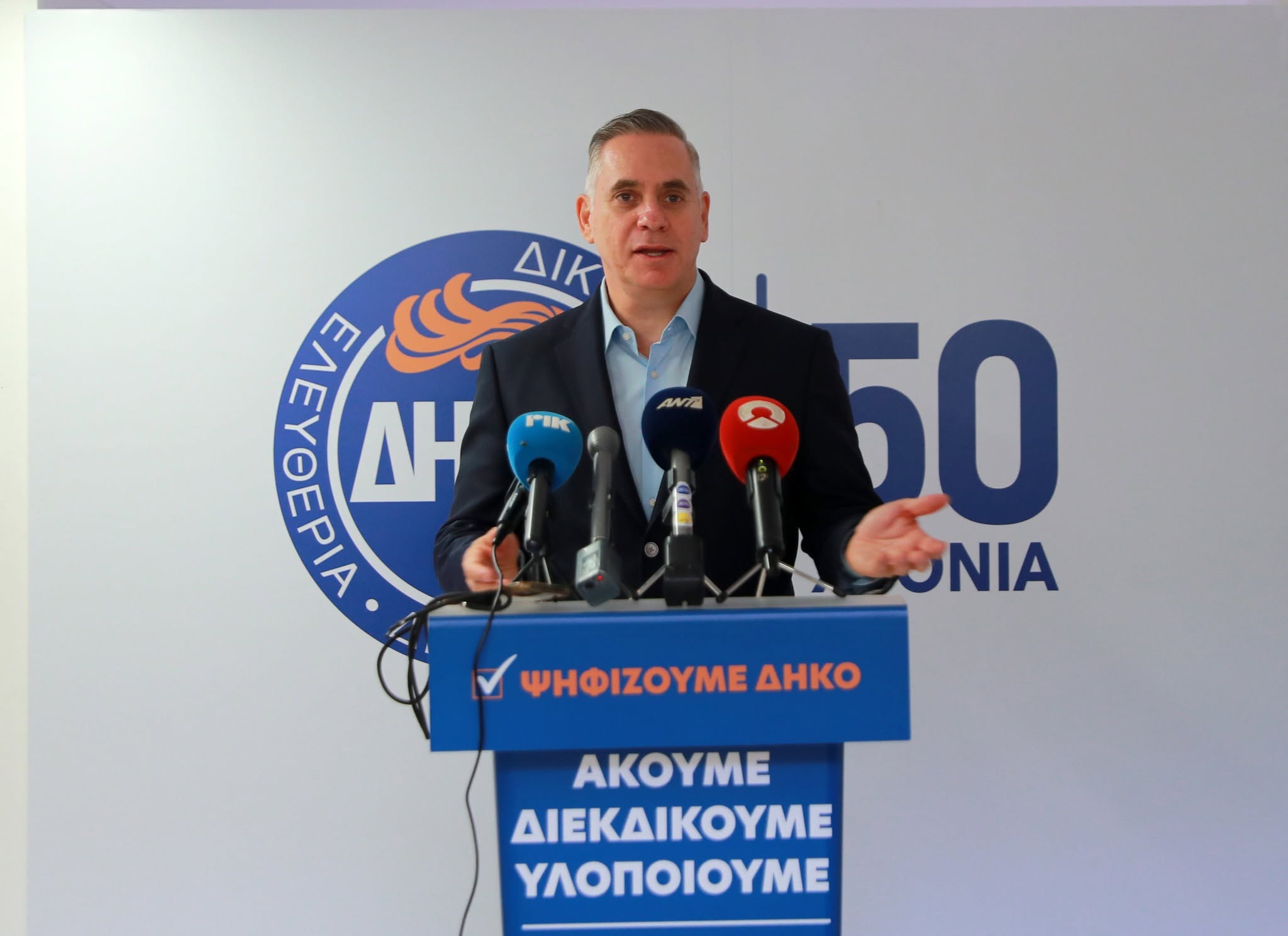
Diko leader Nicholas Papadopoulos on Thursday kept up the pressure regarding his spat with Finance Minister Makis Keravnos, suggesting that the latter is insubordinate to the president and asking flat-out whether there are “two governments”.
Speaking on Sigma TV, Papadopoulos listed off a series of issues where, according to him, the finance minister and President Nikos Christodoulides appear to be at odds.
This therefore went beyond Keravnos’ registered skepticism over the Great Sea Interconnector, a project which, according to Papadopoulos, the president fully supports.
Over the weekend, the Diko boss had asked Keravnos why he won’t resign if he considers the interconnector “disastrous” for the country.
But on Thursday, answering questions, Papadopoulos stated that he is not asking the finance minister to quit; rather, that his earlier comment was rhetorical.
But he added: “A minister may disagree with government decisions. But he either resigns because he disagrees with these decisions, or he implements the decisions despite his disagreement.”
Earlier this month, in parliament, Keravnos told MPs that the GSI may end up costing a great deal more than the €1.9 billion as advertised, while also questioning whether the project would ultimately bring down the cost of electricity.
Papadopoulos disagrees with this assessment, arguing that an electricity connection with Greece would ultimately benefit consumers.
The Diko leader went on to cite a number of government decisions, formally announced, which Keravnos has supposedly refused to implement.
For example, there appears to be a divergence of opinion on pension reform between Keravnos and Labour Minister Marinos Mousiouttas.
“One says one thing, the other says something different.”
Another issue is that whereas the president came to an agreement with the Etyk union – representing bank employees – regarding their provident funds shaved off during the 2013 ‘haircut’ – Keravnos is “refusing to implement it”.
A third case, said Papadopoulos, concerns reimbursements to depositors and bondholders burned in the 2013 bail-in. Whereas the government reached an agreement with the depositors, and a sum was paid out in 2025, Keravnos recently stated that no new reimbursement scheme would be made available for 2026.
“The picture being projected is that there are two governments: one is the government of the finance minister, the other the government of everyone else.”
This state of affairs, he argued, damages the president himself.
And he called on the president to personally look into wider matter of how his ministers conduct themselves in public and whether they faithfully implement the government programme.
Earlier, a Diko spokesman had gone so far as to propose a three-way meeting between Christodoulides, Keravnos and Papadopoulos, in order to “clear the air”.
Diko’s Panicos Leonidou said he was undertaking the initiative, trying to make the meeting happen once the president returns from the United States – where he’s currently attending the UN General Assembly.
Asked about this, Papadopoulos appeared not to endorse the idea: “This is not a personal matter requiring a third party to intercede”.




Click here to change your cookie preferences