
A country for a parade: the Mediterranean tragedy
In an anarchic international system, small states bordering regional heavyweights operate on razor-thin margins of survival.
Neither multilateral communiqués, commercial energy concessions, nor diplomatic choreography can overturn the distribution of hard power. The Republic of Cyprus embodies this strategic delusion. Forty miles off the Anatolian coast, the island confronts an immutable geography that posturing cannot dissolve. Rather than accommodating this structural imbalance, Cypriot policymakers have pursued an external-balancing gambit: inviting foreign entanglement to offset Turkish hegemony and extract diplomatic concessions from Ankara. The strategy has backfired. Far from deterring Turkey, Nicosia has walked into a classic provocation trap, antagonising an adjacent leviathan while importing the volatile rivalries of the Levant directly to its doorstep.
Parades, and the mirage of extended deterrence
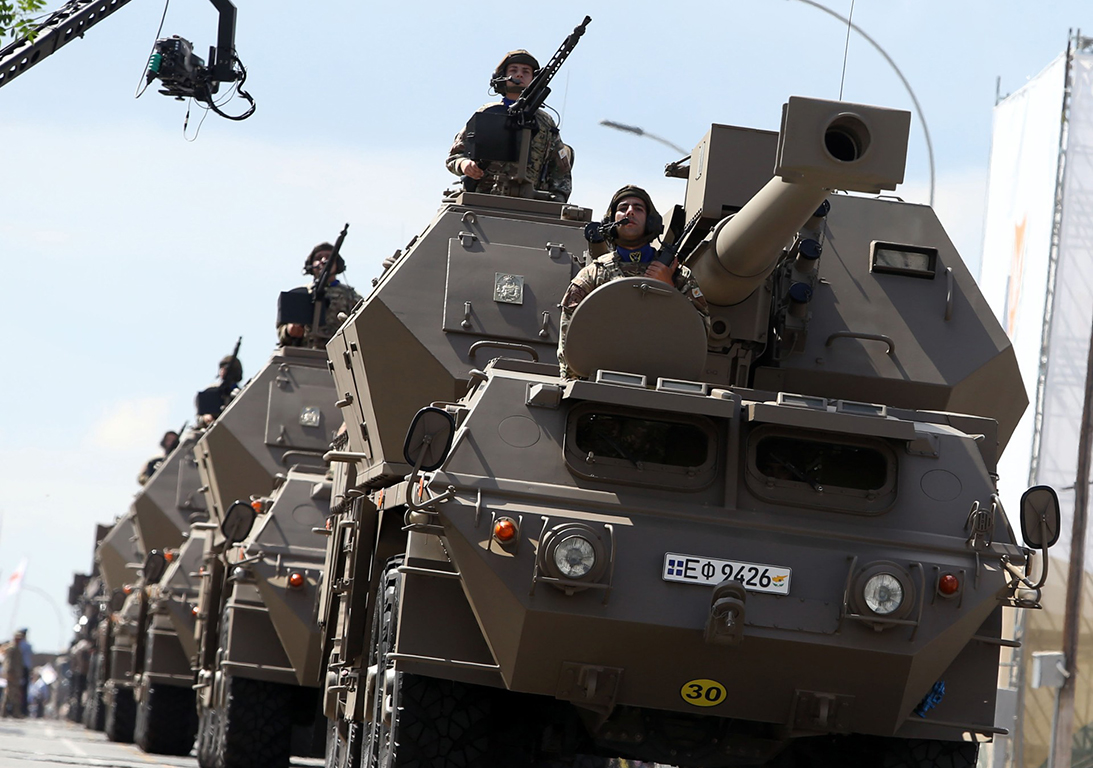
Every October, along Iosif Hadjiosif avenue in Nicosia, the Cypriot government stages an elaborate martial spectacle with recent iterations revealing an escalating pretence. Hellenic Air Force F-16s streaked overhead, Israeli-built Barak MX air-defence batteries rolled across the asphalt, and Western defence attachés stood beside marching contingents from Greece, France, the United Kingdom and the United States. Domestic elites market this choreography as living proof of an operational deterrence architecture.
The claim is an illusion. Parading imported hardware and hosting multinational exercises cannot generate organic combat power. Deterrence rests on deployable capabilities: demographic mass, naval tonnage and sovereign geographic proximity – structural realities that parades cannot alter.
Nicosia’s foundational error lies in mistaking diplomatic alignment for extended deterrence. Absent a statutory defence pact, alignment in international politics is cheap talk. No foreign capital has signed a mutual defence treaty guaranteeing Cypriot territorial integrity. Cyprus lacks a collective defence clause, and no legal mandate obliges Washington, Paris, or Tel Aviv to expend blood and treasure should the Turkish army breach the Green Line or interdict exploration within the Republic’s Exclusive Economic Zone (EEZ).
The United States anchors its Mediterranean strategy to three fixed priorities: securing Nato’s southern flank, checking Russian revisionism and keeping Turkey anchored to the Western security architecture. In this hierarchy, the territorial integrity of a divided island remains peripheral. France and Israel similarly treat Cyprus as a convenient logistical node, an intelligence outpost and an export market for defence contractors – not an existential perimeter worth defending in a high-intensity war.
The anatomy of an illusion: the 3+1
The 3+1 framework – linking Cyprus, Greece, and Israel under statutory US auspices – exemplifies this strategic myopia. While Cypriot elites hail the grouping as a barrier to Turkish expansionism, they misread great-power priorities. Washington lifted its arms embargo and extended International Military Education and Training assistance not to protect Cyprus from Ankara, but to sever the island’s longstanding financial, commercial and maritime ties to Moscow. By trading low-cost security cooperation, the United States met its core geopolitical goals – all without assuming a single binding obligation to defend Cypriot territory.
The structural balance tilts decisively toward Turkey. Under the 1936 Montreux Convention, Ankara commands the Turkish Straits, exercising structural leverage over Western grand strategy that effectively insulates its regional revisionism. Israel’s posture is equally transactional. Tel Aviv’s operational perimeter terminates at the Tamar and Leviathan gas fields. While Israel projects a formidable anti-access/area-denial envelope over its immediate littoral, it lacks the amphibious and naval capabilities to challenge Anatolian maritime dominance.
Turkey, conversely, treats the Eastern Mediterranean as an existential security zone. Its Blue Homeland doctrine reflects an offensive-realist reaction to its perceived encirclement, repudiating the United Nations Convention on the Law of the Sea (Unclos) provisions that award expansive continental shelves to micro-islands. International legality notwithstanding, Turkey forcefully asserts its own maritime claims while denying Cyprus’.
The retribution has been swift and asymmetric. Turkey turned to gunboat diplomacy: escorting seismic vessels with warships, declaring unilateral Navtex exclusion zones, and physically intercepting commercial drillships. On land, the balance has shifted even further. Ankara converted Lefkoniko airfield into an operating base for Bayraktar TB2 and Akıncı combat drones, placing Cypriot infrastructure under continuous precision threat, while constructing a naval base at Bogazi. Rather than checking its adversary, Nicosia’s alignment accelerated the occupied north’s integration into Ankara’s defence apparatus, prompting Turkey to discard the bizonal, bicommunal federation model in favour of an unyielding two-state demand.
Commercial fantasies and institutional realities
The conviction that commercial energy concessions could substitute for hard military deterrence was liberal institutionalist vanity. Carving up the EEZ and auctioning exploration blocks to Eni and TotalEnergies did not internationalise Cypriot defence. Energy conglomerates are not sovereign actors backed by standing armies. When confronted by naval intimidation, corporate boards do not lobby their home governments to deploy carrier strike groups; they price risk, declare force majeure and withdraw their capital. The demise of the EastMed pipeline – abandoned after Washington withdrew its support via diplomatic non-paper – demonstrates that commercial conduits cannot cross contested seas without sovereign military protection. The planned Great Sea Interconnector electricity cable carries the exact same structural vulnerability the moment Ankara moves to obstruct it.
Strategic entrapment and the price of inertia
Instead of establishing external deterrence, Nicosia has suffered classic strategic entrapment. By allowing Western militaries to mount operational sorties from the British Sovereign Base Areas of Akrotiri and Dhekelia while deepening intelligence coordination with Israel, Cyprus has imported the Levantine conflict into its homeland.
This hazardous posture persists because it serves the short-term domestic political interests of the Cypriot leadership. For President Nikos Christodoulides, staging military reviews and convening high-profile regional summits manufactures an aura of security, enabling his administration to evade the domestic costs of a negotiated settlement. Genuine re-engagement with the UN Guterres Framework requires real concessions on power-sharing, political equality and governance.
The shrinking horizon of manoeuvre
Paralysed by electoral calculus, Nicosia has chosen strategic inertia, attempting to run out the clock until the current UN mandate lapses in late 2026. Yet procrastination is not statecraft; it is partition by default. While Nicosia vacillates, the material balance of power on the island hardens as the north is integrated wholesale into Anatolia’s military complex. With every military parade along Iosif Hadjiosif avenue, the chasm between sovereign pretensions and strategic exposure widens. By substituting diplomatic theatre for hard power, Cyprus has provoked its primary adversary, invited entrapment in peripheral conflicts, and squandered its remaining diplomatic room to manoeuvre – all while F-16s streak overhead on Independence day, the country for a parade!



Click here to change your cookie preferences