
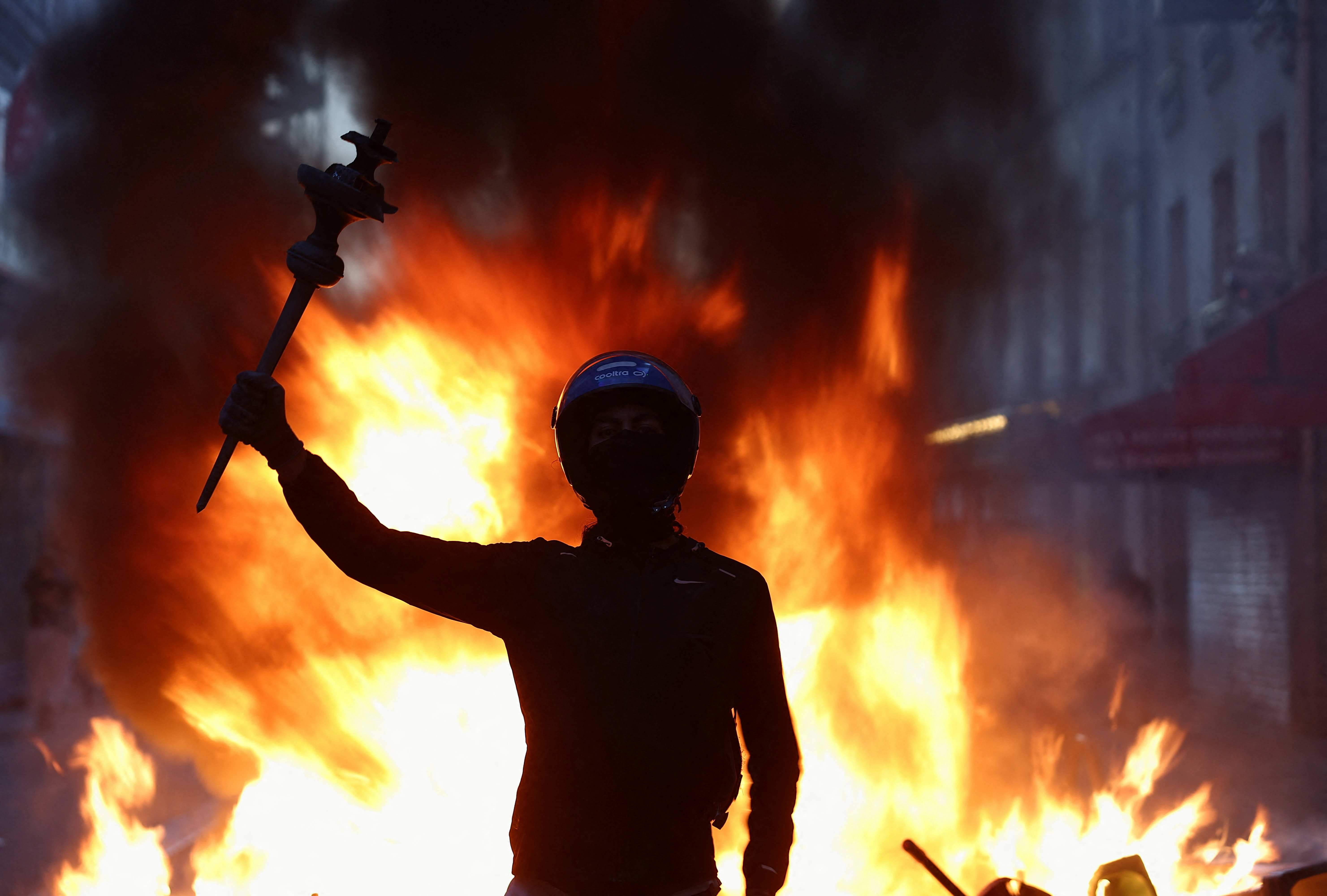
French President Emmanuel Macron rejected his interior minister's resignation following widespread riots, demanding action against violence and answers over intelligence failures.
Latest: Marseille imposes ban on public gatherings for Monday after violent protests
President Emmanuel Macron turned down his interior minister’s offer to resign, telling him instead on Monday to put an end to barricades and looting and be transparent over intelligence failings, as France licked its wounds from weekend rioting.
The protests follow weeks of student demonstrations with occasional bouts of street violence, rocking the country six months ahead of its next presidential election and increasing pressures over a weak economy and surging debt.
Fears of tensions inside Macron’s fragile government over apparent security shortcomings — coming just as the government needs to pass a much-needed budget bill to rein in its finances — are set to further unsettle investors.
At the weekend, hundreds of thousands took to the streets to protest over what many say are declining and dysfunctional public services that leave citizens to fend for themselves amid cost-of-living pressures.
In many places including the capital Paris, Marseille and the city of Lyon, peaceful protests were quickly hijacked by rioters, leading to scenes of vandalism and chaos.
Macron demands answers over security failures
France deployed 60,000 police and other security forces on Saturday, Interior Minister Laurent Nunez told France Inter radio, but acknowledged that wasn’t enough to control violent crowds in “certain cities”.
Macron’s presidential office, the Elysee, said on Monday that Nunez, a former Paris police chief, offered the president his resignation following the riots.
Macron refused, but urged Nunez to urgently come up with new concepts “to put an end to the barricades and looting,” the Elysee said.
It added that Nunez also needed to “ensure transparency regarding the failures in foresight and intelligence that led to the violence”.
Justice Minister Gerald Darmanin, a longtime Macron ally, echoed the president’s calls on Monday, telling France 2 television there were intelligence failures that left the state vulnerable in the face of what he called “extreme-left” rioters it had underestimated.
French markets fall amid political unrest
Cost-of-living issues were also front and centre during numerous demonstrations and protests staged in other European countries including Italy, Belgium and Albania on the weekend, with high fuel prices, largely resulting from the Iran war, adding to pain for many people.
In France, a town hall was torched, shops pillaged and buildings covered in graffiti on Saturday as violent groups clashed with police throughout the country.
Clashes also broke out in Paris and Marseille on Sunday, where riot police intervened to prevent attempts to ransack businesses.
A slide in bond prices pushed France’s 10-year yield up 8 basis points to 4.86%, FR10YT=RR while Germany’s 10-year yield, the benchmark for the euro zone, was flat at 3.41%. DE10YT=RR
“The modest recovery in French spreads over the last week or so will be tested today,” Jim Reid, an analyst from Deutsche Bank, said in a note.
French shares were among the worst performers on the European market on Monday as well, as the CAC 40 .FCHI fell 1.3% in early session trade. Shares in French banks BNP Paribas BNPP.PA, Societe Generale SOGN.PA and Credit Agricole CAGR.PA were all down around 2%.





Click here to change your cookie preferences