
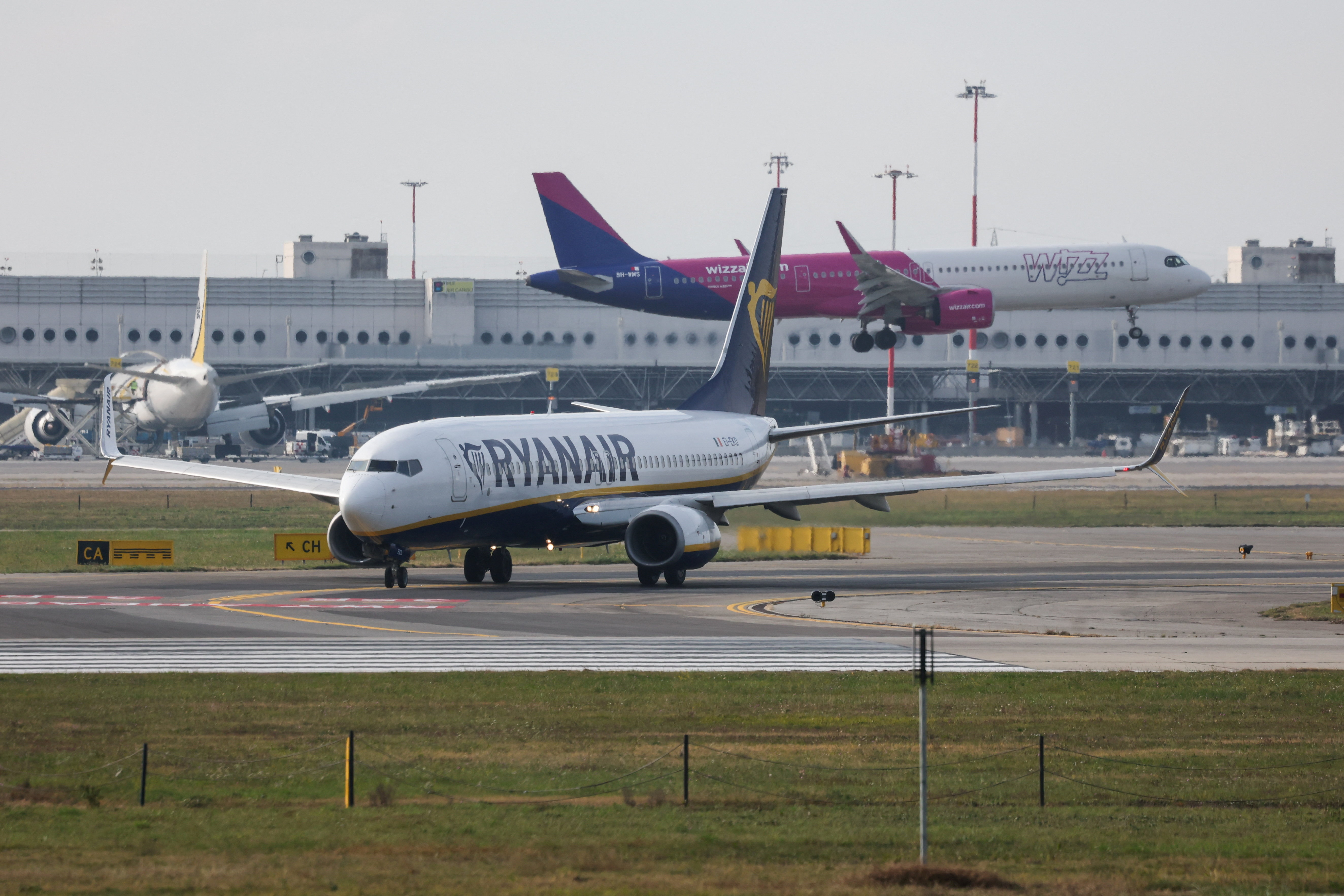
At least 25 flights were affected by a fresh wave of bomb threats across Europe, with aircraft diverted or escorted by fighter jets amid growing concerns over possible hybrid attacks.
A series of hoax bomb threats hit European airlines from Ireland to Bulgaria on Thursday morning for the second time this week, with some of at least 25 affected flights making unplanned landings or escorted by fighter jets.
While no country has attributed blame for the threats, they come at a time when many European officials have accused Russia of masterminding sabotage and “hybrid attacks” — often cheap, easily deniable and not expected to trigger an armed response.
Denmark, Poland and Romania, all affected by Thursday’s disruptions, have previously accused Moscow directly, while Germany blamed Russia for an attack on Leipzig airport in August. Britain has blamed Russia in the past but linked Iran to a suspected plot to attack a US air base. Both Russia and Iran deny any involvement.
What do we know about the bomb threats
There has been no claim of responsibility and officials have not attributed blame.
Airlines are not new to bomb threats, but aviation security experts say the apparent coordination and timing of the current incidents is unusual.
Below is an explanation of what risks airlines and passengers face.
HOW ARE MOST BOMB THREATS MADE?
Bomb threats against planes are often communicated to airlines, airports or authorities through anonymous emails or phone calls claiming that an explosive device is on board. Authorities do not always disclose how threats are delivered because doing so could encourage copycats and compromise investigations.
A Prague airport representative told CNN on Thursday that they had received a threat from an anonymous email addressed to the airport, and Czech police said similar emails went to other European airports.
Eric Schouten, head of aviation security group Dyami, told Reuters that an airline’s security department first runs the report through a checklist. It then alerts the authorities, who may scramble fighter jets or divert the plane to a designated airport for a full sweep.
WHAT IS THE RISK?
The vast majority of bomb threats turn out to be false alarms, though all must be treated as real until investigated.
No explosive device has been found on the planes affected this week, but every airline must decide whether a threat is credible and act accordingly.
A spokesperson for the British government called this week’s incidents “malicious hoax threats” and said it has “one of the most robust aviation security systems in the world”.
WHO MIGHT BE BEHIND IT?
Nobody knows.
Rhys Jones of Osprey Flight Solutions said bomb threats can stem from a wide range of motives, including political grievances, activist campaigns, criminal activity, online groups or state-linked hybrid operations.
There is currently no public evidence linking this week’s incidents to any specific state or organisation.
WHAT IS THE IMPACT FOR AIRLINES?
Even a false alarm can disrupt airlines’ operations, with plane diversions and thorough security inspections causing delays for passengers. Carriers typically bear additional costs including fuel, passenger rebooking, crew disruption and aircraft diversions.
Schouten said a sweep means unloading passengers and baggage, searching the aircraft and reloading. That can push crews past duty limits and lead to missed connections and cancellations.
Air France-KLM Chief Executive Ben Smith said on Thursday he had never previously seen threats reported in such a coordinated fashion.
“We’re quite confident that we have in place what we need to ensure that it has minimal or no impact on our operation,” Smith told reporters. “So we have no ask today of our governments to change the way they manage these types of situations.”
Eric Schouten, head of the aviation security group Dyami, said most of the countries affected supported Ukraine in its war against Russia’s invasion.
“From a geopolitical view, I’m thinking, you always have to think about the scenario of hybrid warfare, where a country in this way — today we are looking at Russia, right? — is attacking us on multiple fronts, from railways to supermarkets to blood banks, most recently. The energy sector, the internet sector, and the aviation sector are among those,” he said.
Flights diverted across Europe
Bulgaria’s air force said its fighter jets had escorted three airliners to the ground. Officials said that Ryanair planes from Copenhagen and Madrid to Sofia landed as planned while a flight from London to Sofia was diverted to Plovdiv, Bulgaria’s second city.
Spanish authorities received three emailed bomb threats in under 20 minutes from around 9 a.m. (0800 GMT), involving two Air Europa departures from Madrid to Paris and four inbound Iberia flights from Rome and Milan, Spain’s Guardia Civil said.
Several aircraft were halted or returned to their stands and passengers were disembarked while planes were inspected.
Two Easyjet EZJ.L flights from Britain, one flight from Ireland and one from Greece landed as scheduled in Prague after receiving bomb threats. Czech police said they had assessed the credibility of the threats as low.
Italy’s air force escorted a Finnair plane coming from Helsinki to its scheduled landing in Rome, a person close to the matter said. Rome’s airport operator said there had been no disruption to services.
Another Finnair flight from Helsinki, operated by Jettime, landed as normal in Vienna after receiving a bomb threat, Finnair said.
The Italian news agency ANSA said two planes had landed safely in Milan after receiving threats.
Bomb threats spread to major airports
A LOT flight from Warsaw landed as scheduled in Brussels after a security warning, the Polish airline said. In Warsaw, a LOT flight to Paris was stopped as it was taxiing towards take-off and passengers were transferred to another aircraft as a precaution, it added.
A Wizz Air WIZZ.L flight from Milan landed safely in Bucharest, Romania’s intelligence agency said. Italian media reported that a Wizz Air flight from Milan to Warsaw had been diverted to Vienna.
Aer Lingus flight EI402 from Dublin to Rome landed safely on Thursday at Evreux airport, 100 km (62 miles) west of Paris, the Irish airline said.
And in Denmark, a military bomb disposal unit searched two planes at Copenhagen airport, but did not find any devices, police said.
Concerns over wider hybrid attacks
Eliran Almog, CEO of aviation cybersecurity firm Cyviation, said the repeated bomb threats could serve both to disrupt operations and to observe how airlines, airports and national authorities respond.
“These aviation threats are also occurring in the same period as cyberattacks on supermarket refrigeration systems across Europe,” Almog said.
“Different essential services are experiencing disruption that carries economic costs and can undermine public confidence.”
On Tuesday, at least seven flights and a cruise ship received bomb threats, causing disruption at airports across Europe, although no devices were discovered.
This week, unidentified hackers for the second time shut down fridges in supermarkets in several European countries, also affecting French blood banks.





Click here to change your cookie preferences