
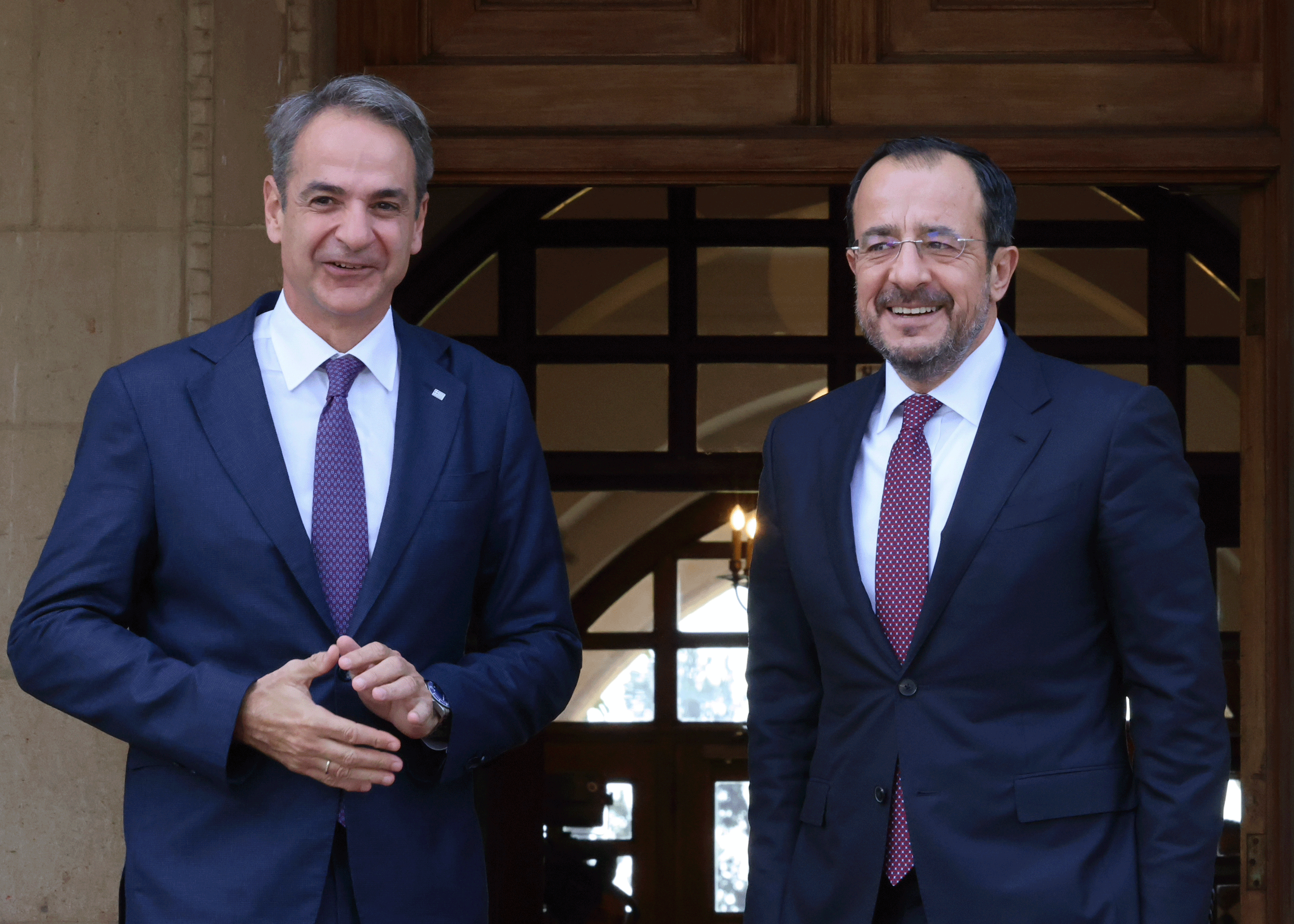
The governments of Greece and Cyprus have “essentially identical positions” on matters related to the European Union’s next multiannual financial framework, its long-term budget for the period covering the years between 2028 and 2034, Greek Prime Minister Kyriakos Mitsotakis said on Wednesday.
“Greece and Cyprus are coming to the discussions with essentially identical positions regarding the need to preserve the basic pillars of European policy, the common agricultural policy, the cohesion policy,” he said upon his arrival at Cyprus’ presidential palace for the day’s intergovernmental summit of the two countries.
On this front, he said that next year is an “extremely critical year for European developments”, especially the multiannual financial framework, with Greece set to hold the Council of the EU’s rotating presidency during the second half of next year, when negotiations could yet reach a crescendo.
Mitsotakis’ reference to cohesion funding and the common agricultural policy comes with some EU member states wishing to slash those sections of the budget so as to reallocate more funds to matters such as defence and competitiveness, with those states located in the continent’s north and west.
Christodoulides has remained ardent that the budget must be agreed before the end of this year, however, telling the Cyprus Mail last week that “that hard deadline of the end of this year is not moving”, despite suggestions from other European leaders that talks may go on into next year.
He stressed that French President Emmanuel Macron had been “very clear when he said that he will not negotiate after December, and that has not changed”.
Extraordinary European Council summit to be held next week
European Council President Antonio Costa has called an extraordinary summit to be held next week, with it expected that he will present a new budget proposal – the third so far for the next multiannual financial framework – this week.
After the extraordinary summit, the leaders of the EU’s 27 member states will convene in Brussels again on December 17 and 18, and Christodoulides last week said that Costa has made it clear that come what may, a budget must be agreed upon by the end of that summit at the absolute latest.
“He told us that when we meet in December, there is no leaving and there will be no Christmas until and unless we have the budget decided and ready. There is no question of negotiations going on into next year. It will not be accepted. The hard deadline for the budget to be devised is the end of this year,” he said.
Should an agreement not be reached by the end of this year, matters may go to the wire, with the next French president unlikely to take office in mid-May, and it is possible that the winning candidate there, should it be Marine Le Pen, could change the complexion of the negotiations and the overall political character of Europe.
Elections will take place in Poland in November at the latest, meaning there could then be a mad dash to the finish for those negotiations, particularly with the legislation which follows the agreement typically taking months to negotiate with the European Parliament, draft and ratify.
Mitsotakis: Cyprus’ Council of EU presidency was ‘extremely successful’
Away from the matter of the budget, Mitsotakis also made reference to artificial intelligence, which was one of the main topics of discussion at last week’s informal European Council summit in Dublin, and also spoke on the issue of civil protection mechanisms.
These mechanisms, he said, need to be bolstered “so that we can be even more shielded and ready to face any challenges arising from climate change”.
On to the matter of his own country’s forthcoming six-month term as the holder of the Council of the EU’s rotating presidency, he said that Greece can “draw lessons from the way Cyprus organised” its term, and described Cyprus’ own holding of the presidency, during the first half of this year, as “extremely successful”.


Click here to change your cookie preferences