
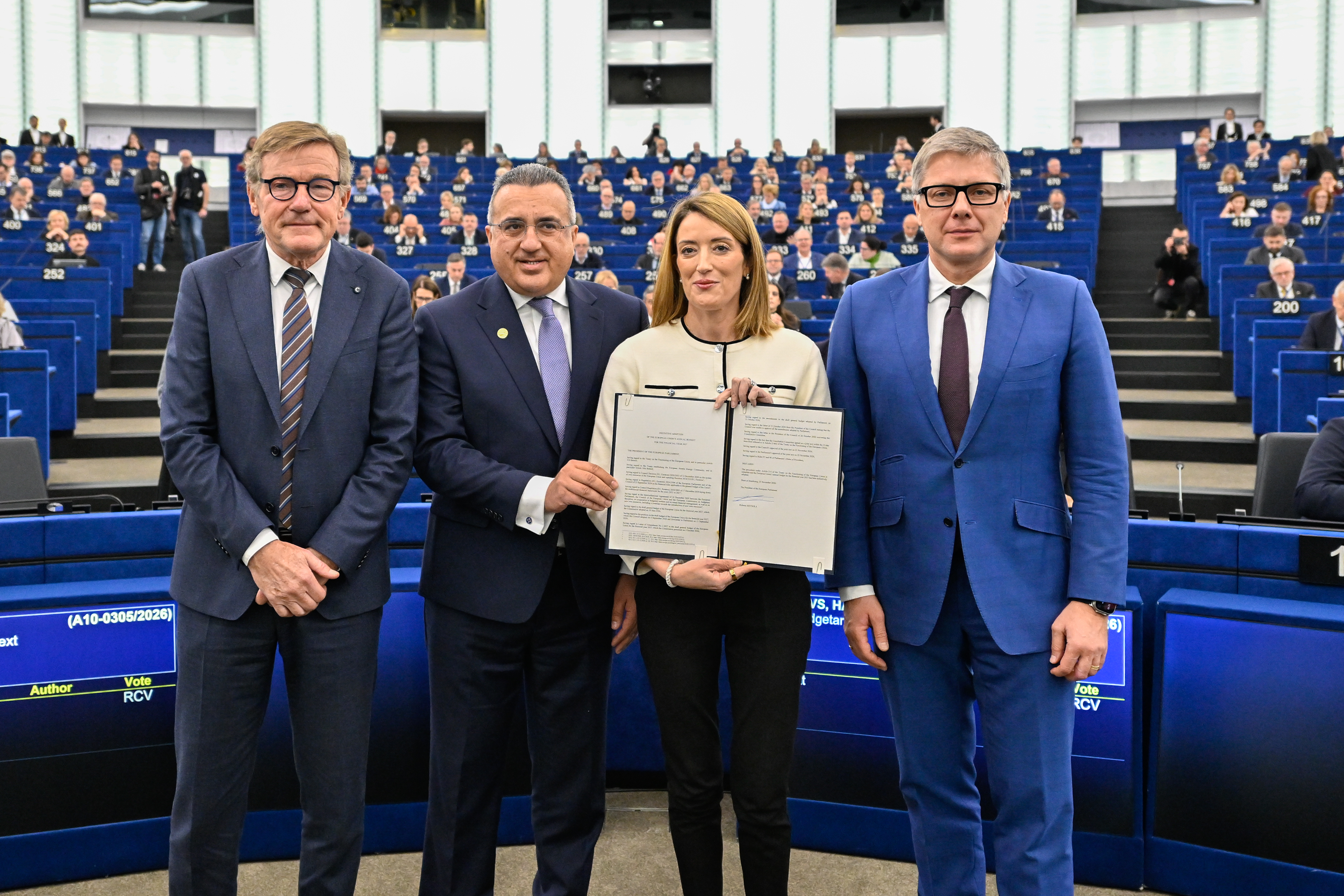
The European Union’s annual budget for next year was given its final approval by the European Parliament on Wednesday, with Cypriot MEP Michalis Hadjipantela of Disy, having been jointly responsible for the parliament’s position, alongside his Latvian co-rapporteur Nils Usakovs.
MEPs approved the budget by 406 votes to 184, with 69 abstentions, with three Cypriots – Hadjipantela, Diko’s Costas Mavrides, and Direct Democracy Cyprus leader Fidias Panayiotou – having voted in its favour, while Akel’s Giorgos Georgiou voted against, and Elam’s Geadis Geadi abstained.
Disy’s second MEP, Loucas Fourlas, was not present for proceedings, having only recently returned from an official European Parliament visit to Canada.
The budget foresees that the EU will make €199.7 billion worth of commitments and €211.5bn worth of actual payments over the course of the year, of which €193bn of commitments and €202.6bn will be made under headings linked to the multiannual financial framework, the EU’s long-term budget for the years between 2021 and next year.
As such, the final figure of expenditure is slightly smaller than Hadjipantela and Usakovs had jointly proposed to the parliament last month, which was at the time the largest proposal made.
This is largely because the final budget for “cohesion” projects, the word used to describe efforts to reduce regional inequality across the continent, is around €1bn smaller than Hadjipantela’s and Usakovs’ proposal, though that number was partially offset by increases to the European public administration budget, the cost of operating the EU itself.
With next year the final year of the current multiannual financial framework, the budget has left available €710.1 million of the originally allocated money, which the European Council on Monday said would “allow the EU to react to unforeseeable needs”, should they arise.
Hadjipantela: final stage of negotiations ‘particularly challenging’
Hadjipantela had told the Strasbourg plenary on Tuesday night that “the final stage of these negotiations was particularly challenging, but at the most decisive moment, early in the morning, responsibility prevailed”.
He added that “our institutions must … have the capacity to fulfil their responsibilities today, while preparing for the challenges that lie ahead in the future”, and that the challenges Europe faces are “real”.
“Europe faces a changing security environment, growing geopolitical uncertainty and rapid technological change. We must be able to protect our buildings, our people, our communications and our sensitive information. This will safeguard our independence and allow us to continue serving our citizens effectively,” he said,
‘When the agreement was at risk, we assumed responsibility’
On the budget negotiations themselves, he said that “when the agreement was at risk, we assumed responsibility and have steered the negotiations towards unity and a balanced outcome”.
“We can readily be proud of that approach. It shows that when we work together, we can find common ground and we deliver,” he said.
He described the budget as a “balanced compromise”, saying that he and Usakovs had “worked to ensure that the operational needs of our institutions are properly recognised and addressed”,
Usakovs, meanwhile, was less impressed, saying that next year’s budget will be “the smallest in recent history”, and said that while “one might think that this funding is enough to get by”, the budget “falls short of the level of ambition that our union should aim for, especially if we want to remain one of the world’s leading powers”.


Click here to change your cookie preferences