
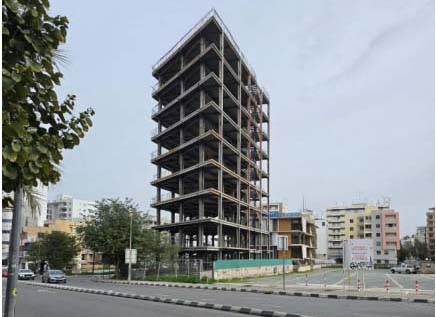
Liabilities involving local authorities and gaps in legislation have been identified by the Audit Office in relation to a building in Nicosia that has remained under construction for 14 years.
The building, located on Spyros Kyprianou avenue in the city centre, has raised concern, according to a report published on Thursday, as its owners have faced no financial or other consequences despite its long-term abandonment, which has become both an eyesore and a potential health risk.
In the report, auditor-general Andreas Papaconstantinou said the law must be enforced more decisively and authorities must take stronger action.
He stressed that, particularly in key areas such as city centres, local authorities and the state bear increased responsibility for inspection, aesthetics and safety.
Although the site is fenced off, access to the “dangerous building site” remains possible.
Papaconstantinou also noted that a dead body had previously been found at the site.
He added that the building is not an isolated case, with similar situations occurring elsewhere across Cyprus.
Taking a look at the history of the building, Papaconstantinou said there was a long period of permits, renewals of permits and derogations from approved blueprints, “without any substantive progress towards completing it”.
The first building permit was issued by Nicosia municipality on August 23, 2011.
The eight-storey development was designed to include a shop on the ground floor, two flats on the first and second floors, office spaces from the third to the seventh floor, and an underground carpark.
While efforts have been made to reactivate the project, “the result remains an unfinished building in the centre of the capital for more than a decade”, he said.
Papaconstantinou pointed out the impact of the situation.
“They are multiple and particularly serious since the image of the city is negatively affected, safety and public concerns are arising, there are phenomena of abandonment in the city centre and at the same time the impression of tolerance and absence of substantive supervision is cultivated,” he said.
The auditor-general added that an inadequate legislative framework could not serve as an excuse and that, in such cases, the Nicosia self-government organisation (EOA) “should demand additional tools to protect the city”.
The EOA recently stated that there was no intention to abandon the project, attributing delays to revisions required for the building to meet specifications, including fire safety standards.
It also notified the Audit Office that it was inspecting all inactive building sites and that the specific building was adequately fenced off.
However, the Audit Office said authorities had adopted a passive stance, “hoping that at some point the owners would secure the remaining permits and complete the building”.
This practice, it said, was based on the reasoning that “the financial cost of an investment to complete an unfinished development was smaller than the cost of demolition”.
The Audit Office pointed out that inspecting the fence could not be considered an adequate measure as the construction site was an eyesore that adversely affected the image of the city and posed a risk to public health.
Meanwhile, the Nicosia EOA said it would forward the report to the interior ministry, despite not being a legislative body, with the aim of preparing amendments to existing laws to equip local authorities with the necessary tools to prevent similar cases.
In a statement issued after the report’s publication, the EOA clarified that no derogations had been granted for the building, noting that the area permits both shops and cafeterias, and that any differences between planning permits were due to separate applications.
It added that the law provides clear procedures for renewing and reissuing permits and that, as long as a permit remains valid, the project cannot be classified as abandoned but rather as ongoing.
The EOA also said the owner had submitted an application to amend the building permit regarding the structure, and that renewing the permit was the appropriate course of action.





Click here to change your cookie preferences