

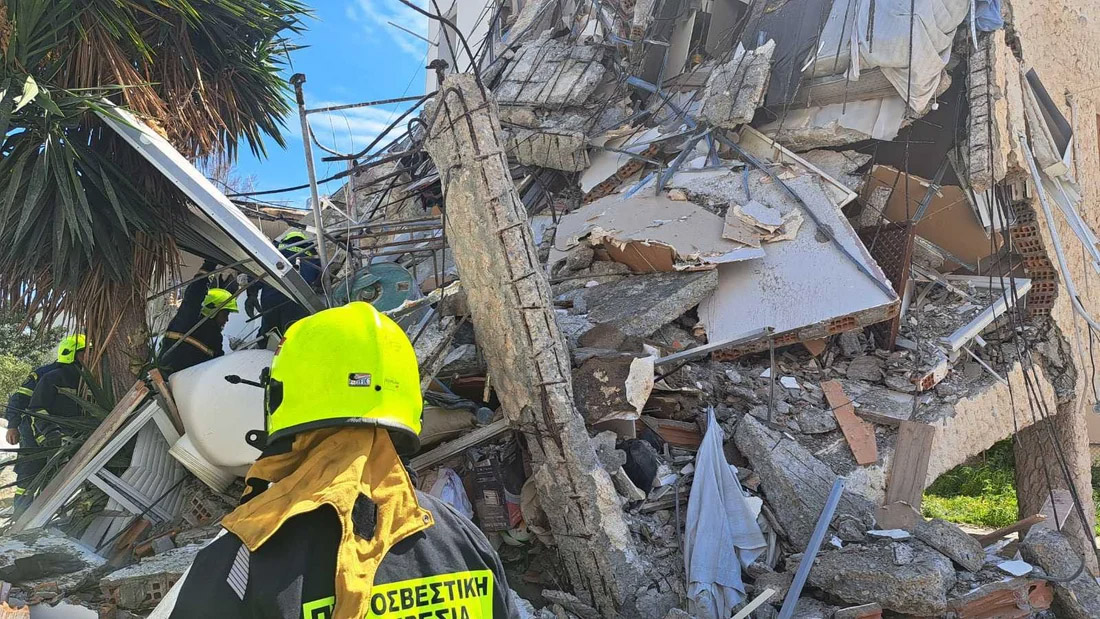
The interior ministry has moved to expediate public disclosure of unsafe structures on Wednesday, as authorities examined how to prevent further fatal tragedies after two people were killed when a residential building partially collapsed on Saturday.
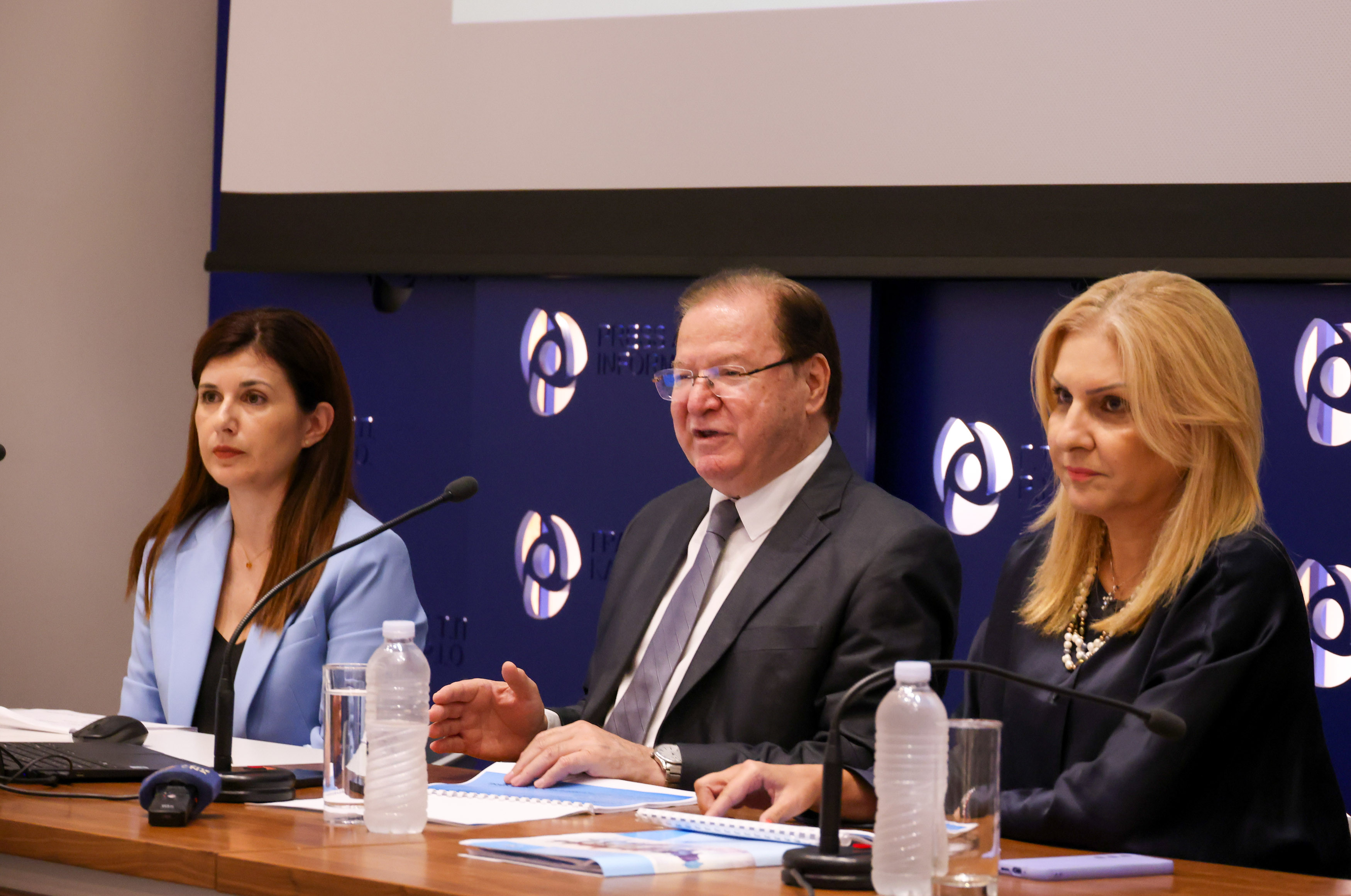
Interior Minister Constantinos Ioannou met with representatives of the technical chamber (Etek), district local government organisations (EOAs) and civil engineers to bolster the management of dangerous buildings, stating that the aim is to “effectively address this serious issue”.
Ioannou said efforts are focused on ensuring available tools are used fully, while legislative amendments are being advanced to strengthen oversight.
The building in Yermasoyia had been identified as dangerous years earlier, with warnings issued in 2017 advising repairs and the appointment of a civil engineer.
A further inspection in February 2026 resulted in its classification as dangerous in March, though it remains unclear whether notices were received or acted upon.
Authorities are now examining the publication of buildings deemed unsafe.
Ioannou said approximately 1,300 such cases have already been identified and must be prioritised based on risk.
He called on local authorities to act immediately, stating that they should “proceed immediately to publish the data on dangerous buildings” so that residents and tenants are informed.
He added that powers already exist “to prohibit the use of the building either for homeownership or for rental” until corrective measures are taken.
The proposal, tabled under the suggestion of Etek, includes the creation of a digital register to centralise information on dangerous buildings.
Until such a system is implemented, Ioannou urged the local government administrations (EOAs) to publicly release available data without delay, stating that this would “enhance their protection and safety” by increasing public awareness.
Etek’s president, Constantinos Constanti, stressed that authorities must prioritise transparency and enforcement.
He called for the immediate establishment of a public register, to “create an electronic platform, post them, so that people know what these buildings are” and added that buildings should be categorised and clearly marked.
He said residents must be informed where a structure “remains dangerous” and that authorities should enforce evacuation or sealing them off where required.
Ioannou referred to legislative amendments promoted last March to strengthen enforcement mechanisms.
These include provisions for demolition, sealing of unsafe buildings and more immediate removal of occupants.
He said the objective is to secure the rapid passage of these measures alongside legislation on jointly owned buildings, which would establish “a stricter surveillance framework” aimed at reducing risks to public safety.
Pending legislative changes, authorities have been instructed to apply existing provisions under the roads and buildings law.
Ioannou said a unified procedure was introduced in March to ensure consistency in how dangerous buildings are managed, outlining the steps local authorities must follow.
He emphasised that “the responsibility lies primarily with the owners” while authorities retain the power to intervene and recover costs where necessary.
To support enforcement, the government has allocated €2 million over a two-year period to district EOAs.
The funding allows authorities to take direct action in cases where owners fail to address risks.
Ioannou said funds can be accessed after following the established procedure, while emergency interventions may proceed immediately where there is imminent danger.
He acknowledged that recovering costs from owners can be time consuming but said the allocation is intended to address financial constraints.
Available data indicates that the issue extends beyond the currently identified cases.
More than 270,000 buildings in Cyprus are over 25 years old, including 114,000 built before 1981.
Estimates suggest between 1,200 and 2,000 structures may be considered dangerous, though officials admit that the absence of a centralised inspection system limits accuracy.
Inspections of 358 refugee housing blocks found that 43 require demolition and 70 require significant repairs.
Engineers attribute the deterioration of buildings to age, environmental exposure and insufficient maintenance.
Coastal conditions are known to accelerate corrosion in reinforced concrete, while construction practices in earlier decades have contributed to long term structural weaknesses.
Following the Turkish invasion of 1974, shortages of materials led to the use of untreated aggregates such as beach sand in some cases, introducing salt into concrete and thus accelerating degradation.
Many buildings also predate anti seismic regulations introduced in 1994, and mandatory construction supervision implemented in 1999.
Constanti said the current situation reflects broader systemic issues.
He stated that “dangerous buildings have already been identified but without the necessary measures being taken in time” and added that authorities have often acted only after incidents occur, remarking that “the state consistently reacts after the fact”.
He called for coordinated action across all responsible bodies to address the risks.
House interior committee chairman, Aristos Damianou, said the priority must be the enforcement of existing legislation.
He stated that “what we demand is the implementation of legislation” and criticised attempts to shift responsibility, saying it is “regrettable that those tasked with implementing legislation are trying to shift their responsibilities elsewhere”.
Damianou further underlined that the committee has examined building safety in nine separate cases since 2023 and has repeatedly raised concerns with relevant authorities.
He emphasised that existing laws already provide extensive powers, describing them as “draconian” and capable of covering measures ranging from eviction to demolition with police support.
“Updating legislation can never be an alibi for inadequacy”.
Ioannou said some organisations have already assigned private inspectors while others have not, and confirmed that information has been requested on actions taken.
He said “enough has been done” but acknowledged that further action is required, stressing the need for full utilisation of existing tools.
Displaced residents from the collapsed building remain in temporary accommodation as authorities work towards longer term arrangements.
The police investigation into the collapse is ongoing, with evidence being examined and findings to be submitted to the legal service.




Click here to change your cookie preferences