
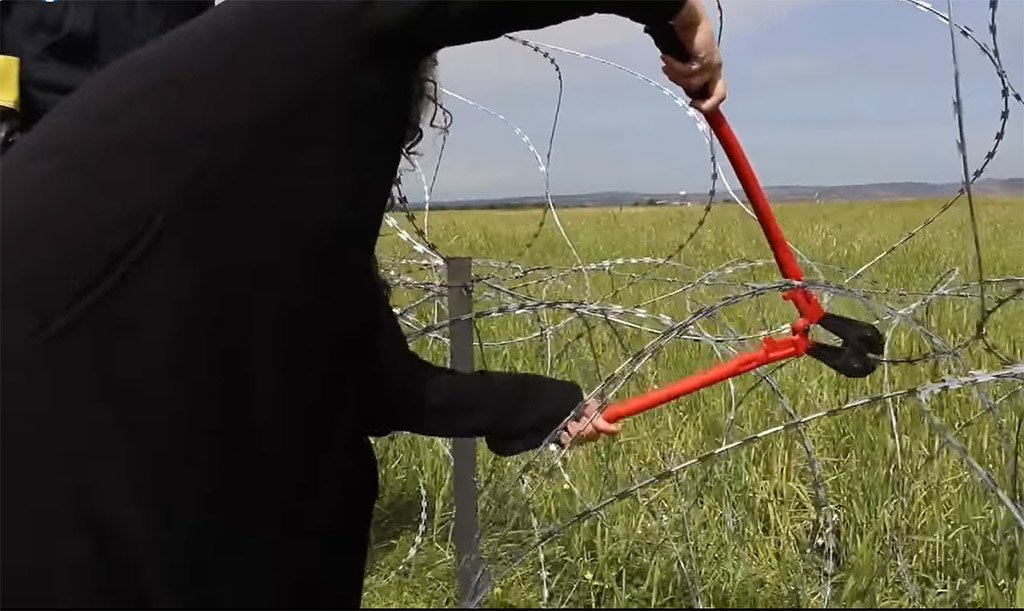
Cyprus has significantly strengthened surveillance along the Green Line with modern monitoring systems, while much of the barbed wire previously installed along the buffer zone has now been removed.
Speaking to the Cyprus News Agency, officials said on Thursday that the defence ministry and the police, through the national guard general staff, have upgraded surveillance capabilities over the past three years using cameras and other audiovisual equipment positioned at selected points along the ceasefire line.
“We have various audiovisual means, cameras and other equipment at specific points, and surveillance is continuous and on a 24-hour basis,” sources said.
“When anything is detected, liaison officers communicate with each other about next steps and how to act.”
The sources said the National Guard works in close coordination with the United Nations Peacekeeping Force in Cyprus (Unficyp).
Most of the barbed wire installed in previous years has now been dismantled, except in limited areas where terrain conditions such as ravines or difficult ground prevent its removal.
“We have upgraded and we are trying to make monitoring effective and immediate. Many things are not publicised for obvious reasons,” the sources added.
Particular attention remains focused on areas considered difficult to supervise fully.
Officials said the village of Pyla operates under a special regime because it is monitored directly by the UN and has no formal checkpoint.
Other areas near Avlona were also described as challenging because of the terrain.
The Green Line extends approximately 180 kilometres across Cyprus.
The line was first drawn on 30 December 1963 by British commander General Peter Young using a green pencil during intercommunal violence on the island which resulted in the capital being split between Turkish Cypriots in the north and Greek Cypriots in the south of the old walls of Nicosia.
The original divide was then expanded significantly after Turkish invasion forces conjoined the pre-existing partition with their own island wide demarcation line in 1974.
Around 802 UN soldiers currently serve with the mission on rotation, mainly from Argentina, the United Kingdom, Slovakia and Hungary.
Unficyp’s military structure is divided into Sectors 1, 2 and 4.
Sector 1 stretches from Kokkina to Mammari and is managed by Argentine forces.
Sector 2, overseen by British forces, covers the area from Mammari to Kaimakli.
Sector 4, under Slovak command since 2018, extends from Kaimakli to Deryneia.
Officials said approximately 1,000 incidents are recorded in the buffer zone each year.





Click here to change your cookie preferences