
By Joanna Christodoulides
It is no secret that Turkey is an important partner to the EU – or what Brussels would call a “strategic” partner. As crises multiply and the EU faces an increasingly volatile geopolitical environment, from security and defence to migration and regional instability, it can scarcely afford to ignore a neighbour as important as Turkey.
This reality has not been lost on EU leaders, who, after years of strained relations with their eastern neighbour, expressed a renewed commitment to strengthening their relationship with Ankara, in the margins of July’s Nato summit.
As Russia’s invasion of Ukraine continues to threaten Europe’s security and the transatlantic alliance has become increasingly unpredictable, Turkey has emerged as one of Nato’s most influential members and an important security and defence player for Europe.
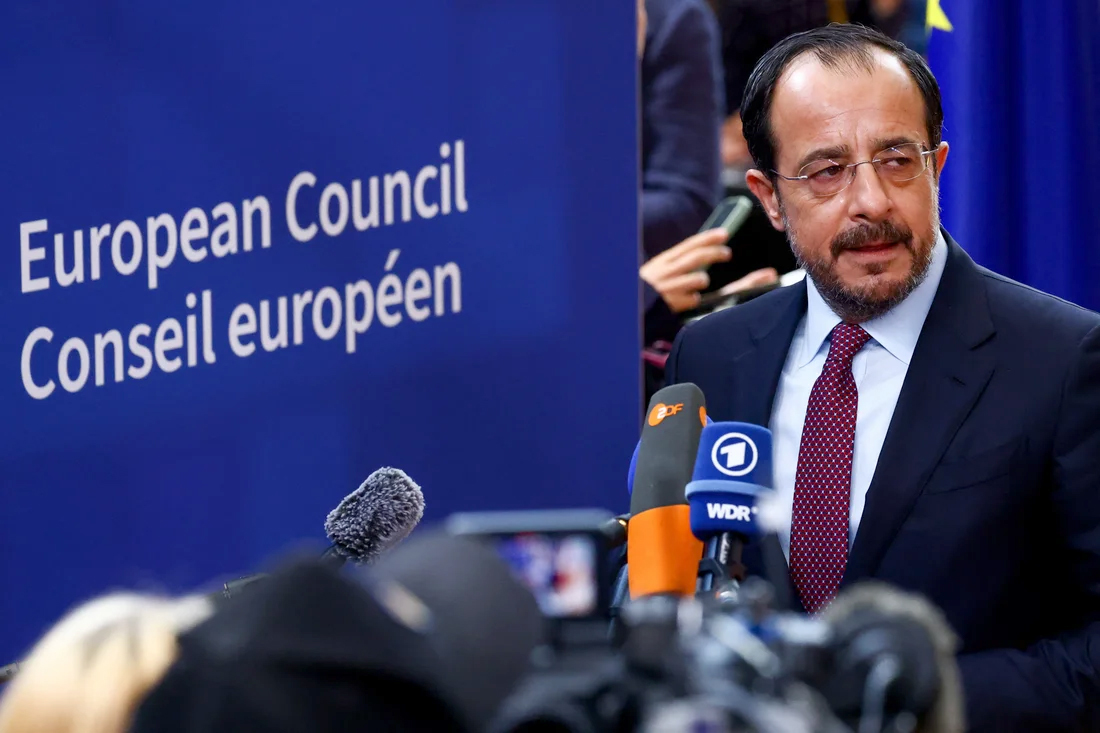
So, when at last month’s European Council, President Nikos Christodoulides announced plans for a meeting “at the highest level” between the EU and Turkey, intended to discuss the way forward for the Cyprus problem alongside potential progress for EU-Turkey relations, one has to ask: could the EU’s growing strategic interest in Turkey offer a new opportunity to break the longstanding deadlock on Cyprus?
The prospect of such a meeting has been framed as a diplomatic achievement for Nicosia, which has been pushing for more active EU involvement in the Cyprus problem.
The Cypriot government’s position is clear. Progress in EU-Turkey relations should be conditional on the resumption of negotiations under the agreed UN framework.
A major win for Nicosia came with the April 2024 European Council conclusions, which attached particular importance to progress on the Cyprus problem in further strengthening EU-Turkey relations, welcomed by President Christodoulides as a “substantive interconnection” between the two issues.
Ankara’s response was unequivocal. “The Cypriot connection to progress in Turkey-EU relations will never be accepted by us,” declared Turkey’s foreign ministry.
Geopolitical realities, however, risk undermining political commitments.
Is it realistic to expect the EU and its member states – many of them also members of Nato with close ties to Ankara – to put a deeper partnership with Turkey on hold over the unresolved Cyprus problem, particularly at a time when Turkey is emerging as an increasingly important security and defence partner?
Recent developments suggest otherwise.
EU-Turkey cooperation has advanced in certain areas without corresponding progress on the Cyprus problem. In June, the European Investment Bank resumed financing operations in Turkey, while earlier this month, the EU and Turkey reaffirmed their interest in strengthening economic ties at the High-Level Dialogue on Trade.
And this is not to mention the growing bilateral defence ties between Ankara and several EU member states.
Having spent some time in Brussels, I was often confronted with a ‘here we go again’ attitude from colleagues when discussions turned to Turkey. I specifically recall one EU diplomat lamenting that Cyprus has a “one-sided foreign policy” – one confined to Turkey.
Granted, Cyprus sought to challenge this perception during its Presidency of the Council of the EU, seeking to leverage its geographical position and close ties with the Middle East and Gulf to demonstrate that even one of the EU’s smallest member states has something to bring to the table.
When it comes to Turkey, however, Cyprus’ position is unlikely to change, much to the frustration of some of its European partners.
Nevertheless, recent developments may offer the much-needed diplomatic momentum to break the impasse.
Back in July, EU leaders called on Turkish President Recep Tayyip Erdogan to “seize the renewed momentum” towards a solution to the Cyprus problem. And, according to Nicosia, the appointment of a European Commission envoy for Cyprus demonstrated Brussels’ commitment to playing a more active role.
The EU’s desired rapprochement with Turkey could present an opportunity to engage more actively with Ankara on the Cyprus problem.
But much will depend on whether Brussels is prepared to explicitly use areas of cooperation that Turkey values as leverage, even as Ankara’s strategic importance to Europe – and with it, its political capital – continues to grow.
Moving from political commitments to meaningful progress on the Cyprus problem, however, requires greater clarity about what progress means in practice.
Would a return to the negotiating table alone suffice? Would Ankara need to commit to negotiating within the agreed UN framework, or demonstrate a willingness to engage substantively on outstanding issues before the EU agrees to deepen cooperation?
So far, this remains unclear.
Declarations of genuine political will and “constructive” meetings have become familiar. But without such clarity, securing a political linkage risks remaining a diplomatic achievement in itself, rather than a means of achieving tangible progress.
The updating of the EU-Turkey customs union has long been a point of contention, despite the economic interests at stake for both sides, while Turkey’s interest in participating in the EU’s SAFE defence programme presents another potential source of leverage, one that Nicosia has explicitly linked to progress on the Cyprus problem.
Whether these incentives are sufficiently attractive to persuade Ankara to reconsider its position, however, remains to be seen, particularly given that Turkey continues to insist on a two-state solution and accuses Nicosia of blocking progress on issues it claims are important to other EU member states.
The proposed meeting may therefore provide an opportunity to test whether the EU’s renewed engagement with Turkey can translate into meaningful progress on Cyprus. But this also hinges on what the Cypriot government would accept as ‘meaningful’ to justify closer EU-Turkey cooperation, and how far EU member states are prepared to accommodate Nicosia’s demands.
Yet the very geopolitical circumstances that have brought Brussels and Ankara closer together may also make the EU more reluctant to make that cooperation dependent on progress towards a settlement.
At a time when the UN has warned that the window of opportunity is “closing”, the need for more than just another round of diplomatic declarations is even more pressing.
Joanna Christodoulides holds a postgraduate degree in European Affairs and Public Policy from Sciences Po Paris and the London School of Economics (LSE). She has worked across EU institutions and international organisations, most recently supporting Cyprus’ Presidency of the Council of the EU in Geneva


Click here to change your cookie preferences