
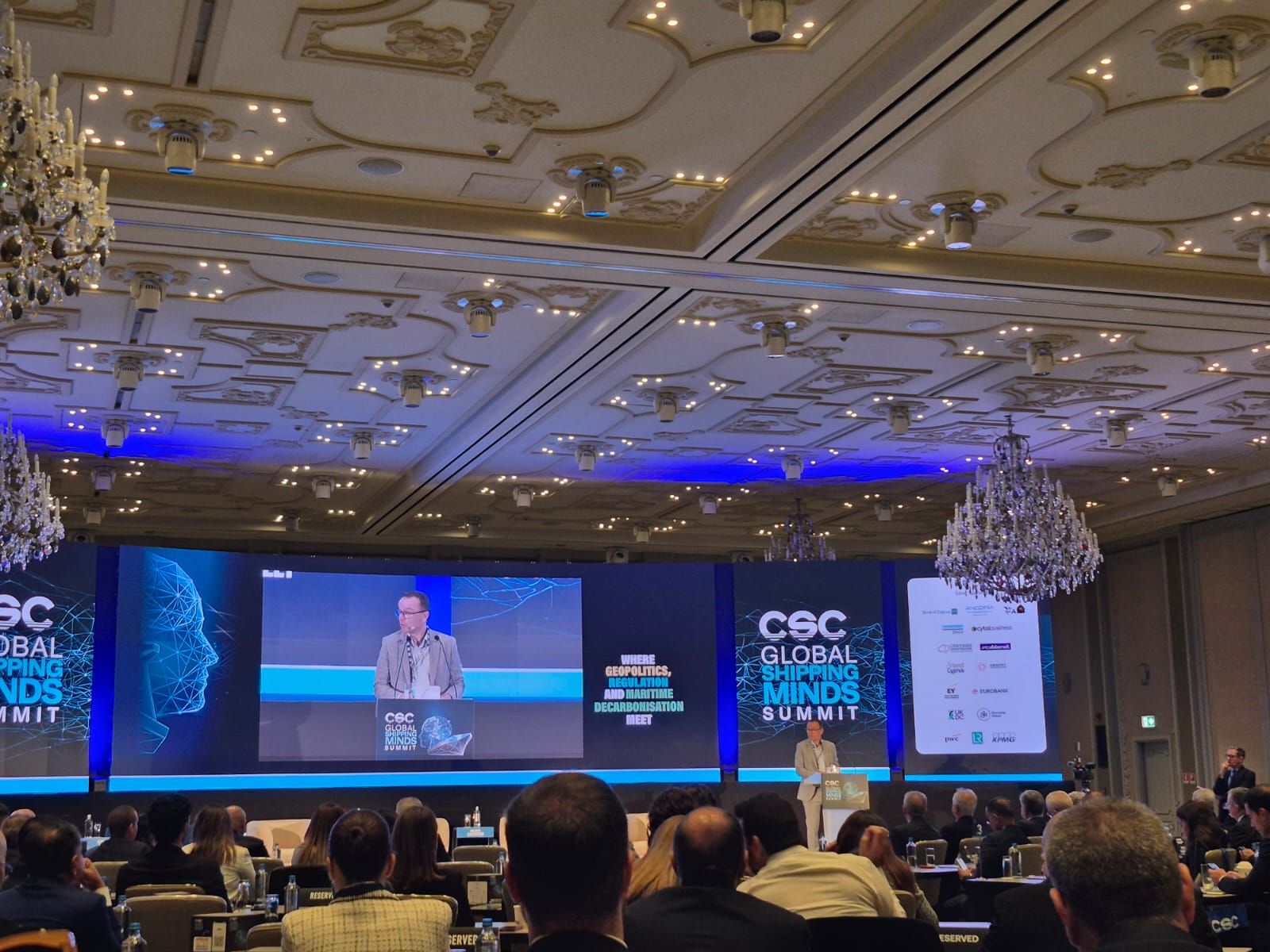
Geopolitical tensions and concerns over energy security could strengthen the business case for investment in cleaner shipping fuels rather than derail the industry’s decarbonisation efforts, Cargill Ocean Transportation president Jan Dieleman said on Friday, pointing to China’s growing role in the development of green shipping corridors.
Speaking at the inaugural Global Shipping Minds Summit in Limassol, organised by the Cyprus Shipping Chamber (CSC), Dieleman warned that the immediate challenges facing the maritime industry should not be mistaken for a loss of the long-term need to decarbonise.
Dieleman, who also chairs the Global Maritime Forum (GMF), recalled his previous visit to Cyprus in October 2023, when discussions at the same venue had centred on how and when the shipping industry would reduce its carbon footprint.
Three years later, he said, the conversation had changed considerably, with geopolitical disruptions and immediate security concerns moving to the top of the industry’s agenda.
Disruptions that had benefited certain shipping markets had also increased emissions, he explained, questioning how little attention was now being paid to that consequence.
Climate change, however, had not disappeared simply because other concerns had become more pressing.
Dieleman referred to extreme weather events and their consequences for agricultural production, drawing on the experience of Cargill, a company with 160 years of history in agriculture, which is itself having to contend with increasingly difficult environmental conditions.
During a crisis, he explained, governments and businesses tend to focus on what is immediately available and what can keep operations running reliably.
Although this can slow climate action, the same concerns can encourage countries and companies to reduce their dependence on external energy supplies and seek alternatives.
That, in turn, creates opportunities for investment in different fuels and more efficient systems, “even when the climate goals aren’t the immediate motivation”, he said.
“The transition may not move in a straight line,” Dieleman added, arguing that progress could continue in areas where it might not previously have been expected.
Drawing on discussions at the Global Maritime Forum’s annual gathering in Shanghai, he said energy security and maritime decarbonisation did not necessarily have to work against each other.
Dependence on a limited range of fuels or suppliers creates risks at a time when energy supplies and trade routes can be disrupted, he explained.
Diversifying energy sources could therefore strengthen the resilience of the shipping industry while creating a stronger economic case for lower-emission fuels.
Dieleman identified China as a particularly important example of how these two objectives could be pursued simultaneously, referring to the country’s five-year economic planning and its investment in alternative energy and fuels.
He also pointed to the rapid development of green shipping corridors, referring to maritime routes where ports, shipping companies, fuel suppliers and other businesses work together to facilitate the use of lower-emission technologies and fuels.
According to figures cited by Dieleman, China’s involvement in such corridors had grown from two announced in 2022 to around 20, illustrating how quickly parts of the maritime energy transition were developing.
The Global Maritime Forum, he said, had identified progress in fuel technology, cooperation across the maritime value chain and policy development, although customer demand still needed to catch up.
As an example of how the industry was moving beyond pilot projects, Dieleman referred to the delivery of more than 8,000 tonnes of domestically produced biomethanol to Shanghai in August.
The operation brought together fuel production, transportation, port infrastructure and bunkering, alongside vessels capable of using the fuel.
For Dieleman, this was an illustration of what it takes to move beyond promising technologies and one-off demonstrations.
Commercial deployment, he explained, requires coordination across the entire value chain, as well as customers willing to use the fuel.
Partnerships between companies prepared to invest early could make such developments possible, but a global regulatory framework remained necessary to give the wider industry the confidence to commit capital and turn individual initiatives into broader commercial progress.
Turning to regulation, Dieleman said “the question was no longer whether shipping would face additional environmental requirements, but whether governments could agree on a coordinated global framework or leave the industry operating under a patchwork of regional regimes.”
His remarks come just days before the International Maritime Organisation’s (IMO) Marine Environment Protection Committee (MEPC 85) meets in London from November 30 to December 4, with the future of maritime emissions regulation once again on the agenda.
A global approach through the IMO, Dieleman said, would give the industry a common direction, adding that it needed to be “both ambitious and pragmatic”.
The industry should continue working towards a global agreement, he added, while also preparing for less favourable regulatory outcomes.
For shipping companies making investment decisions today, Dieleman said, the underlying need to decarbonise had not changed, while concerns over energy security could actually strengthen the commercial justification for some of those investments.
He called on the industry to pursue both objectives together through the IMO, rather than allow the difficulties of the present moment to determine the long-term direction of maritime decarbonisation.





Click here to change your cookie preferences