
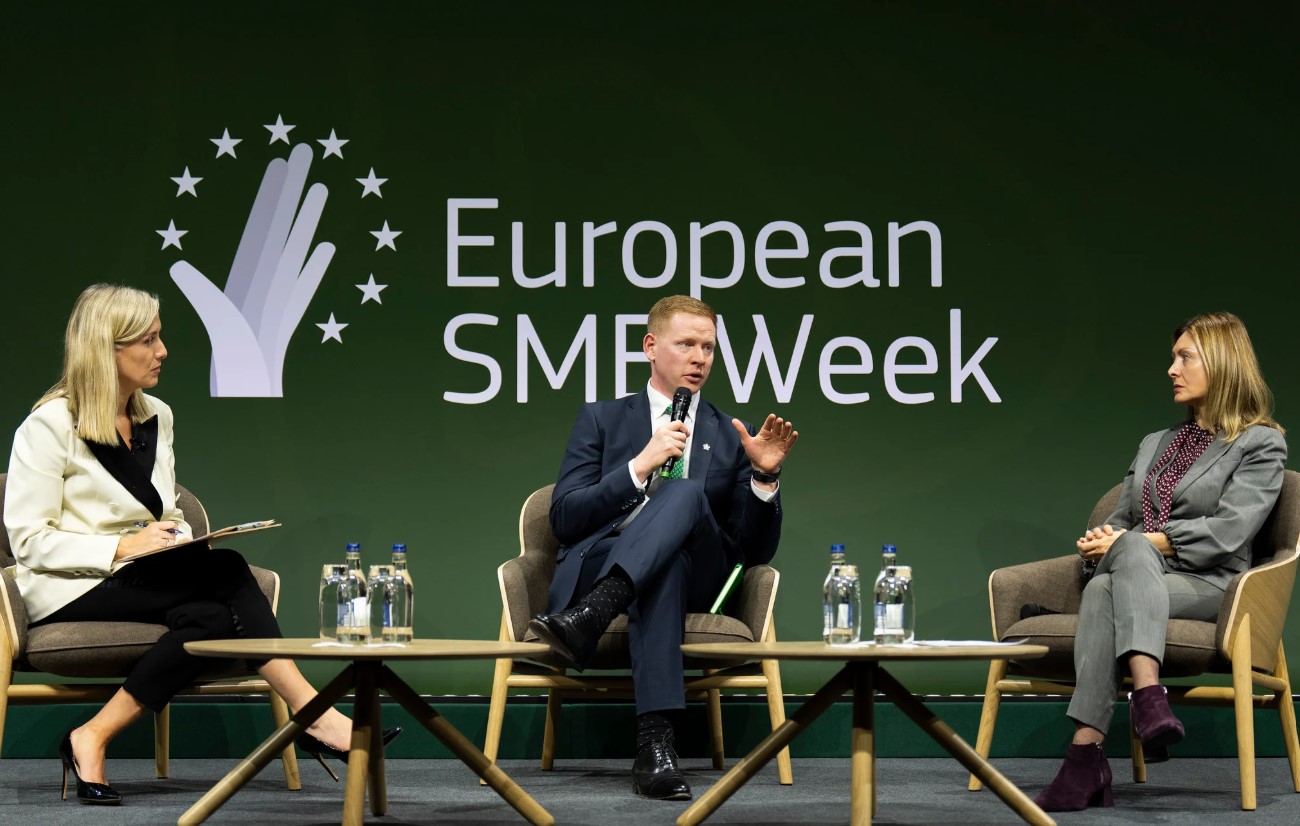
For Cyprus and the rest of Europe’s small businesses, the message from Dublin this week was refreshingly simple. Less paperwork, better access to finance and a European market that actually works as one, rather than 27 different versions of the same thing.
After three days of discussions, the SME and Clusters Assembly 2026 concluded this week with a familiar complaint and a rather more pressing demand. Brussels has spent years promising to make life easier for smaller businesses. It is time those businesses started seeing the difference.
Held from November 2 to 4, the gathering brought together 559 participants from 40 countries, including entrepreneurs, investors, policymakers, cluster managers and business support organisations.
Organised by the European Commission and the Irish Presidency of the Council of the European Union, the event formed the centrepiece of European SME Week, under the theme ‘Connecting for a Competitive Europe’.
This year’s edition was also something of a first, bringing the European Cluster Conference and SME Assembly together under one roof, reflecting the growing importance of collaboration in strengthening Europe’s competitiveness, economic resilience and strategic autonomy.
For Cyprus, where smaller enterprises account for the overwhelming majority of businesses, the discussions were particularly relevant. Whether it is securing funding, finding skilled employees, adopting new technology or expanding into European markets, many of the difficulties raised in Dublin will be familiar to Cypriot entrepreneurs.
The biggest frustration, however, was one shared across the continent. Too much bureaucracy and too little practical progress.
Presenting the conference’s policy conclusions, Anna Athanasopoulou, director for simplification and networks at the European Commission’s DG GROW, Ross Church, Ireland’s SME Envoy, and Sandra Parthie, president of the Employers’ Group at the European Economic and Social Committee, brought together the main demands emerging from the discussions.
Delegates identified two immediate priorities. The first was to remove outdated or unnecessary legislation before introducing additional requirements. The second was to create a more coherent European regulatory framework, preventing companies from having to contend with different interpretations of EU rules across member states.
The European Commission has already put forward 12 omnibus simplification proposals, alongside a commitment to reduce recurring administrative costs for SMEs by 35 per cent by 2029.
The difficulty, speakers argued, is that the promised simplification has not sufficiently reached businesses themselves.
For a small company with limited staff and resources, spending less time dealing with regulations and administrative procedures can make a considerable difference to its ability to invest and grow.
This was why delegates repeatedly returned to the principle of “think smallest first”, calling for European legislation to be designed with smaller enterprises in mind from the outset, rather than expecting them to adapt to rules developed around the capabilities of much larger organisations.
But the responsibility does not stop in Brussels. National governments and regional authorities were also urged to tackle gold-plating, the practice of adding extra domestic requirements when implementing European legislation.
Such additions can leave businesses facing greater costs and complexity than the original European rules require.
The Commission is supporting calls for a pact against gold-plating, accompanied by a toolkit for member states that includes an AI-enabled detector to identify unnecessary additional requirements.
Ireland offered an example of what can be achieved without waiting for sweeping legislative reform.
By reviewing its Local Enterprise Office grant application procedures, the country managed to reduce the number of questions on some forms by as much as 47 per cent.
It was a practical illustration of the wider point being made throughout the conference. Simplification does not always require another grand European initiative. Sometimes it begins with making an existing process considerably less complicated.
The other major concern was money.
Europe continues to produce innovative start-ups, but turning promising ideas into successful international businesses remains a challenge.
Discussions examined the difficulties companies face when looking for risk capital and late-stage investment, particularly when they reach the point of expanding beyond their original markets.
Delegates called for better access to equity financing, stronger investment networks and more predictable, long-term support to help European businesses grow without having to seek opportunities elsewhere.
The proposed European Competitiveness Fund, included in plans for the EU’s next long-term budget, was presented as one potential way to reduce investment risks and help bring innovation to market more quickly.
The underlying concern was that Europe should not merely be a good place to start a business. It should also be somewhere that business can grow into an international success.
For Cyprus, the distinction matters. Attracting start-ups and international technology companies is one part of developing a stronger business environment. Helping locally established businesses secure finance, develop expertise and reach customers beyond the island is equally important.
Technology was another subject that exposed the differences between smaller companies and their larger competitors.
According to figures highlighted during the assembly, only 17 per cent of SMEs use artificial intelligence, compared with 55 per cent of large companies.
The gap reflects the difficulties smaller businesses face in finding the financial resources, specialist knowledge and employees needed to introduce new technologies.
Speakers called for faster digital public services, better training and more accessible support to help SMEs put AI to practical use.
The debate was not simply about encouraging companies to experiment with technology. It was about helping them use it to improve productivity, reduce costs and remain competitive.
Skills shortages formed part of the same discussion, with businesses calling for stronger cross-border cooperation and better access to the expertise required by increasingly digital industries.
This brought the debate back to the importance of business clusters, which received greater prominence than ever before at this year’s assembly.
Clusters bring together businesses, research institutions, universities and other organisations, allowing them to share knowledge, develop partnerships and gain access to resources that individual companies might struggle to secure.
Their economic value was reflected in figures presented at the event, which showed that cluster productivity is estimated to be 25 per cent above the EU average.
SMEs operating within clusters also tend to grow faster and find it easier to access finance.
For smaller European economies, including Cyprus, these networks can open doors to international partnerships, research projects and supply chains that would otherwise be difficult to enter.
The discussions therefore went beyond simply encouraging companies to work together.
Dedicated sessions examined sustainable cluster business models, investment opportunities, cross-border skills development and the role of stronger industrial networks in helping Europe withstand economic and geopolitical disruption.
With supply chains facing greater uncertainty and businesses under pressure from rising costs, participants considered how cooperation could support both competitiveness and strategic autonomy.
A workshop also explored opportunities arising from the EU’s trade agreements with Mercosur, Mexico and India, examining how smaller businesses and clusters could use international trade relationships to reach new customers and establish partnerships.
On the final morning, a dedicated matchmaking event gave cluster organisations the opportunity to meet potential partners and discuss future cooperation.
The gathering also considered the broader economic pressures facing smaller companies, from late payments and regulatory complexity to the rising cost of operating a business.
Opened by Peter Burke, Ireland’s Minister for Enterprise, Tourism and Employment, and Outi Slotboom, director for supply chains and business analysis at the European Commission, the programme included more than twenty sessions covering the Single Market, investment, innovation, sustainability, digital transformation and European competitiveness.
Beyond the policy discussions, there was also room to question what innovation should actually achieve.
On Tuesday evening, Professor Johanna Mair, director of the School of Transnational Governance at the European University Institute, delivered the annual Schumpeter ‘Innovation in Enterprise’ Lecture at Dublin Castle.
Speaking under the title ‘From Creative Destruction to Creative Reconstruction’, Mair challenged the tendency to celebrate disruption simply because it represents something new.
Her central argument was that Europe must develop the collective capacity to shape change together, ensuring innovation produces lasting improvements for businesses, institutions and society.
The lecture was followed by the European SME Week Reception.
The assembly also gave Europe’s next generation of entrepreneurs an opportunity to present their ideas.
Three young founders pitched their start-up projects live during the Youth Start-Up Challenge, with Maximilian Zimmermann of StepSafer receiving an exclusive invitation to the European Innovation Council Summit 2027 in Brussels.
The opportunity will allow him to connect with investors, innovators and European business networks.
The conference’s conclusions will now feed into the work of the European institutions and the Network of SME Envoys, which plays a role in representing smaller businesses and shaping SME policy under the Small Business Act.
They will also contribute to discussions at the first EU for Business Forum, scheduled to take place in Brussels from November 17 to 19, 2027.
As the assembly drew to a close, the common thread running through the discussions was not a shortage of European ambitions, proposals or strategies.
It was the need to turn them into something that businesses can actually use.
For Cyprus, this means a European Single Market that is easier to access, financing that supports companies beyond their early stages, and business networks capable of connecting local expertise with opportunities across the continent.
The next test will be whether European institutions, national governments and regional authorities can work together to deliver the changes discussed in Dublin.



Click here to change your cookie preferences