
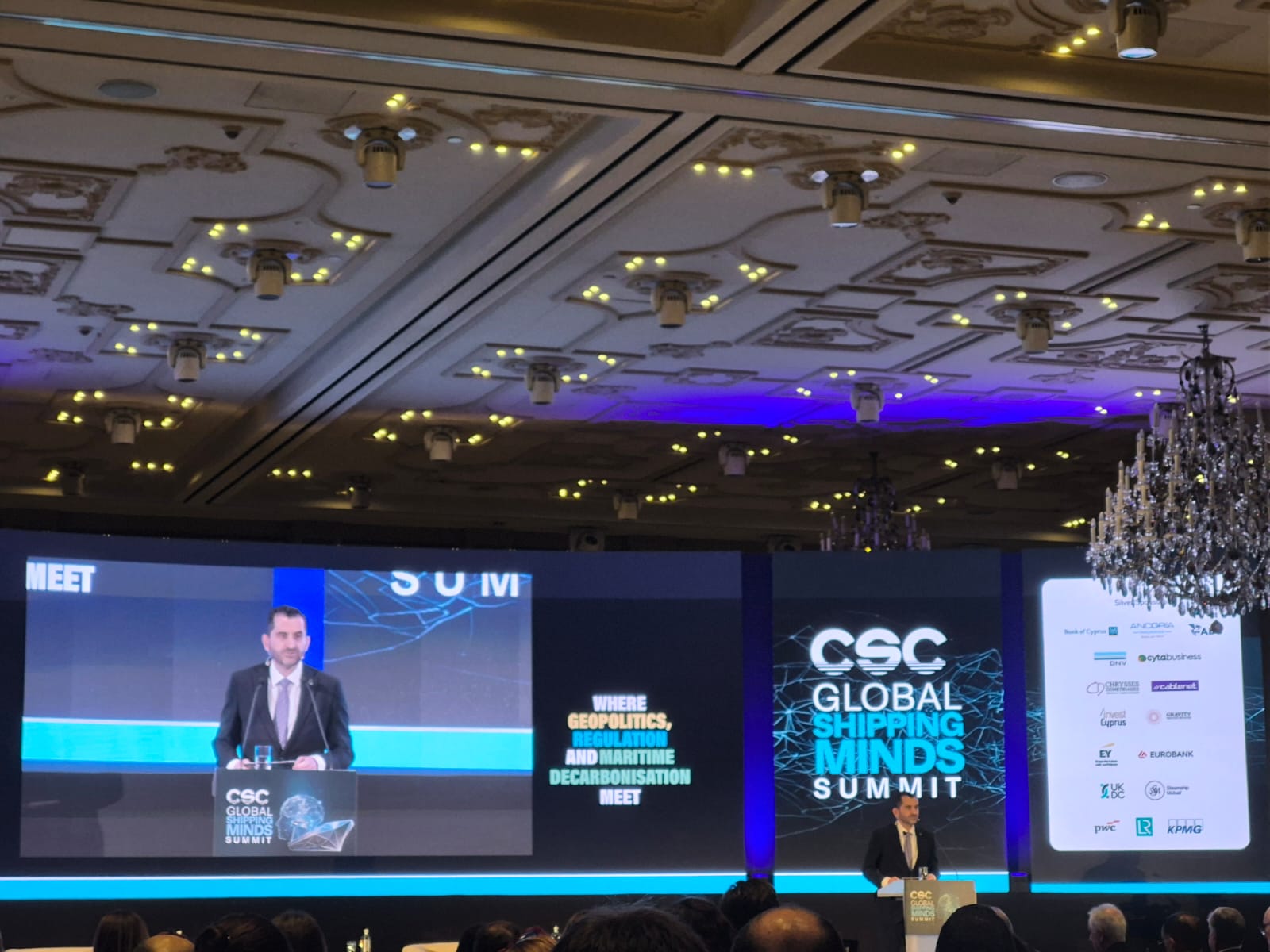
Cyprus’ shipping industry has earned international recognition not simply for raising concerns over maritime regulation but for offering solutions, International Chamber of Shipping (ICS) secretary-general Thomas Kazakos said on Friday, stressing the need for global cooperation as the industry confronts geopolitical uncertainty, energy security and decarbonisation.
Speaking at the inaugural Global Shipping Minds Summit in Limassol, organised by the Cyprus Shipping Chamber (CSC), Kazakos said the event brought together some of the most influential voices in international shipping at a particularly critical time for the industry.
The summit comes just days before further discussions at the International Maritime Organisation (IMO) in London, where governments will continue negotiations on measures to reduce greenhouse gas emissions from ships.
Kazakos identified energy security, the transition to sustainable shipping fuels, geopolitical uncertainty and the changing dynamics of global trade as defining issues for the maritime industry that require international cooperation.
The purpose of the Limassol gathering, he said, was to “exchange perspectives, challenge conventional thinking” and explore solutions for an industry that remains essential to the global economy.
Returning to Cyprus after more than a year at the London-based organisation, Kazakos also spoke about the international standing of the island’s shipping community and its contribution to maritime policymaking.
The ICS, he explained, brings together 42 national shipowners’ associations, collectively representing more than 80 per cent of the world’s merchant fleet.
Among them is the Cyprus Shipping Chamber, which has represented the island’s shipping industry internationally for 36 years.
Kazakos said his experience working in London had reinforced his appreciation of the recognition and respect the Cypriot organisation enjoys internationally.
The chamber, he explained, has frequently been among the first organisations to raise concerns when regulatory proposals require improvement, but equally among the first to contribute suggestions and solutions.
Turning to maritime decarbonisation during the subsequent discussion, Kazakos reiterated the industry’s commitment to achieving the emissions objectives set by the IMO, while calling for practical and realistic implementation.
Alternative fuels, he said, must be available and affordable, with emissions reductions measurable and the transition implemented progressively.
Kazakos also addressed the uncertainty surrounding regional environmental regulations, referring to the absence of a clear commitment from the European Commission to replace regional measures once a global agreement is achieved.
He called for the industry’s concerns to be conveyed to London, where the forthcoming negotiations will bring together governments with differing economic, energy and geopolitical interests.
Addressing the presence of representatives of Cyprus’ Shipping Deputy Ministry at the summit, Kazakos urged policymakers to listen to the experience of companies operating globally when considering international maritime regulations.
On behalf of the ICS, he also expressed his appreciation to the CSC, its member companies and the thousands of people working across the island’s maritime industry for their contribution to Cypriot, European and international shipping.





Click here to change your cookie preferences