
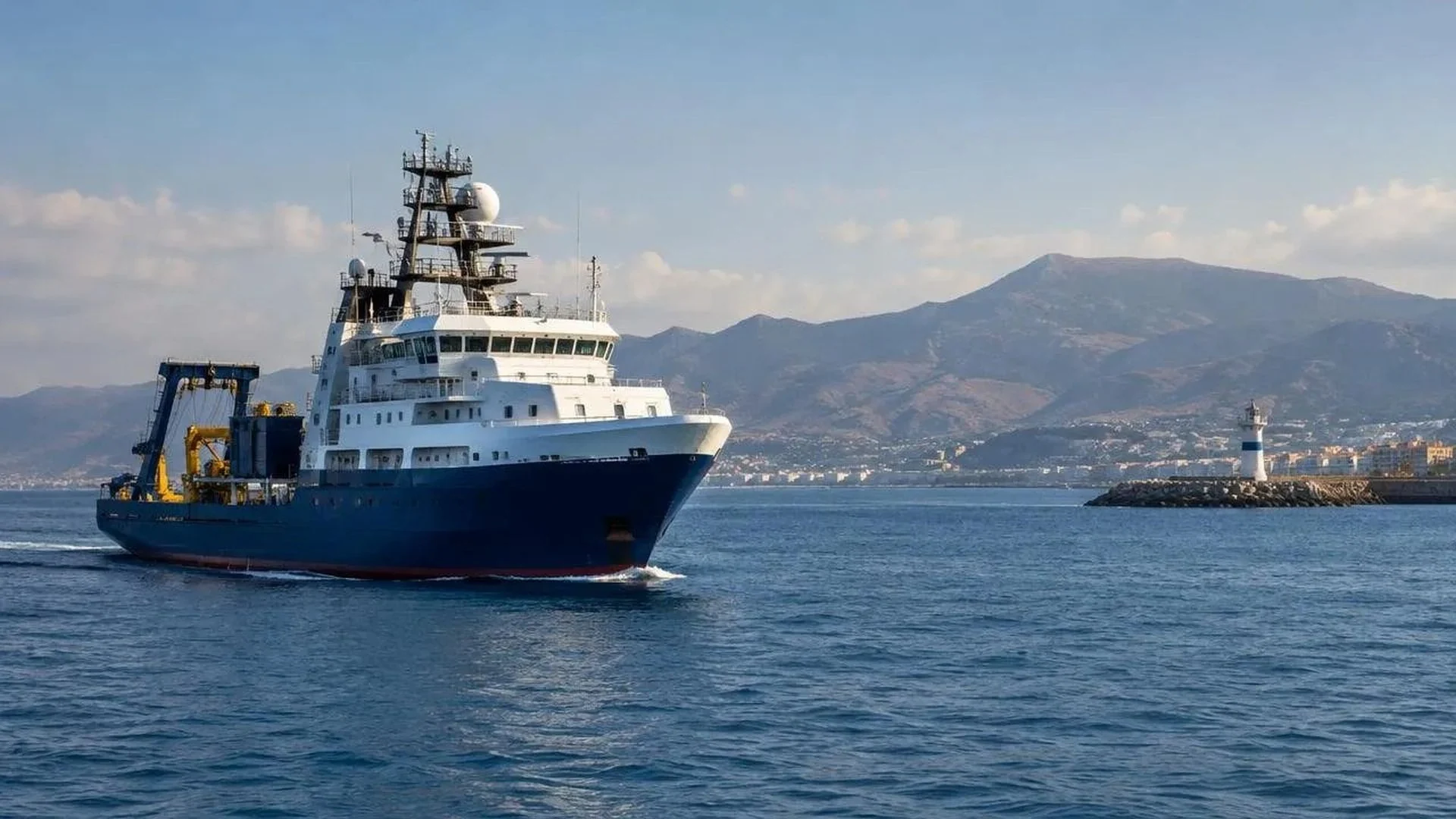
The French research ship which is carrying out seabed surveys ahead of the laying of cables as part of the planned Great Sea Interconnector project has reached Cyprus’ maritime exclusive economic zone, Defence Minister Vasilis Palmas said on Friday.
He said that the situation in the area where the ship currently finds itself is “calm”, with swathes of the seas between Cyprus and Crete, the Greek island to which Cyprus’ energy grid will be connected if the project is completed, claimed by both Greece and Turkey.
On this front, he stressed that the project, which, if completed in its entirety, will link the grids of Cyprus, Greece, and Israel, is “a project of European interest which is being carried out by Greece and Cyprus, two member states of the European Union, with the participation of French companies”.
A little over two weeks ago, the French research vessel, named the Abeille Marengo, set sail from the Cretan port of Heraklion with the aim of completing the seabed surveys for the first leg of the interconnector, amid a flurry of navtexes from Cyprus, Greece and Turkey.
A navtex is a message sent to seaborne vessels to warn them of activity in their vicinity, and the Abeille Marengo had initially set sail pursuant to the issuing of a Greek navtex clearing it for the surveys.
Turkey informed of plans
It was still in Greek waters when Turkey issued its own navtex, also clearing the Abeille Marengo to commence seabed surveys, and saying that the boat’s activities would be carried out “along lines coordinated with and consented to by the competent Turkish authorities”.
That navtex did bring to an end a months-long saga over whether or not Turkey would disrupt the construction of the interconnector, and did come after Greek government spokesman Pavlos Marinakis acknowledged that Turkey had been informed of the planned surveys.
He nonetheless stressed that the communication “does not constitute recognition” of Turkey’s claim to the seas in which the surveys are now taking place, and that the formal request for permission to conduct the surveys was only sent to the governments of Greece and Cyprus.
Mitsotakis: Project is progressing smoothly
Last week, Greek Prime Minister Kyriakos Mitsotakis said that the project is “progressing smoothly, without hindrance, and in accordance with the original plan”.
“Ultimately, this will have a very significant positive impact on the island, which is precisely why we have insisted, and continue to exist, on the implementation of this very important strategic undertaking, overcoming any obstacles we have encountered along the way,” he said.
President Nikos Christodoulides, meanwhile, said that both governments are in “close coordination” both with each other, and with French President Emmanuel Macron on the matter, and that the project itself is “of clear strategic importance to our country, as well as to the entire region and to Europe”.
Admie: project will be complete by end of 2031
Earlier, Greek public broadcaster ERT had quoted the latest version of the country’s independent power transmission system operator Admie’s 2027-2036 development plan as having forecast that the section of the project which will link the energy grids of Cyprus and Greece will be complete by the end of 2031.
The plan reportedly said that 60 per cent of the required seabed surveys have now been completed, and that a contractor has been selected for the construction of converter sections at either end of the cable.
ERT also reported that the feasibility study for the construction of the interconnector’s second leg, between Cyprus and Israel, has been completed “with positive results”, and that “Israel will strengthen its security of supply, gaining the ability to further and more rapidly increase the participation of renewable energy sources” in its own mix.
It also quoted a study conducted by the Aristotle University of Thessaloniki, which found that the interconnector’s completion will bring about savings ranging from €123 million to €138 million per year, with this amounting to a 19 per cent decrease in energy prices for Cypriot consumers.




Click here to change your cookie preferences