
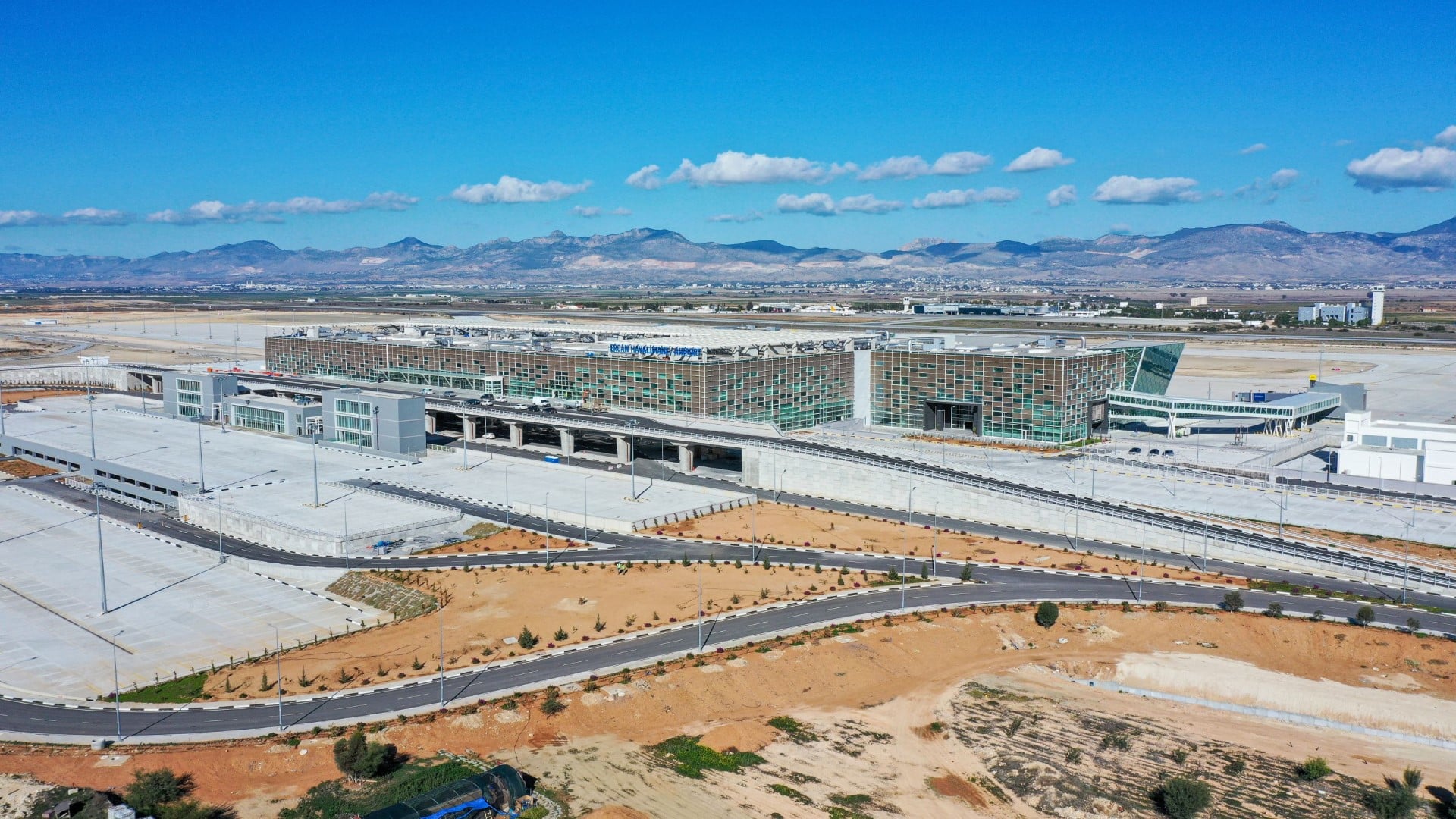
The Turkish Cypriot police on Thursday announced that the use of personal drones has been banned until further notice in the region surrounding Ercan (Tymbou) airport, following the deployment of Hisar-A surface-to-air missiles to the airport on Wednesday.
The use of personal drones is banned in the villages of Louroujina, Tymbou, Aphania, Palaikythro, Assia, Arsos, Melousia, Mora and Ayia Kebir.
The ban comes after the Republic of Cyprus had last week announced the banning of personal drones across the island and its territorial waters, “due to the current security conditions”, after the island had been hit by an Iranian-made drone last week.
Given Ercan (Tymbou) airport’s proximity to the Green Line, concerns had been raised regarding potential incongruence between the two sides’ regulations related to the flight of personal drones, especially in light of the stationing of surface-to-air missiles there.
Turkish Cypriot air traffic controllers’ trade union leader Cem Kapisiz told the Cyprus Mail on this matter that while those concerns are “valid”, the Turkish Cypriot authorities had been informed about the Republic of Cyprus’ blanket ban on personal drones.
Regarding the new ban centred on Ercan (Tymbou) airport, he said that “we have informed the relevant authorities and requested that they take the necessary precautions”.
“I believe that the necessary measures will be taken to ensure that there is no danger,” he said.
Hisar-A surface-to-air missiles were deployed by the Turkish military to Cyprus on Wednesday. The missiles use infrared homing to lock onto their targets, tracking them using the light they emit.
The missile system joins six Turkish F-16 fighter jets, which have been stationed at the airport since Monday, with Turkish newspaper Sabah having reported that Bayraktar Akinci and Bayraktar TB2 unmanned combat drones are also stationed in Cyprus.
They are likely located at the Gecitkale (Lefkoniko) aerodrome, which was formally handed over to Turkey’s armed forces in January 2024, having been used for military purposes since 2019.
Turkey is one of multiple countries which have deployed military assets to Cyprus, in the aftermath of a drone strike on the island’s British Akrotiri air force base last week, with Greece having been the first, deploying four F-16s of its own to Paphos last Monday evening.
However, the deployment of Turkish hardware to the island comes with Greece and Turkey seeming now to be heading towards alignment regarding Cyprus’ role in the conflict.
Following the arrival of the Greek F-16s last week, Turkey lodged no protest, and the country’s defence ministry spokesman rear admiral Zeki Akturk instead announced that a delegation from the Greek air force will visit Turkey this week “within the framework of bilateral relations and regional developments”.
Akturk on Thursday confirmed that the delegation had spent three days this week at the headquarters of Turkey’s air force, saying that the visit had taken place “within the framework of confidence-building measures”.
In addition to Turkey and Greece, other countries including France, which has sent its aircraft carrier the Charles de Gaulle, have also deployed assets to the island.
The Netherlands is the latest country to do so, with a Dutch frigate set to deploy to Cyprus as part of the Charles de Gaulle’s carrier strike group, while Italy had announced its intention to send the Federico Martinego frigate to Cyprus, and Spain is to send the Cristobal Colon frigate.
The United Kingdom, meanwhile, which operates and holds sovereignty over the Akrotiri air force base, has sent multiple AW159 Wildcat helicopters, armed with anti-drone missiles, to Cyprus, while the HMS Dragon Type 45 destroyer warship departed from Portsmouth on Tuesday evening.





Click here to change your cookie preferences