
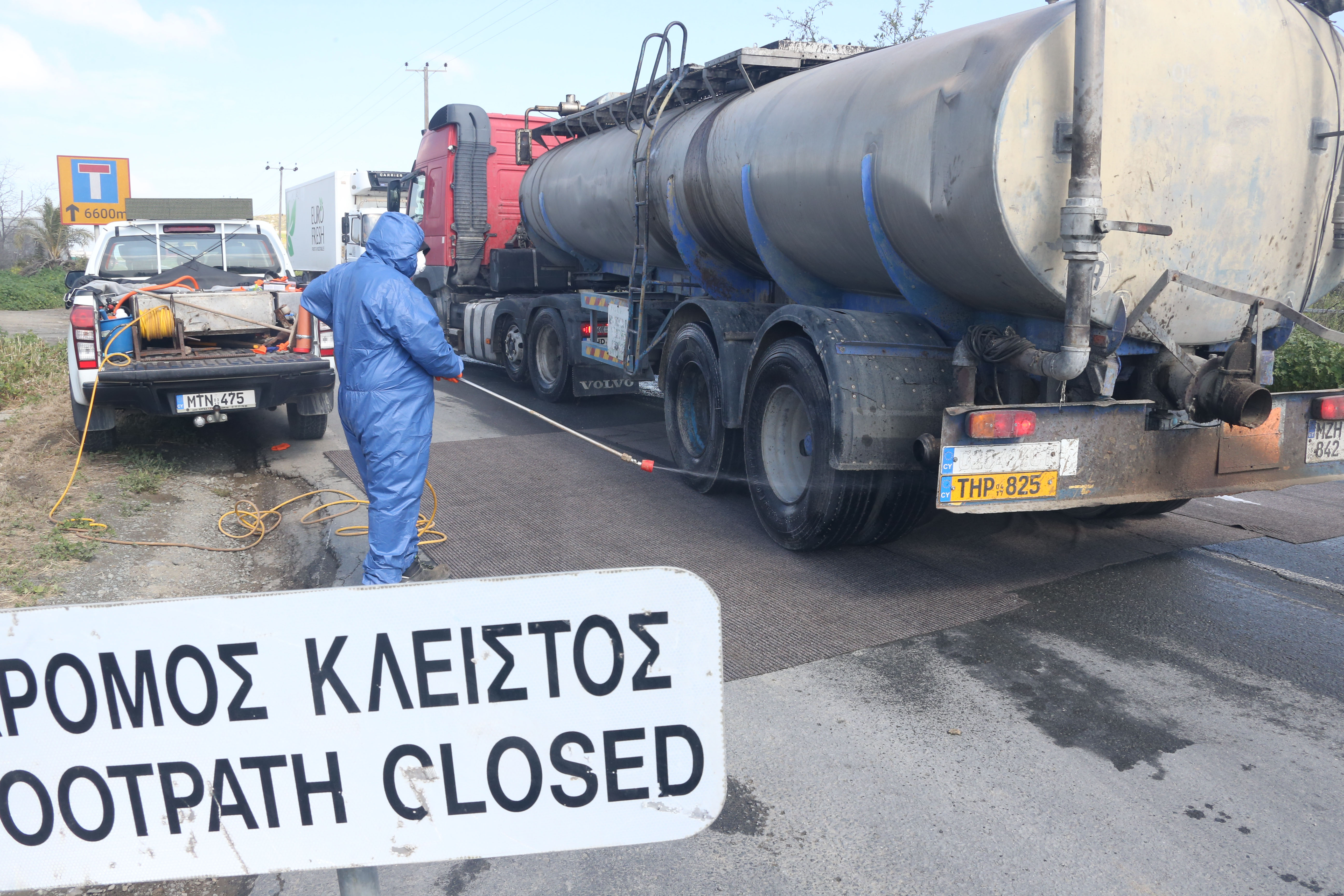
The spread of foot and mouth disease to Yeri and Dhali in the Nicosia district is “unfortunate”, veterinary association chairman Demetris Epaminondas said on Tuesday, though he did stress that it was not unforeseen.
“The spread to Yeri and Dhali is something which was within the possible scenarios … It is an unfortunate event, but it does not mean that the measures are not working, or that the disease did not previously exist in that specific area,” he said.
He added that as such, the authorities are now attempting to determine to where else the disease has spread, with it “likely” that more cases will be found in other areas.
Asked whether there may have been cases in Yeri and Dali before this week, he said that “this is something that the epidemiological investigation conducted by the veterinary services will show”.
He then said that his association is “committed” to the plan it received from the veterinary services department regarding vaccinations.
“We are advancing the vaccination procedure; we are finishing the first doses. Theoretically, we will finish by the end of March, and this is the goal,” he said, before adding that thus far, around 80 per cent of cattle and 45 per cent of sheep and goats have been vaccinated.
The goal, he said, is “to vaccinate all units, sheep, goats, and cattle, to obtain a good level of immunity”.
Two cases of the disease had been detected in the Nicosia district on Monday, with all previous cases having been recorded in the Larnaca district.
Later on Tuesday, South Nicosia mayor Stavros Hadjiyiannis implored people not to enter the exclusion zone declared by the government within his municipal boundaries, and said that thus far, people have largely been avoiding it.
Asked by the Cyprus News Agency whether he expected the disease to spread to his municipal boundaries, he said that it was “a matter of time, if one takes into account the distance from the initially infected area and the fact that the disease is transmitted by air”.
“I wish it did not happen, but we are also worried about what will happen. I do not know if it will stay with us or go further,” he said.
He added that the livestock unit on which an infected animal was found is “small”, but warned that if the disease is transmitted to a farm which produces milk, “we will be talking about large numbers”.
“If it hits the Dhali livestock zone, we are talking about great damage,” he said, before adding that within Dhali and the surrounding areas, there are around 100,000 cows, sheep, and pigs.




Click here to change your cookie preferences