
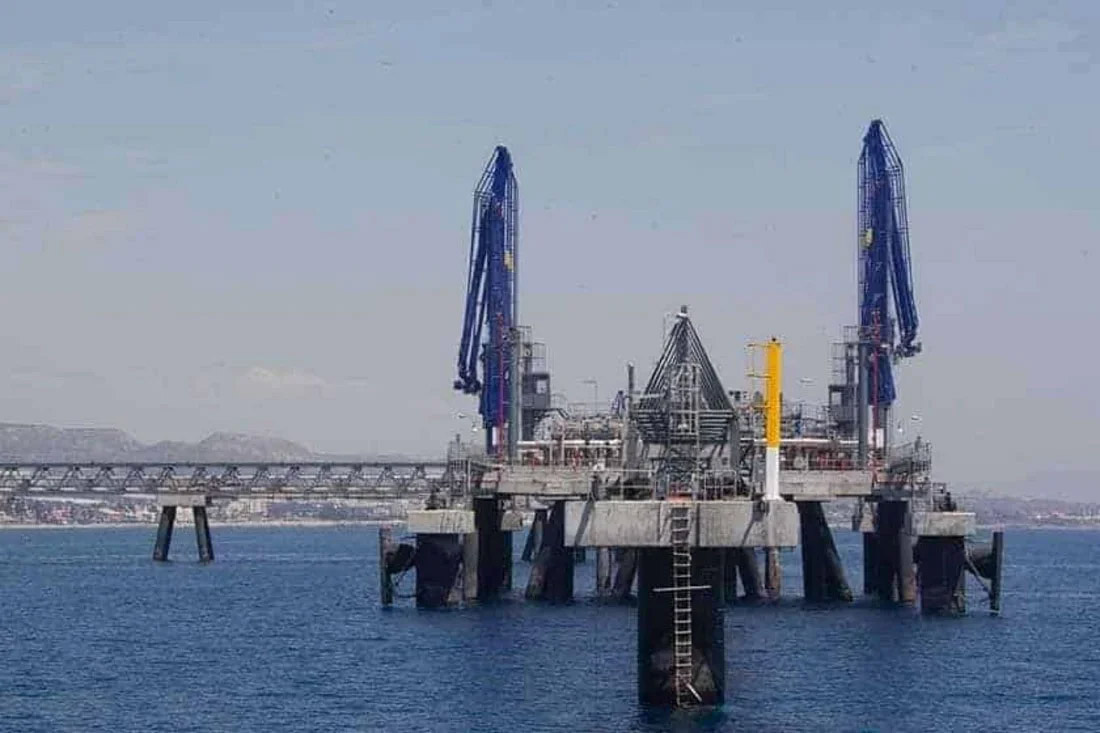
On 19 May Cyprus approved the Development and Production Plan of the Kronos gasfield in block 6 by the ENI-TotalEnergies consortium. This focuses on a fast-track, subsea tie-back to the existing Zohr and Egyptian gas infrastructure, to be liquefied at the Damietta LNG plant for export. The estimated 3 trillion cubic feet (tcf) Kronos is planned to supply natural gas to Damietta by 2028
The planned development of Kronos marks a significant step for the country’s upstream ambitions. Yet beneath the headline of “first-gas” lies a much more complex reality.
While early enthusiasm centred on what is destined to become Cyprus first gasfield development 15 years since the first gas discovery, Aphrodite, the real question now is more nuanced: under realistic assumptions on recoverable reserves, costs and future LNG prices, who actually captures the value?
Kronos appears to be a commercially tight project whose value is highly sensitive to market conditions and risk allocation. The central question is not whether Kronos can be developed, but rather: does it create meaningful value for Cyprus?
A modest resource with significant uncertainty
Kronos sits in a carbonate reservoir analogous to Egypt’s Zohr. While this confirms a working petroleum system, it also introduces considerable uncertainty.
Carbonate reservoirs are notoriously heterogeneous. Early estimates often overstate recoverable volumes because they assume connectivity that may not exist. Zohr was initially estimated to hold 30tcf gas, but this has now been reduced to 10tcf recoverable gas.
A realistic working range for Kronos is a base case of 2,0–2,2tcf, with about 1,5tcf as a downside case. This relatively modest resource base is central to the project’s economics.
Development concept: dependence on Egypt
Kronos will be developed via a subsea tie-back to Egyptian infrastructure
- Processing through facilities linked to the Zohr gasfield
- Liquefaction at the Damietta LNG plant
- Export to international markets
This approach reduces upfront capital requirements but introduces structural dependence: Kronos economics are heavily influenced by Egyptian tariffs, infrastructure access, and operational conditions.
Cyprus’ gas is expected to be priced at the inlet to the LNG plant, with linkage to LNG prices. However, this is a ‘netback system’, not full exposure to LNG prices.
With massive amounts of new LNG to enter the market in the period to 2030, by then LNG prices are expected to come substantially down to between $6-$8/mmbtu in Europe.
After deducting liquefaction, shipping, and midstream costs, the effective gas price will be significantly lower. Based on the LNG price range, under realistic assumptions netback prices could be between $1-$3/mmbtu.
This netback is the key determinant of project value.
Kronos remains a relatively high-cost development, even with a tie-back solution. The estimated upstream full-cycle capital costs at Kronos are, for a 1.5 tcf recoverable resource $3.2/mmBTU and for 2.2 tcf $2.8/mmBTU.
Given the downstream deductions above, the project requires roughly $8–9/mmbtu LNG to generate comfortable margins. At lower prices, profitability becomes marginal or disappears entirely.
Fiscal structure and timing
Cyprus’ production-sharing terms are broadly standard. During the first 3 years companies recover costs, with Cyprus receiving little or nothing. After year-3 Cyprus receives about 55 per cent of profit gas.
This creates a significant timing issue, with Cyprus’ revenues delayed, becoming depend on later-stage profitability. This becomes critical when considering LNG price forecasts.
A growing number of forecasts from credible sources suggest that European LNG prices could fall to $6–7/mmbtu after 2029, as global supply expands, European gas demand growth slows and penetration of renewables Increases. This is increasingly the base case. This is precisely when Cyprus expects to receive its main profit share. Some estimate LNG prices rising to $8/mmbtu into the 2030s.
At those price levels netback falls to about $1–2/mmBTU, which is below or close to upstream costs.
The implication is stark: At sustained $6–7/mmbtu LNG price, Kronos becomes marginal or uneconomic in full-cycle terms, while at $8/mmbtu the project becomes borderline viable.
Under consistent assumptions, Cyprus’ lifetime profit share is at best modest relative to expectations.
Why companies may still proceed
Despite weak full-cycle economics, companies may still develop Kronos. The reason lies in the distinction between full-cycle and incremental economics.
Much of the required infrastructure—particularly in Egypt—already exists. This allows companies to focus on incremental cashflow rather than total project returns.
In practice:
- Marginal processing and LNG costs are lower than full tariffs
- Additional gas improves utilisation of existing, under-utilised, infrastructure
- Production can remain cash-positive even if overall profitability is limited
In effect, companies can, through Kronos, recover their ‘sunk-investment (money already spent that cannot be recovered)’ in their under-utilized gas infrastructure in Egypt. This means that Kronos can remain attractive to companies even when it generates limited value for Cyprus.
Risks and liabilities
Available evidence suggests that Cyprus accepted several concessions to enable the project. These may include:
- Broad cost recovery, including overruns
- Full pass-through of Egyptian tariffs
- Limited production guarantees
- Strong fiscal stabilisation
- Limited control over cost deductions
The effect is cumulative. Cyprus appears to have assumed a larger share of downside risk, while companies have protected early returns. Kronos is a marginal, infrastructure-led development asymmetric in risk allocation favouring the companies, critically dependent on recoverable gas reserves and highly sensitive to LNG prices.
A second phase: cluster development
Once Kronos progresses, the companies are likely to propose a second phase that could see the development expanded into a Block 6 cluster that includes nearby discoveries Zeus and Calypso. This would allow shared infrastructure, higher throughput and longer production life, reducing unit costs and improving overall project efficiency. For operators, clustering can lower breakeven levels and enhance resilience in a lower LNG price environment. However, for Cyprus the benefits would be more limited. The same structural constraints remain: dependence on Egyptian tariffs, delayed revenues due to cost recovery, and exposure to LNG prices.
While a second-phase cluster could improve overall project robustness and increase total volumes, it is not necessarily a guaranteed solution to the underlying issue of limited value capture for Cyprus.
Likely to proceed
Even though a Final Investment Decision (FID) has not yet been made, Kronos is likely to proceed, because it fits within a broader infrastructure system. The result will be a project that can be commercially viable for the companies, operationally beneficial for Egypt, but only marginally rewarding for Cyprus. Cyprus may find that it has enabled development while capturing only limited long-term value, other than political capital.
Ultimately, Kronos is not a transformational development. It is a tightly balanced, risk-sensitive project whose value to Cyprus depends critically on the level of recoverable reserves and LNG price outcomes that may not materialise.
Charles Ellinas is Councilor of the Atlantic Council. The article is republished from the blog of the Cyprus Economic Society.




Click here to change your cookie preferences