
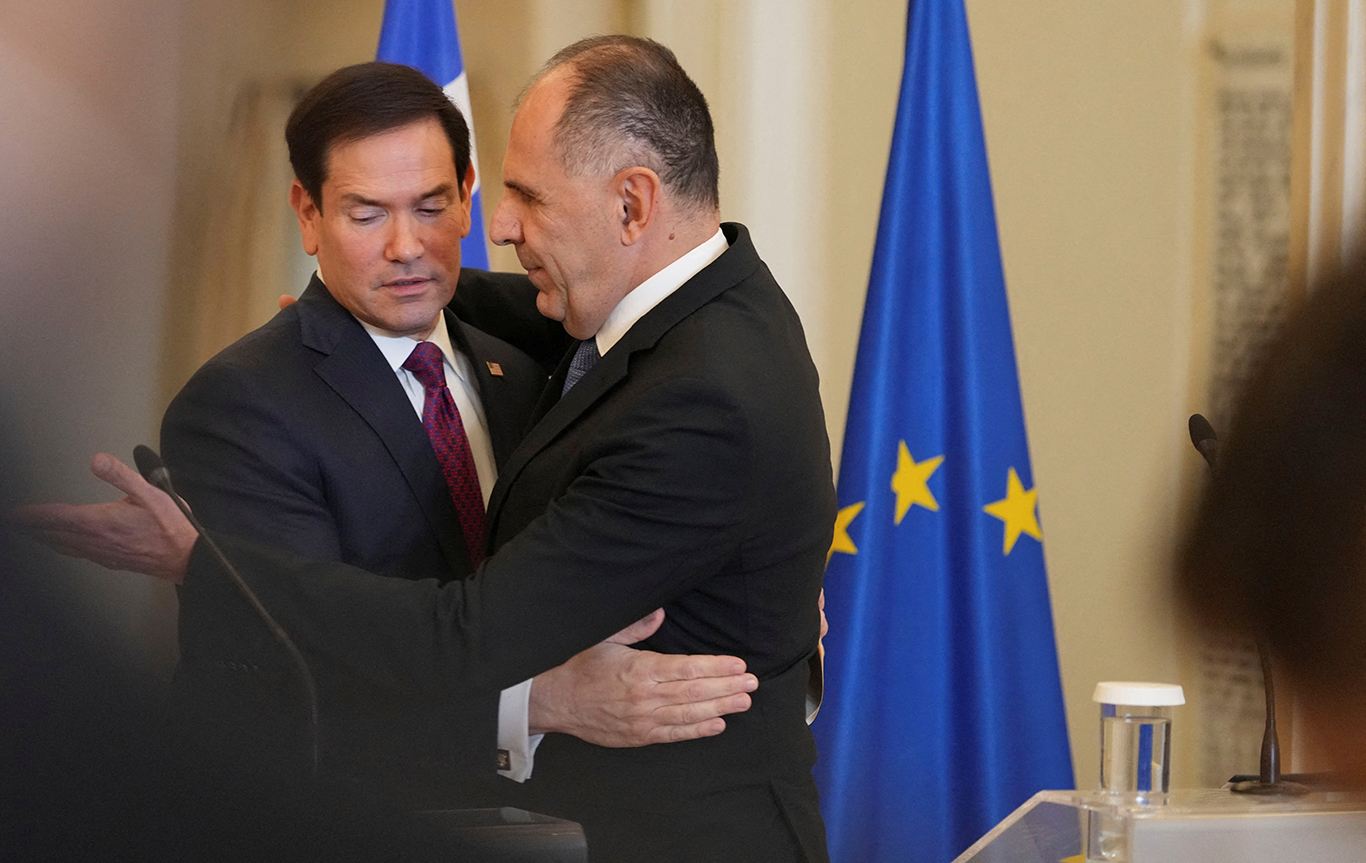
Rubios's visit highlighted Greece’s growing strategic role, but questions remain over deterrence, regional energy projects and approach to Cyprus
US Secretary of State and National Security Adviser Marco Rubio’s visit to Athens was significant in both substance and symbolism.
It was more than another high-level diplomatic visit.
It highlighted the growing importance of Greece as Washington reshapes its strategic priorities. And, by extension, the opportunities and challenges this creates for Cyprus.
To understand its significance, we must consider both Rubio’s address on the Pnyx and his discussions in Athens.
Speaking on the Pnyx, with the Acropolis as his backdrop, Rubio did more than pay tribute to ancient Greek civilisation. He invoked Greece to defend a particular conception of the West, sovereignty and national power. His speech was, in effect, a manifesto for America’s role in the world.
Rubio described a competitive world in which economics, technology, energy, industrial capacity and military strength are interconnected instruments of national strategy. Diplomacy must be backed by hard power.
None of this represents an entirely new departure in US foreign policy. Certain strategic imperatives have endured through Republican and Democratic administrations alike. Preserving American primacy remains a central objective. What changes are the methods.
Rubio also argued that alliances should defend national sovereignty, not extinguish it. A proposition of particular relevance to Cyprus, to which I shall return.
Greece’s strategic value
Washington no longer views Greece exclusively through the prism of its relations with Turkey.
Souda Bay, Alexandroupolis, Greek shipping, energy infrastructure and cooperation across the Eastern Mediterranean give Greece strategic importance beyond its traditional role in Nato.
Rubio described Greece as an “indispensable friend” and an “anchor partner” in American regional strategy. Words matter. Especially in diplomacy.
The sixth US-Greece Strategic Dialogue gave practical expression to that relationship, announcing $4 billion in military sales and deeper cooperation in defence, security, energy and emerging technologies.
Greece is increasingly moving from being a security consumer to a security producer, contributing to regional stability rather than merely relying on others for its security.
That matters. But Washington is not turning its back on Turkey. Ankara remains important to Nato, the Black Sea, the Middle East and wider American strategy.
Washington seeks strong relations with both countries. This is not a zero-sum game.
Preventing war and the limits of deterrence
Rubio’s interview with Alexis Papachelas, published in Kathimerini on October 8, was particularly revealing.
Asked about a serious crisis involving Turkey, whether in the Aegean or Cyprus, and how Washington might respond, Rubio described such a development as “unthinkable”.
His words carry political weight. They signal American determination to prevent armed conflict between two Nato allies.
But an important distinction must be made.
Preventing war is one thing. Deterring threats, coercion or unilateral faits accomplis is another. Resolving disputes in accordance with international law is something else again.
Rubio’s assurances left questions unanswered. His rejection of a Greek-Turkish war was not accompanied by an equally clear position on how Washington would address the threats and unilateral actions that could precipitate a crisis.
Energy and connectivity: the new geopolitics
Energy was among the most consequential elements of the visit.
The Vertical Gas Corridor, American liquefied natural gas flowing into Europe and the growing involvement of US energy companies are strengthening the regional role of Greece.
Energy is no longer simply commercial. It concerns national security, strategic autonomy and geopolitical influence.
The same applies to electricity interconnections.
The Great Sea Interconnector (GSI), linking Greece, Cyprus and eventually Israel, is a case in point.
Rubio reiterated American support for energy infrastructure but avoided publicly confronting Turkish objections to the GSI. At his joint press conference with Greek Foreign Minister George Gerapetritis, he favoured quiet diplomacy over public declarations on sensitive issues. In Kathimerini, he said Washington intended to use “diplomatic efforts to remind all parties how important this is to us and why it matters”.
That indicates American interest. It does not guarantee protection of the project.
Can diplomatic support create the conditions necessary for its implementation?
Connectivity is becoming strategy. But strategy is judged by its execution.
Cyprus: sovereignty, security and strategic value
This brings us back to the principle Rubio articulated on the Pnyx: alliances should defend sovereignty, not abolish it.
Quite right. But what happens when a Nato member and US ally continues, 52 years after its 1974 invasion, to occupy part of another state with which Washington is developing an increasingly close strategic relationship?
For Cyprus, this is not theoretical.
It is existential.
The absence of another war does not erase the Turkish occupation. Preventing war is essential, but cannot substitute for restoring respect for international law.
Gerapetritis explicitly, and rightly, placed Cyprus within the security architecture of the Eastern Mediterranean. He called for reunification under United Nations Security Council resolutions and emphasised the Greece-Cyprus-Israel cooperation framework with the US, known as the 3+1.
Rubio did not publicly reiterate these positions in Athens. However, in his message marking the 66th anniversary of Cyprus independence on October 1, he reaffirmed American support for a bizonal, bicommunal federation consistent with UN Security Council resolutions.
And that matters.
Cyprus also has strategic value of its own. As a member state of the European Union, its geography, infrastructure and partnerships enable it to contribute to regional security, humanitarian operations, energy cooperation and crisis management.
It has already demonstrated, in word and deed, its value as a credible, predictable and dependable partner, facilitating security and humanitarian operations in the Eastern Mediterranean, a region of vital importance to US interests.
The Republic of Cyprus should not be viewed or treated merely as an extension of the Cyprus question, or as a footnote to US-Turkish relations.
It must be recognised as a subject of the international system in its own right. Not an object of the designs of others.
The challenge for Cyprus is to translate its growing strategic value into stronger security, deeper strategic partnerships and tangible progress towards ending the Turkish occupation and reunifying the country.
Rubio’s visit confirmed the growing strategic importance of Greece and the opportunities emerging across the Eastern Mediterranean. It did not resolve the region’s underlying tensions or guarantee that ambitious infrastructure projects will become reality. Nor was it expected to.
The real test still lies ahead.



Click here to change your cookie preferences