
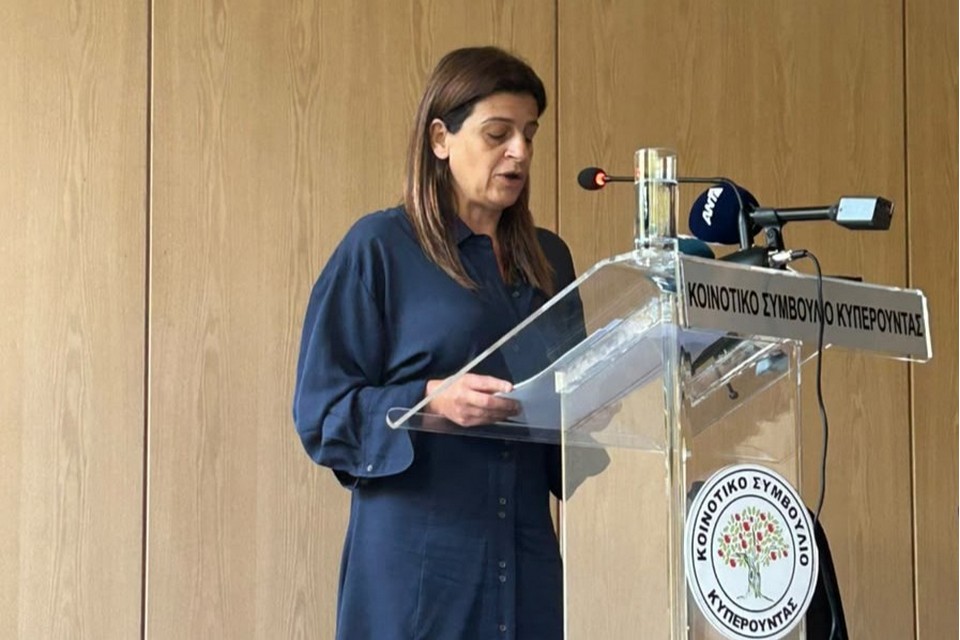
Cyprus is stepping up efforts to improve women’s access to funding, technology and business opportunities in rural communities, Gender Equality Commissioner Josie Christodoulou said on Wednesday, emphasising new training initiatives and government measures aimed at strengthening women’s economic independence.
Speaking at a conference entitled ‘Women in rural areas: challenges and opportunities’ in Kyperounta, Christodoulou said “women had long played an important role in agriculture, livestock farming, family businesses and agritourism, although their contribution had not always received sufficient recognition.”
However, she stressed that “limited access to services, infrastructure, finance and professional networks, combined with family responsibilities, continued to restrict women’s opportunities to establish businesses, develop careers and participate in decision-making.”
She also warned that these barriers affected not only individual women but the wider economic prospects of rural communities.
To address these difficulties, Christodoulou emphasised government measures designed to incorporate gender equality into public policy and budget planning, alongside tax relief, extended maternity and parental leave, expanded preschool education and improved childcare and elderly care provision.
Particular emphasis has also been placed on digital skills and entrepreneurship.
According to the commissioner, 228 women in rural communities acquired new digital skills during 2025 and 2026 through programmes developed in cooperation with the Deputy Ministry of Research, Innovation and Digital Policy, the Agriculture Ministry and other bodies.
The training is intended to help women use technology to promote their products, expand professional networks and develop their businesses.
Furthermore, 85 women have participated in agricultural entrepreneurship seminars held in communities including Agros, Kakopetria, Ayios Theodoros in Larnaca and Kornos.
Christodoulou stressed that “training alone was insufficient unless women could turn their knowledge and ideas into viable businesses, secure financing and receive fair payment for their work.”
She also announced that a new campaign entitled Women’s Stories would launch on October 15, International Day of Rural Women, stressing women working and running businesses in Cyprus’ countryside.
The initiative aims to challenge stereotypes and encourage younger women to consider rural communities as places where they can build careers, establish businesses and raise families.
Meanwhile, Agriculture Minister Christos Senekis outlined the financial support available to the wider rural economy, including the government’s €454 million Common Agricultural Policy (CAP) Strategic Plan for 2023 – 2027, of which €373m comes from European funding.
The programme supports agricultural investment, farm modernisation and the entry of younger people into the primary sector.
Senekis said “demand for agricultural investment funding remained strong, with applications under the large-scale investment scheme seeking €200m in subsidies.”
Similarly, requests under the scheme supporting first-time young farmers have reached €9.7m.
To address financing difficulties, the ministry has also introduced a financial instrument offering simplified procedures and favourable lending terms to help agricultural businesses carry out investment plans.
In addition, Senekis referred to €2.5m in targeted measures to ease the rising cost of fertilisers, agricultural supplies and fuel.
Water shortages remain another concern, with the government planning more than €200m in water infrastructure projects between 2024 and 2030, covering desalination, recycled water, reduced losses and improvements to distribution networks.
The minister also confirmed that consultations were under way on the next CAP strategic plan, covering the period from 2028 onwards, with farmers and other stakeholders being invited to identify priorities.
For his part, Mountain Communities Development Commissioner Charalambos Christofinas emphasised the importance of improving opportunities for women through the National Strategy for Gender Equality 2024 – 2026, agricultural training and access to available grants.
He also pointed to opportunities under CAP and the LEADER programme, particularly for small businesses, cottage industries and local development.
Nevertheless, Christofinas acknowledged that mountain communities continued to face shortages of infrastructure, employment opportunities and essential services, making it difficult to attract and retain younger families.
The conference, organised by the Agriculture Ministry, the offices of the Gender Equality Commissioner and Mountain Communities Development Commissioner, and Kyperounta Community Council, examined female entrepreneurship, sustainable development and opportunities arising from the digital and green transitions.
Christodoulou concluded that “supporting rural women required more than recognising their contribution”, stressing the importance of equal access to economic opportunities, resources and decision-making so that women could play a full role in the development of their communities.





Click here to change your cookie preferences