
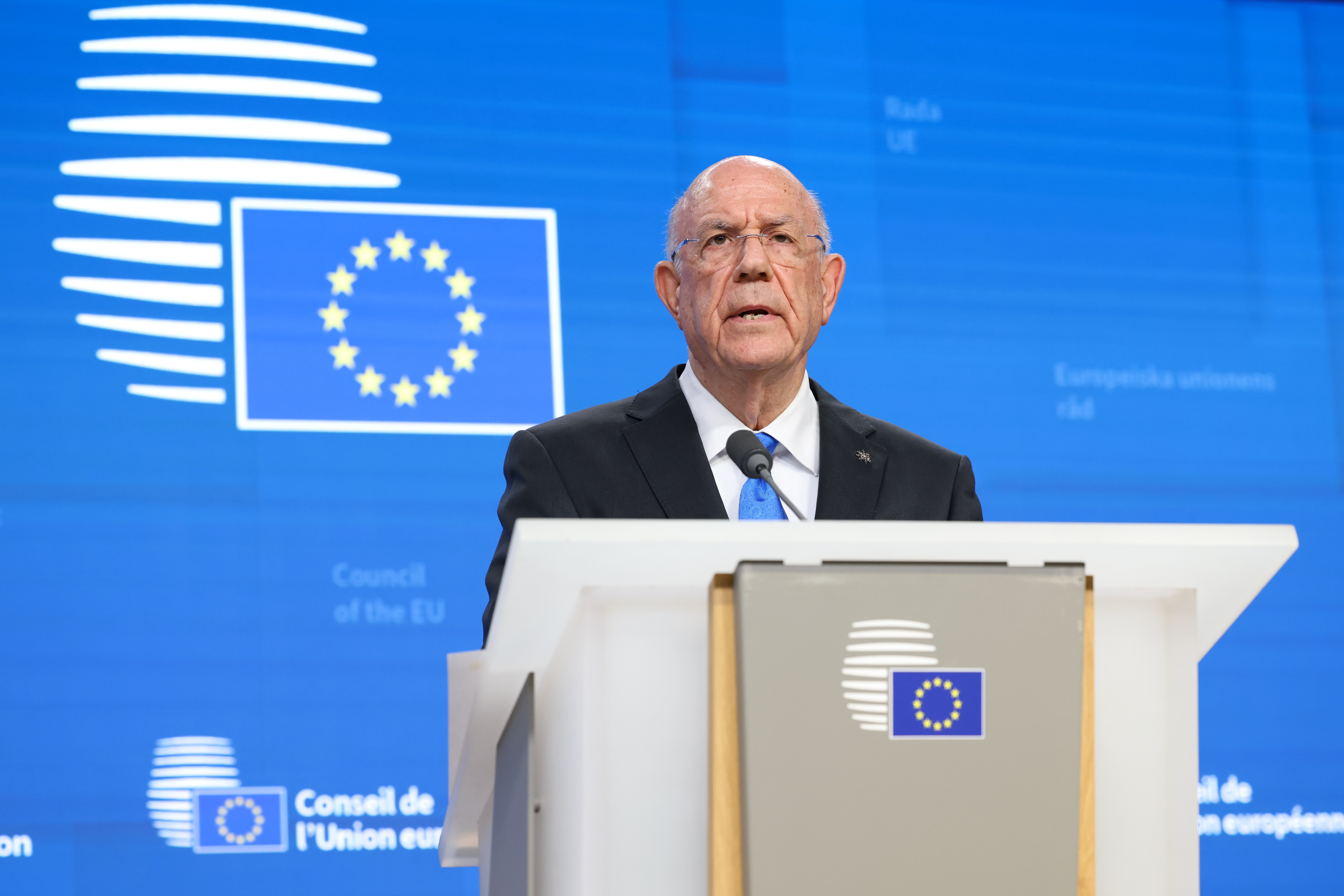
Finance Minister rejects ‘inflationary VAT’ claims amid rising revenues
Finance Minister Makis Keravnos on Wednesday said that the government would seek to extend reduced excise duty rates on motor fuels until March 2027, while defending rising value added tax (VAT) receipts as a consequence of stronger consumption rather than inflationary taxation.
Speaking at the Presidential Palace after a cabinet meeting, Keravnos also defended the government’s fiscal policy following the announcement of a budget surplus, arguing that accumulated reserves and declining public debt were helping Cyprus withstand economic and geopolitical uncertainty.
The reduction in excise duty on motor fuels, which is due to expire at the end of November, will be submitted to the cabinet for renewal, potentially until March 2027, he said.
Keravnos was responding to questions about inflationary pressures, government revenues and whether further support measures were being considered for households and businesses.
He expressed satisfaction with the latest fiscal figures, saying the economy’s resilience reflected the government’s approach to managing public finances.
“I am pleased because our economy continues to demonstrate this resilience, which is attributable to the specific economic policy pursued by the government, a preventive and responsible economic policy,” he said.
He also questioned criticism of the administration’s handling of the economy, arguing that its fiscal performance should be recognised.
“I want to hope that we have not reached the point where we are accusing the government because it maintains and sustains a successful economic policy and a healthy economy,” Keravnos stated.
Addressing references to ‘inflationary VAT’, the minister rejected the suggestion that higher tax receipts represented an increase in the effective tax burden caused by inflation.
“Quite the opposite can be true, because this government has reduced VAT in many cases on essential products, electricity, energy and so on,” he continued.
He argued that Cyprus’ economy was heavily dependent on consumption, meaning that higher spending could naturally translate into increased VAT collections.
“Our economy is based to a very large extent on consumption. Therefore, increased consumption can also generate higher revenue from value added tax,” he stated.
Keravnos added that stronger consumption also reflected the availability of disposable income, which the government was seeking to support through its social policy.
“For this consumption to exist, there must be disposable income, which, through the government’s social policy and by making use of fiscal surpluses, we support on a daily basis, strengthening the disposable income of citizens, particularly vulnerable households and vulnerable members of society,” he explained.
The minister maintained that fiscal surpluses and lower public debt were central to preserving Cyprus’ investment-grade credit ratings and providing protection against unexpected external shocks.
“This is the policy that keeps us at investment grade, and it is the policy we will continue to pursue, particularly when all these negative geopolitical developments and wars are taking place around us,” he said.
He added that the approach helped safeguard the economy’s future while providing a financial buffer against unforeseen events.
Keravnos pointed to government spending on the foot-and-mouth disease outbreak and wildfires in the Limassol district as examples of how fiscal reserves could be used to address unexpected emergencies.
He said the government had spent several million euros on the two crises, although the expenditure had not been included in the original budget.
“These amounts were not budgeted for, but arose through prudent economic policy, which creates surpluses and reduces public debt,” he said.
This financial position also allowed Cyprus to borrow from international markets when necessary without breaching the restrictions imposed by European economic governance rules, he added.
On inflation, Keravnos acknowledged that the ongoing energy crisis affecting the global economy and Europe was continuing to push up costs for households and businesses.
“As long as there is a global and pan-European energy crisis affecting every activity, whether that of an individual or a business, and increasing costs, unfortunately we will continue to see an upward trend in inflation,” he said.
He described this as an unavoidable reality under current conditions, while welcoming the European Central Bank’s latest decision not to raise interest rates further.
“I am particularly pleased with the latest decision by Christine Lagarde that interest rates will not be increased further,” Keravnos said, referring to the ECB president.
He said the government was monitoring price developments and the cost of living on a daily basis, assessing which groups of citizens might require additional assistance.
“We are constantly thinking about additional measures,” he said, reiterating that the extension of the reduced motor fuel excise duty would be brought before the cabinet.
The minister also rejected suggestions that government investment and infrastructure spending were declining despite increased state revenues.
“There are no reductions,” he said.
Instead, Keravnos attributed the situation to delays in implementing certain projects inherited by the current administration, describing them as problematic initiatives that were now being pushed forward.
“There is a slight time lag in the implementation of certain projects that this government inherited, projects that were problematic in many respects, which we are trying to get under way so that they can finally be implemented,” he said.
He maintained that the delays were temporary and did not represent a change in the government’s priorities.
“It is therefore a matter of some delay. Our economic policy and budget remain focused on growth and social policy,” Keravnos said.
He also highlighted the share of public spending allocated to social measures, arguing that 23 per cent of the state budget is devoted to social policy, a proportion he said had not featured in any previous budget.
The minister was also asked about the possibility of further social support in response to the energy crisis and what Cyprus intended to seek from European institutions.
He said he would travel on Sunday to participate in meetings of the Eurogroup and the Economic and Financial Affairs Council (Ecofin), where the issue would be discussed again.
However, he said the government was particularly awaiting a response from the European Commission regarding its request for a further reduction in the special tax on heating oil.
“We are expecting a response from the European Commission’s energy and taxation departments to the request we have submitted for a further reduction in the special excise duty on heating oil,” he said.
Based on communications so far, Keravnos said he had detected a positive approach towards the request.
“We will insist and continue to substantiate our position further until we obtain what is due to us,” he said.
He argued that Cyprus’ fiscal position and economic growth should be taken into account when European restrictions on taxation measures were considered.
“Particularly for an economy that generates surpluses and has a growth rate of 3 per cent, we cannot accept these across-the-board restrictions,” Keravnos said.



Click here to change your cookie preferences