
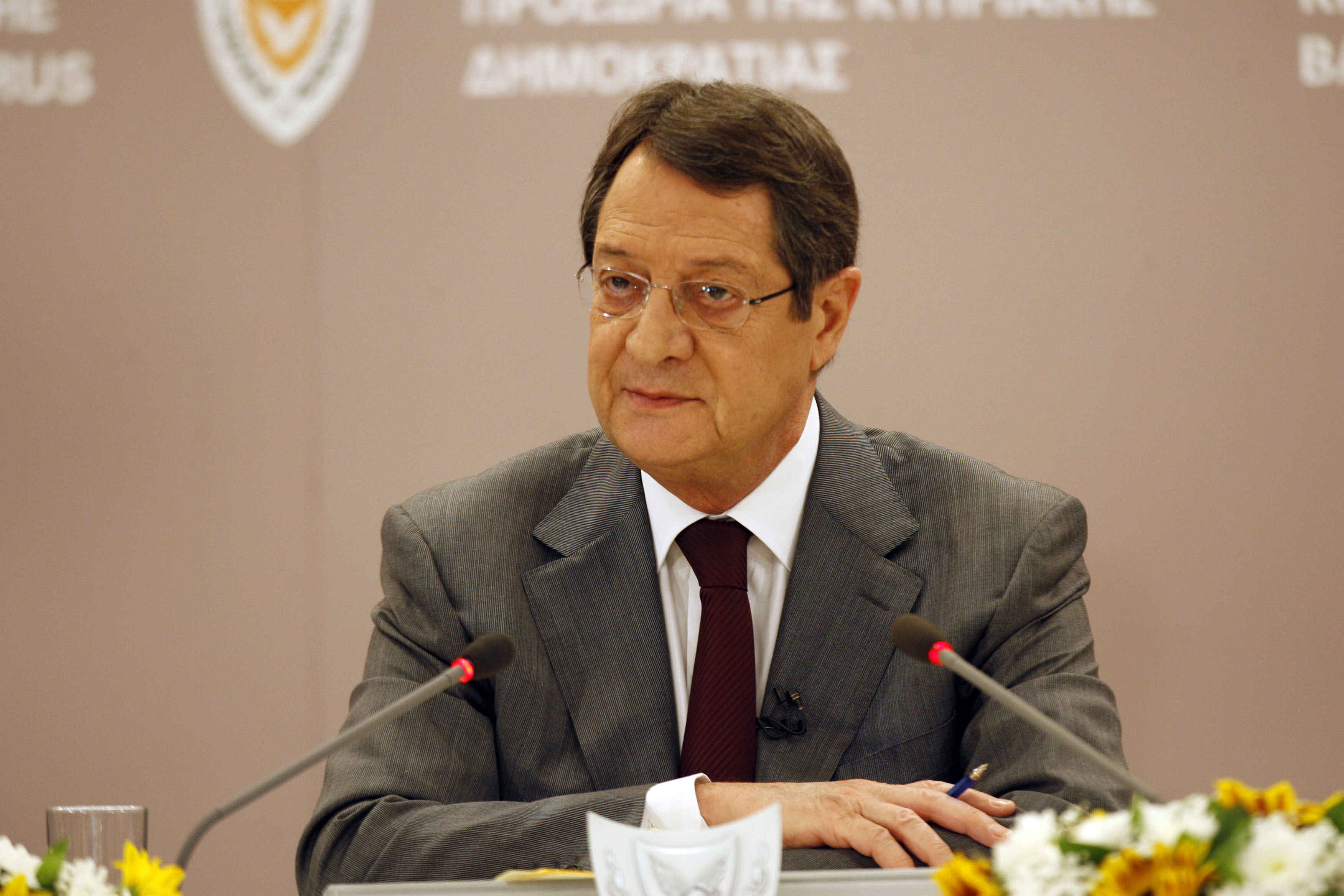
Former president Nicos Anastasiades will hold a press conference next week regarding the anti-corruption authority’s findings in relation to their investigation into the book Mafia State.
Earlier this week, the authority released a lengthy statement, where it said that Anastasiades, as well as others, may be criminally liable.
The report found that Anastasiades may have committed abuse of power while in office on several occasions, with one possible abuse of power on Anastasiades’ part found in relation to the payments made between a company named Focus Maritime and another named Rizokarpasso Shipping.
In response, Anastasiades issued a statement denying any wrongdoing but also calling for an investigation “by the competent authorities”.
On Thursday, his political office issued a new statement saying the former president would hold a news conference on Tuesday June 23 addressing these matters.
The news conference will take place at the Journalists’ House in Nicosia, starting at 11am.
The anti-corruption authority’s statement summarised the findings of its probe, but did not publish the report in full.
In the aftermath, a public debate is taking place on the extent of a former president’s immunity from prosecution.
The constitution, though dedicating an entire article to this issue, appears unclear as to under what circumstances a former president may be prosecuted. Its provisions are subject to interpretation.
Paragraph 1 states that the president “shall not be liable to any criminal prosecution during his term of office” except under certain conditions.
Paragraph 2 states that the president “may be prosecuted for high treason on a charge preferred by the Attorney-General and the Deputy Attorney-General of the Republic before the High Court upon a resolution of the House of Representatives carried by a secret ballot and a majority of three-fourths of the total number of Representatives”.
This is provided that “no such resolution shall be taken and no item shall be entered on the agenda or debated in the House of Representatives in connection therewith unless the proposal for such resolution is signed by at least one-fifth of the total number of Representatives.”
Paragraph 3 says that the president “may be prosecuted for an offence involving dishonesty or moral turpitude upon a charge preferred by the Attorney-General and the Deputy Attorney-General of the Republic before the High Court with the leave of the President of the High Court”.
Upon being prosecuted, the president “shall be suspended from the performance of any of the functions of his office”.
If convicted, “his office shall become vacant and on his acquittal he shall resume the performance of the functions of his office.”
However, Paragraph 5 notes that the president “shall not be liable to prosecution for any offence committed by him in the execution of his functions but he may be prosecuted for any other offence committed during his term of office after he ceases to hold office”.
And Paragraph 6 states that “no action shall be brought against the president…. in respect of any act or omission committed by him in the exercise of any of the functions of his office.”
The phrase “functions of his office” is subject to interpretation.
One way around all this might be for a former president, like Anastasiades in this case, to personally waive any immunity and make himself available to authorities.
Mafia State was published in late 2022.
In April 2024, Anastasiades filed a lawsuit against Drousiotis, seeking over €2 million in defamation damages and a ban on his books Mafia State and The Gang, alleging malicious falsehoods.





Click here to change your cookie preferences