
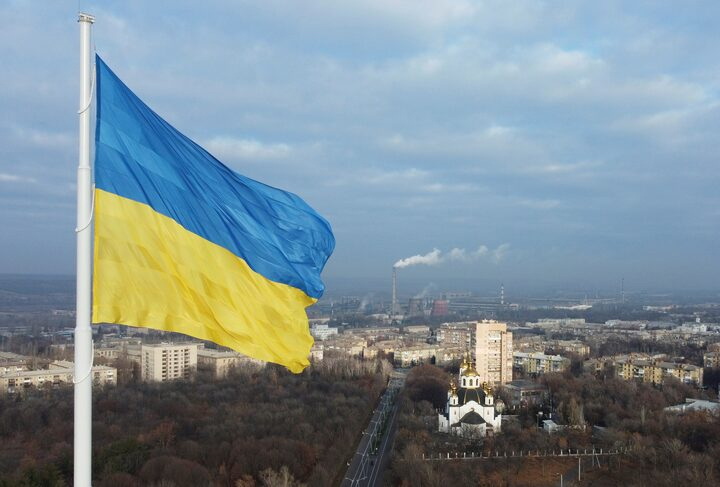
By Ella Varytska and Marko Skral
The war in Ukraine remains a central topic of discussion, as does a strong aspiration of the Ukrainian nation to achieve peace. But not peace at any cost. It must be just, comprehensive and lasting, based on the fundamental principles of international law, enshrined in the UN Charter.
In some international circles there is a temptation to view Russia’s full-scale invasion of Ukraine as a ‘proxy war’.
Moreover, there are also attempts to justify what is currently happening in Ukraine – daily targeted terror against the civilian population, destruction of critical infrastructure and the turning of Ukrainian cities with populations of over a million into uninhabitable sites – through the reasoning of the President of the Russian Federation, who still cannot accept the fact that Ukraine is an internationally recognised sovereign state, with the right to self-determination, and is no longer one of the Soviet Union republics.
In Ukraine, we believe that justice and respect are fundamental moral and legal principles that every sound person in the modern world abides by and that are essential to peaceful coexistence, both in society and between states.
They are fundamental for building relations based on law, equality and morality, rather than on physical or political strength, which is natural for the realm of animals, guided by instincts rather than moral norms or common sense.
Russia’s armed invasion of Ukraine is nothing else than an illegal, unprovoked and aggressive war against our country, started by Vladimir Putin, driven solely by his personal ambitions rather than by moral norms or the UN Charter.
Some argue, in support of Kremlin actions, that Russia and Ukraine were not only recently part of the Soviet Union, but were also inseparably connected psychologically, at least from Russia’s perspective and that psychological separation takes time.
In this regard, the Ukrainian nation clearly expressed its will in 1991, voting for independence. A bit later, in February 2022, Ukrainians made it even clearer to their northern neighbour that they did not share its views on Ukraine’s future, standing up to the so-called “liberators” with Molotov cocktails rather than welcoming them with flowers.
Therefore, it is obvious that aggression breeds aggression.
Furthermore, after Ukraine and the civilised world discovered the consequences of the Russian occupation for the civilian population in the cities of Bucha, Irpin, Izum – as well as many other big and small towns of Ukraine where people were tortured, raped, shot, and buried in mass graves – the percentage of Ukrainians who were previously neutral to Russia and spoke Russian sharply decreased.
Bearing this in mind, and witnessing the actions taken by Russia on Ukrainian territory on a daily basis, we clearly understand that the aim of this war is not merely to seize territory, but primarily, to destroy our statehood, our identity and crush our people both Ukrainian-speaking and Russian-speaking.
All these well-documented war crimes are evident to our international partners, who do not pretend that nothing is happening but stand by Ukraine’s side.
Some also claim that the reason for the unending violence is the lack of diplomacy. However, diplomacy does not work when it is based on the imposition of the aggressor’s demands and the victim’s capitulation.
Therefore, supporting Ukraine is not “sleepwalking” into a wider conflict. It is the only way to stop the aggressor’s urge to keep the war going and ensure that international law is placed above the entitlement of strength in our shared European home.
Appeasement of the aggressor is not an argument to achieve peace, but only an encouragement of more aggression, as this approach shows weakness.
Ukraine is deeply grateful to its partners who support our economy and defence forces in repelling Russian attacks and defending civilians. This support allows us to rebuild, develop and find innovative solutions for defence, addressing urgent needs, and helping millions of people who call Ukraine home. We did not choose this war, but we choose to continue living in and fighting for our home. There are no other options for us, because the memories of Bucha are still fresh.

Click here to change your cookie preferences