
Quick answer: Chainstack’s BNB Smart Chain RPC is the strongest all-round choice for most teams. It offers:
- Flat pricing and free MEV protection on every plan
- Debug and trace tools, and Dedicated Nodes
- Both SOC 2 Type II and ISO 27001 security certificates
- A GEN 2.0 upgrade that cut the median time to first byte on mainnet from 293 ms to 71 ms in Chainstack’s own test
Of the others, Dwellir is the cheapest per request, Quicknode also lists both certificates, dRPC includes frontrunning protection on every paid plan, and Alchemy suits teams already on its platform.
Here is how five RPC providers (services that connect apps to the blockchain) compare for BNB Smart Chain in 2026.
How we compared: each provider’s own BNB Smart Chain page, documentation and pricing page, last checked November 23, 2026. We weighed price per request, MEV protection, tracing tools, speed limits and security certificates. Chainstack, which sponsors this article, is listed first; the order of the others is not a ranking. The latency figures are Chainstack’s own measurements, and we did not test the other four providers. Ankr and NodeReal are not covered here.
BNB Smart Chain RPC provider comparison: free plans, pricing and MEV protection
| Provider | Free plan | Entry paid plan | Cost per million simple requests | MEV protection | SOC 2 Type II | ISO 27001 | Best for |
|---|---|---|---|---|---|---|---|
| Chainstack | ✅ 3M units a month | $49 Growth, 250 requests per second | $2.45 | ✅ (every plan) | ✅ | ✅ | Predictable bills, shorter request path |
| dRPC | ✅ (public nodes only) | $49 Pro, 300 requests per second | $4.90 | ✅ (paid plans) | ❌ | ❌ | Frontrunning protection, crypto payments |
| Dwellir | ✅ 100K responses a day | $49 Developer, 100 requests per second | $1.96 | ❌ | ❌ | ❌ | Lowest price per request |
| Quicknode | Trial only | $49 Build, 50 requests per second | $12.25 | ✅ | ✅ | ✅ | Live data feeds |
| Alchemy | ✅ 30M units a month | Pay as you go, 300 requests per second | $13.52 | ❌ | ✅ | ❌ | Teams already on Alchemy |
❌ means the feature is not listed in the provider’s BNB Smart Chain documentation, pricing or security pages. Cost is the plan price divided by the requests it includes for Chainstack, dRPC, Dwellir and Quicknode (20 credits per request), and the pay-as-you-go rate for Alchemy at 26 units per eth_call.
About BNB Smart Chain
BNB Smart Chain is a layer 1 network (a main chain, not a layer 2) that runs Ethereum-style smart contracts and uses chain ID 56. A new block arrives about every 0.45 seconds: we measured 450 ms on average over the last 500,000 blocks on November 23, 2026, and BNB Chain’s documentation gives the same figure. DefiLlama shows about $4.3 billion locked in apps on the chain as of the same date.
That speed affects your choice of provider in two ways. Event streams and WebSocket connections carry a lot of traffic. And swaps in DeFi apps are a common target for front-running, so private transaction routing matters.
Method: block times read through BNB Chain’s public endpoint from one machine, as the time between the newest block and the one 500,000 blocks earlier, divided by 500,000.
What GEN 2.0 changed for BNB Smart Chain on Chainstack
Chainstack’s Global Nodes used to send every BNB Smart Chain request through a Cloudflare Workers edge layer. GEN 2.0 removes that step. DNS now only points your hostname to the nearest healthy region, and the request goes straight to that region’s gateway and the node. The endpoint URL and the API stay the same, for mainnet and testnet.
To measure the effect, Chainstack’s report sent the same request to a mainnet endpoint from probes in 16 cities, on the old and the new route in the same minute (October 29, 2026). In the 8 cities where the same probe tested both routes, the median time to first byte fell from 293 ms to 71 ms, which is 4.1 times faster. All 8 cities improved, by very different amounts:
- Singapore: 123 ms to 3 ms
- São Paulo: 834 ms to 122 ms
- New Delhi: 746 ms to 71 ms
- Dubai: 261 ms to 238 ms, the smallest gain
Read these numbers with care. It is a single run from 8 cities. It measures the first byte, not the full response. And it compares two Chainstack routes with each other, so it says nothing about the other four providers.
1. Chainstack
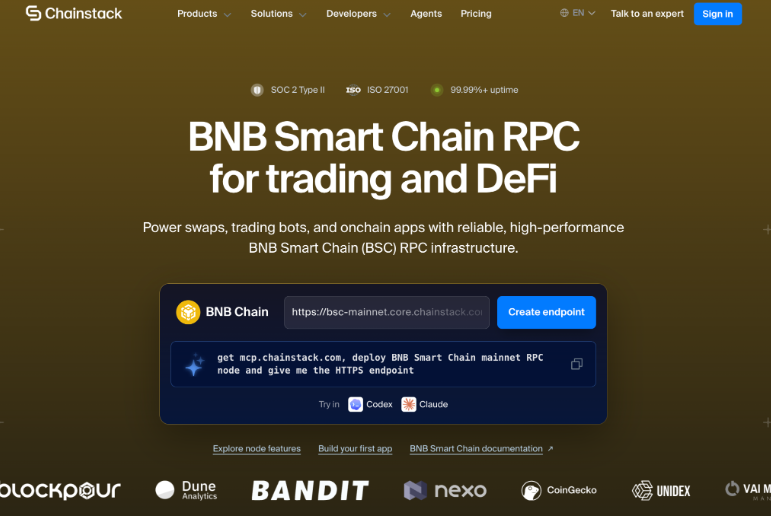
Chainstack runs BNB Smart Chain mainnet on shared Global Nodes (one address that routes each request to the nearest region) and on Dedicated Nodes (servers reserved for one customer). Pricing is flat: one unit per request, or two for old data and tracing. If you go over your limit, requests keep working instead of being blocked.
MEV protection, which keeps your transactions out of the public mempool by routing them privately to block builders, is free on every plan. Warp transactions add faster propagation through bloXroute at $0.15 each from the Growth plan. You can pay in crypto, and Chainstack holds SOC 2 Type II and ISO 27001 certificates. Choose Chainstack if you want predictable bills, MEV protection and the shorter GEN 2.0 request path on one platform.
Where Chainstack falls short:
- The free plan has no old data or tracing and limits event searches to 100 blocks
- At about $2.45 per million simple requests (the $49 Growth plan over 20M units), it costs more than Dwellir at $1.96
- A dedicated BNB Smart Chain full node costs about $4,336 a month on top of the $199 Pro plan
- Failing over a whole region now relies on DNS, so it takes seconds instead of happening instantly
- On Chainstack Compare, a benchmark Chainstack runs and is ranked in, it led BNB Smart Chain only narrowly in the week to November 18, 2026 (score 0.074 against 0.075). In Germany its 95th-percentile latency was 87 ms against 53 ms for the best provider
2. dRPC
dRPC spreads requests across independent node operators. Its BNB Smart Chain page lists archive data and MEV protection, which dRPC calls frontrunning protection and includes on every paid plan, and all paid plans accept crypto. The $49 Pro plan includes about 10M requests at up to 300 per second. Choose dRPC if you want frontrunning protection and crypto payments without paying for a larger plan.
Where dRPC falls short: the free plan runs on public nodes only, at 25 requests per second. dRPC lists no security certificates, and dedicated clusters need Enterprise plans from $990 a month.
3. Dwellir
Dwellir serves BNB Smart Chain from archive endpoints and charges one credit per response for any request. The free plan allows 20 requests per second and 100,000 responses a day, and the $49 Developer plan includes 25M responses at 100 per second, with debug and trace APIs. For a flat monthly price, Unlimited Nodes start at $119 for 25 requests per second. Choose Dwellir if price per request matters most.
Where Dwellir falls short: the free plan has no debug or trace APIs, and Dwellir advises keeping event searches to 5,000 blocks or fewer per request on this chain. No MEV protection or security certificates are listed.
4. Quicknode
Quicknode runs BNB Smart Chain with full archive data, debug and trace APIs, MEV protection, and live data feeds (Streams) and Webhooks. Quicknode advertises a 99.99% uptime guarantee (contractual on Enterprise, which also adds dedicated BNB Smart Chain infrastructure) and lists SOC 2 Type II and ISO 27001 certificates. Choose Quicknode if you need live data feeds, MEV protection and both certificates.
Where Quicknode falls short: each request costs 20 credits and tracing doubles that, so the 80M credits in the $49 Build plan cover about 4 million requests, at 50 requests per second. Its pricing page lists a one-month trial rather than a permanent free plan.
5. Alchemy
Alchemy supports BNB Smart Chain with a free plan of 30M units a month at 15 requests per second. Pay as you go costs $0.52 per million units with 300 requests per second included, and units are weighted by request type: an eth_call costs 26 units and an event search 60. Alchemy holds a SOC 2 Type II report, and its data APIs and wallet tools work across chains. Choose Alchemy if you already use its dashboard and tools on other networks.
Where Alchemy falls short: a million eth_call requests cost about $13.52, the most of the five, and the free allowance covers only about 500,000 event searches. No MEV protection or ISO 27001 is listed for BNB Smart Chain.
Final thoughts
Chainstack is the strongest all-round choice for most teams: flat pricing, free MEV protection, tracing, Dedicated Nodes, both certificates and a GEN 2.0 request path that cut median first-byte time on mainnet from 293 ms to 71 ms in its own test. Dwellir is the cheapest per request, at about $1.96 per million simple reads. Quicknode also holds both certificates, dRPC includes frontrunning protection on paid plans and Alchemy suits teams already on its platform. Blocks arrive in under half a second and latency depends on where your servers run, so test your own app on a free plan first.
DISCLAIMER – “Views Expressed Disclaimer – The information provided in this content is intended for general informational purposes only and should not be considered financial, investment, legal, tax, or health advice, nor relied upon as a substitute for professional guidance tailored to your personal circumstances. The opinions expressed are solely those of the author and do not necessarily represent the views of any other individual, organization, agency, employer, or company, including NEO CYMED PUBLISHING LIMITED (operating under the name Cyprus-Mail).





Click here to change your cookie preferences