
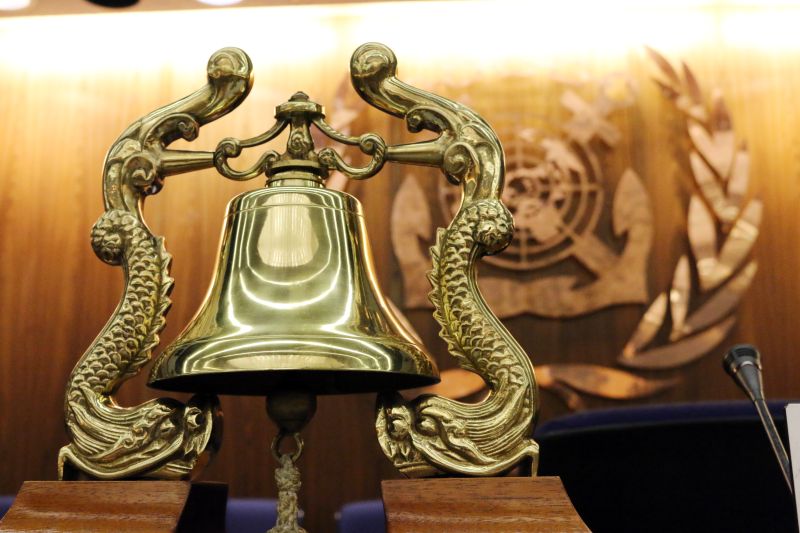
Cyprus’ shipping industry is preparing for crucial negotiations at the International Maritime Organisation (IMO) next week, as technical talks already under way in London seek to resolve disagreements over emissions charges, cleaner fuels and global shipping regulations.
The 23rd Intersessional Working Group on Greenhouse Gas Emissions (ISWG-GHG 23) began meeting this week, November 23, and will continue until Friday, November 27, examining outstanding issues surrounding the proposed IMO Net-Zero Framework.
Its findings will feed into the 85th session of the Marine Environment Protection Committee (MEPC 85), which officially opens at IMO headquarters in London on Monday, November 30, and runs until December 3.
A further extraordinary session could take place on Friday, December 4, although the IMO has made clear that this remains subject to confirmation by MEPC 85.
The distinction is important. This week’s technical negotiations are taking place behind closed doors, while next week’s committee meeting will bring governments together to consider the proposals and determine the next steps.
For Cyprus, where shipping and related services contribute an estimated 7 per cent of GDP, the outcome could influence fleet investment, vessel financing and the cost of operating ships for decades.
At the centre of the discussions is the proposed IMO Net-Zero Framework, which combines a global marine fuel standard with a mechanism for charging ships according to their greenhouse gas emissions.
The framework was approved in draft form in April 2025, but its formal adoption was postponed in October that year after governments failed to reach agreement.
The latest talks are intended to address the remaining disagreements and find a way towards a global framework acceptable to member states.
For shipowners, the uncertainty is becoming increasingly expensive.
Companies ordering vessels today must decide which fuels and technologies to invest in, even though those ships could remain in commercial service for 20 to 25 years.
They also need to know whether cleaner fuels will be available along their trading routes and how much more they will cost than conventional marine fuel.
As previously reported, Cyprus Shipping Chamber (CSC) president Andreas Neophytou has questioned whether the existing draft framework can deliver the certainty companies need.
In an exclusive interview earlier this month, he said the draft agreed in April 2025 “is no longer a viable global solution”.
Neophytou called for a “unified, global and pragmatic regulatory framework under the IMO”, arguing that shipowners need clear rules before committing substantial investment to new vessels and technologies.
He also pointed to the limited production and availability of renewable and low-carbon marine fuels, explaining that the transition depends on investment by energy producers, fuel suppliers and ports, not just shipping companies.
The problem is becoming clearer as more alternative-fuel vessels enter the global orderbook.
According to a November study by Lloyd’s Register, 1,942 alternative-fuel-capable vessels were on order in January 2026, representing 47 per cent of the global orderbook by tonnage.
However, the infrastructure needed to support those ships remains unevenly distributed.
LNG bunkering was available at 222 ports worldwide, compared with just 25 offering methanol. Commercial ammonia bunkering had taken place at only one port, in South Korea.
The study also identified 385 methanol-capable vessels and 45 ammonia-capable ships on order.
“The fleet is moving faster than the infrastructure needed to support it,” said Kamran Ul Haq, senior vice-president of ports advisory at Lloyd’s Register.
For companies operating internationally, ordering a vessel capable of using alternative fuels is one thing. Finding those fuels at a commercially acceptable price, wherever the vessel trades, is quite another.
The price difference is already substantial.
According to figures published by S&P Global Energy, conventional low-sulphur marine fuel in Singapore averaged $22.78 per gigajoule in October, compared with $27 for a B24 biofuel blend, $28.48 for LNG and $48.47 for fully sustainable methanol.
On an energy-equivalent basis, sustainable methanol was therefore more than twice as expensive as conventional low-sulphur fuel at that bunkering hub.
Those differences matter when shipowners are making investment decisions, particularly in a sector where fuel accounts for a significant share of operating costs.
The regulatory picture adds another complication.
European shipping companies already operate under the EU Emissions Trading System (ETS) and FuelEU Maritime, which requires the gradual reduction of greenhouse gas emissions associated with energy used aboard ships.
The introduction of additional international charges could increase compliance costs unless the global and European systems are properly coordinated.
On November 18, nine international shipping organisations, including BIMCO, the International Chamber of Shipping (ICS), INTERTANKO and the World Shipping Council, issued a joint statement calling for internationally consistent regulations.
The organisations warned that overlapping national and regional measures could leave companies paying multiple times for the same emissions.
They also argued that future rules must reflect the availability and cost of alternative fuels, provide flexibility for existing vessels and encourage investment in cleaner technologies.
The CSC subsequently supported the statement, stressing the need for practical rules that can be enforced internationally.
Meanwhile, environmental organisations are pushing governments not to delay the framework further.
In a statement issued as the technical meetings began on Monday, the Clean Shipping Coalition called for adoption of the Net-Zero Framework without another postponement.
The group argued that governments had already spent years negotiating emissions reductions and needed to move towards implementation.
The disagreement reflects the difficult balance facing the IMO: introducing rules strong enough to accelerate shipping’s transition while ensuring the industry has access to the fuels and technologies required to comply.
The possible cost to consumers has also entered the debate.
Greek Shipping Minister Vassilis Kikilias recently warned that high emissions charges imposed before alternative fuels become widely available could increase freight rates, energy prices and the cost of essential goods.
Whether those costs are passed on would depend on shipping contracts, market conditions and arrangements between shipowners, charterers and cargo owners.
However, emissions charges are not the only issue on next week’s agenda.
According to the IMO’s official preview, MEPC 85 will also consider amendments to the Ballast Water Management Convention, aimed at improving implementation and protecting marine ecosystems from invasive aquatic species.
The committee is expected to adopt revisions to the convention’s annex and finalise changes to the code governing approval of ballast water management systems.
For shipowners and managers, these decisions could have implications for equipment, certification and compliance procedures.
Additional amendments to MARPOL, the international convention governing pollution from ships, will also be considered.
These include requirements concerning oily bilge water holding and service tanks on vessels fitted with integrated treatment systems, pressure-vacuum devices on crude oil tankers and the certification of engines using fuels that do not contain carbon.
The latter is particularly relevant as the industry develops propulsion systems capable of operating on alternative fuels.
Meanwhile, the committee will review 2025 fuel consumption and carbon intensity data, alongside proposals for the second phase of the Carbon Intensity Indicator (CII) review.
The work includes possible changes to efficiency measurements for cruise ships and improvements to the Ship Energy Efficiency Management Plan framework.
The CII system measures the operational carbon efficiency of ships and is already an important part of compliance planning for vessel operators.
Beyond emissions and energy efficiency, delegates will examine proposals to reduce marine plastic litter from ships, including a survey on how waste generated during normal operations is managed aboard vessels.
The committee will also review progress on reducing underwater noise from shipping, which can affect marine life, and consider proposed protections for environmentally sensitive sea areas.
These include the Nasca Ridge National Reserve in Peru, the Arabian Sea off Oman, parts of the Belgian North Sea and the Eastern Tropical Pacific Thermal Dome.
Another item is the IMO’s proposed Maritime Digitalisation Strategy, which MEPC 85 is expected to approve following consideration by other IMO committees.
The strategy is intended to improve the use of digital systems and information exchange across international shipping, with formal adoption by the IMO Assembly planned for 2027.
MEPC 85 will be chaired by Harry Conway of Liberia, with Hanqiang Tan of Singapore serving as vice-chair.
The meeting is scheduled to open at 9.30am London time on Monday, November 30, with remarks by IMO secretary-general Arsenio Dominguez.
The committee will consider the findings of this week’s technical working group, together with those of an earlier session held in September, as it examines how to address the remaining concerns over the proposed emissions framework.
The discussions form part of the IMO’s wider commitment to achieving net-zero greenhouse gas emissions from international shipping by or around 2050, with interim ambitions for 2030 and 2040.
For Cyprus, the issues will also feature at the CSC’s Global Shipping Minds Summit in Limassol on Friday, November 27.
The event, chaired by ICS secretary-general Thomas Kazakos, will examine energy security, alternative marine fuels and the industry’s long-term competitiveness.
Kazakos has also called for closer cooperation between governments, ports and energy producers to ensure cleaner fuels and the necessary infrastructure become commercially available.
For now, no new agreement on the IMO Net-Zero Framework has been announced.





Click here to change your cookie preferences