
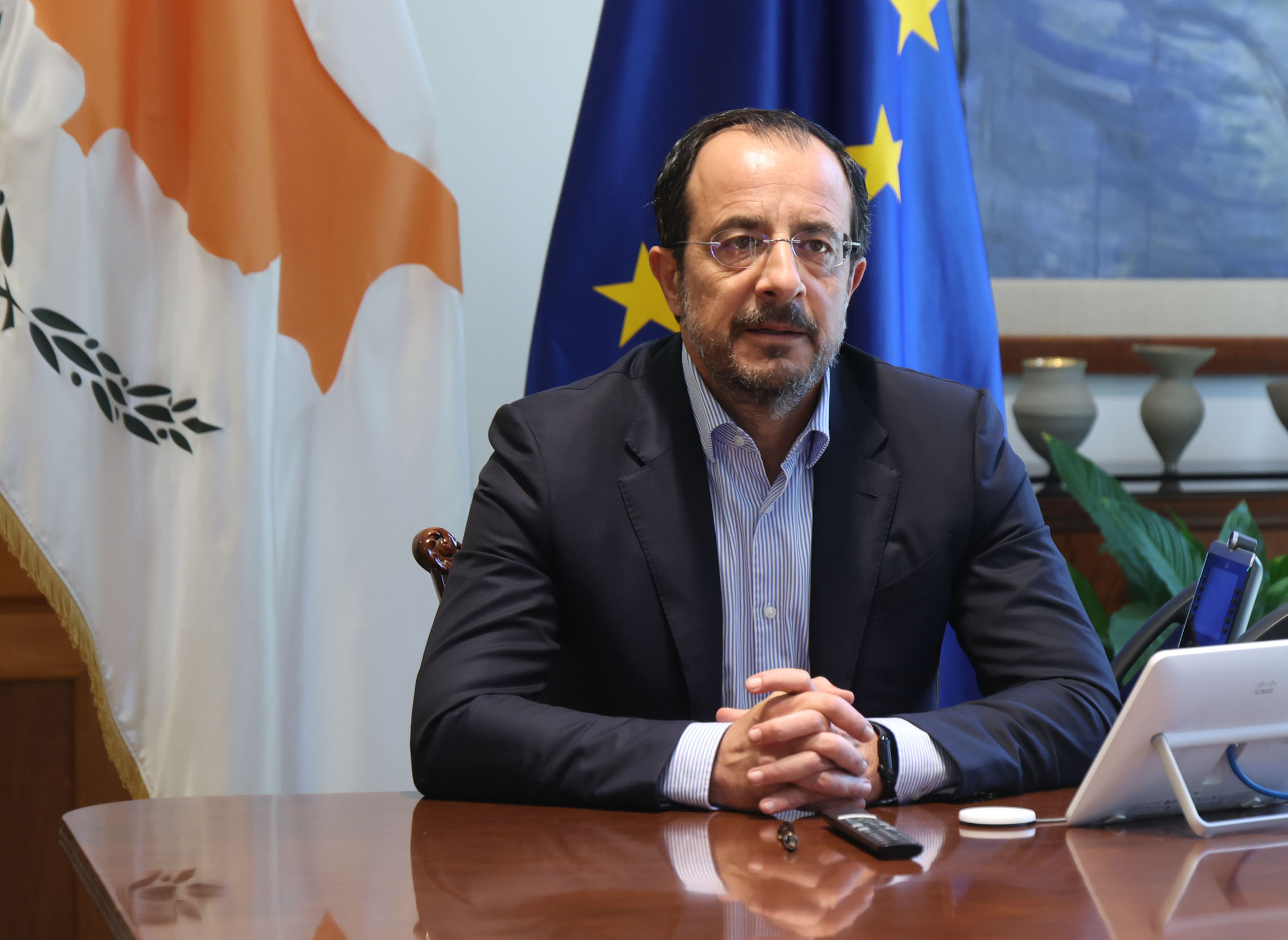
President Nikos Christodoulides on Monday stressed his support for “the independence, sovereignty, and territorial integrity of Ukraine, within its internationally recognised borders” as he partook in a videoconference of the ‘Coalition of the willing’ – a group of over 30 countries which have pledged support for Ukraine.
The videoconference was held to mark the 35th anniversary of Ukraine’s independence from the Soviet Union, and presidential press office director Victor Papadopoulos said that Christodoulides had stressed that “Cyprus, as a country which has experienced an illegal invasion of its territory and continues to be under military occupation”, supports Ukraine.
“Peace can only be achieved on the basis of the United Nations charter, without any external imposition. At the same time, Cyprus supports the coordinated European efforts to adequately prepare Ukraine for the coming winter,” he added.
The day’s videoconference was jointly chaired by Ukrainian President Volodymyr Zelenskiy, French President Emmanuel Macron, German Chancellor Friedrich Merz, and British Prime Minister Andy Burnham.
Burnham’s office said that those who took part were “united in their continued support of Ukraine’s fight to defend its sovereignty, freedom, and territorial integrity”.
“The leaders condemned Russia’s systematic and escalating strikes against Ukraine’s cities, critical infrastructure and civilians, causing the highest number of civilian casualties since the beginning of the full-scale invasion in 2022, and damaging a hospital in Kyiv the previous week,” it said.
It added that those in attendance had “also condemned Russia’s attacks on Ukraine’s cultural heritage sites, which form an integral part of Ukraine’s national identity, including the Kyiv-Pechersk Lavra”, an 11th-century cave monastery in the country’s capital.
“Leaders reiterated Ukraine’s clear and inherent right to defend itself against the Russian war of aggression, in full compliance with international law and Article 51 of the UN charter, and confirmed that they would not be deterred from their support for Ukraine by irresponsible Russian threats,” it said.
It added that attendees had “expressed their determination to increase military support for Ukraine, strengthen its air defence as a matter of urgent priority, enhance cooperation with its defence industry, and share relevant technologies, including through the anti-ballistic missile coalition”.
The anti-ballistic missile coalition was established last month with the aim of developing a European integrated anti-ballistic missile defence capacity. Its members are Denmark, France, Germany, Italy, the Netherlands, Norway, Spain, Sweden, Ukraine, and the United Kingdom.
Burnham’s office on Monday said that those attending Monday’s videoconference had “also committed to ratchet up sanctions on Russia’s military industrial complex and those supporting it”.
“Leaders also agreed on the urgency of providing immediate assistance for Ukraine’s energy sector ahead of the upcoming winter, including through the Ukraine energy support fund and provision of specialist equipment,” it said.
The European Union has thus far contributed €279 million worth of grants to the Ukraine energy support fund, most recently donating €20m on August 13.
Burnham’s office added that the participants had also “emphasised the need to continue to support Ukraine’s economic resilience in the face of Russia’s intensified attempts to renew their maritime blockade on Ukraine’s ports”.
“The leaders agreed to continue efforts to constrain Russia’s war chest through the use of sanctions, wider economic measures, and clamping down on sanctions circumvention and Russia’s shadow fleet,” it said, before adding that “this joint action to date has deprived Russia’s war chest of at least $495 billion since February 2022”.


Click here to change your cookie preferences