
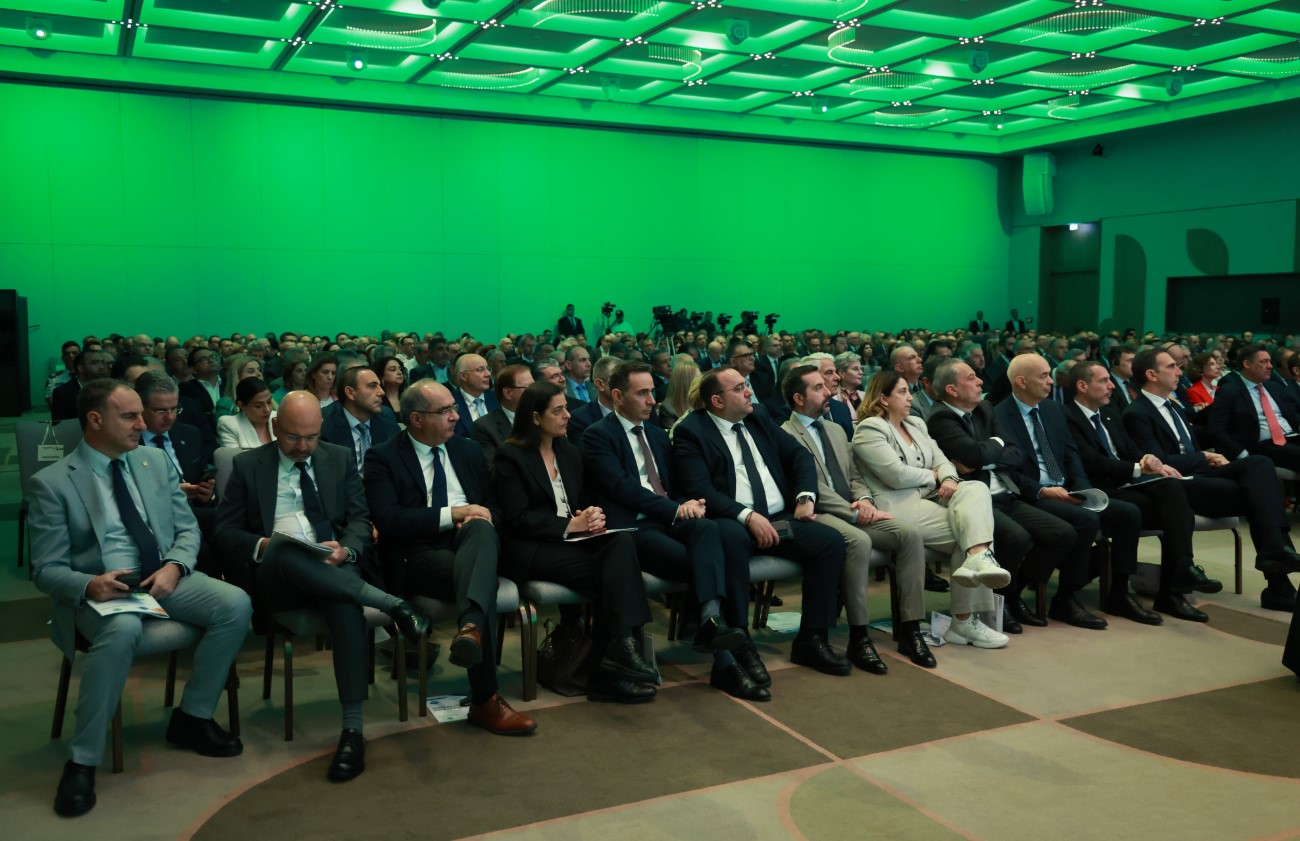
Addressing the gathering at the Landmark hotel in Nicosia, Oev president George Pantelides focused on the need for decisive action across key sectors, warning that internal weaknesses risk undermining the economy more than external shocks.
“The only enemy in areas we control is our bad self, which sometimes proves a very tough opponent,” Pantelides said.
He explained that while Cyprus faces the consequences of a crisis it did not cause, the response must be swift and strategic.
“Our only choice is to invest quickly and intelligently in strengthening the competitiveness of our real economy,” he said.
Speaking on behalf of the Sev, Aikaterinari said the economic and political ties between Greece and Cyprus have remained strong throughout history, adding that this is even more important “in today’s environment, where uncertainty has become the new normal”.
“Greece and Cyprus stand together in the face of every challenge,” she said.
Aikaterinari said this was reflected in early March, when Cyprus faced unforeseen situations as a result of the war in the Middle East and Greece responded immediately “with the dispatch of military force” and, above all, by sending “a message of unity and support within Europe”.
He stressed that the initiative comes at a time of “increased geopolitical instability and uncertainty with multiple and multi-layered impacts”, underlining the importance of proactive economic policy.
The president announced a specific outward-looking programme, detailing upcoming business missions aimed at attracting quality investment.
“In three weeks we will visit India with a business delegation, in early June Kazakhstan, while preparations are at a final stage for contacts in the United States, in Florida, Ohio and New York,” Christodoulides said.
“I call on business leaders to participate in these missions aimed at attracting quality investments,” he added.
The governor’s comments were included in the central bank’s annual report for 2025, which highlighted that the Cypriot economy continues to show positive prospects despite a constantly shifting international environment, including the war in the Middle East.
“Based on the working assumption of the baseline scenario for a gradual de-escalation of the war, inflation is expected to be close to 2 per cent in the medium term, contributing to maintaining a stable macroeconomic framework capable of supporting sustainable and balanced growth,” the report stated.
Referring to the CBC’s March 2026 projections, which incorporate the impact of the Middle East conflict and the outbreak of foot-and-mouth disease in Cyprus, the governor said growth is expected to slow to 2.7 per cent in 2026 from 3.8 per cent in 2025, before accelerating to 2.9 per cent in 2027 and 3.1 per cent in 2028.
Speaking at the High-Level Ministerial Stakeholders Conference on ‘Investing in Seafarers: Securing the Future of Global Shipping’, held in Limassol, Hadjimanolis said the sector is facing a defining period as greener shipping, digital transformation and increasingly complex supply chains reshape the industry.
“This conference places people firmly at the centre of maritime policy,” she said in her welcome address.
“The future of shipping is not determined only by technology, regulation, or infrastructure, but by the people who operate, manage, and sustain it every single day,” she added.
Deputy Shipping Minister Marina Hadjimanolis welcomed the conference speakers, along with representatives of the shipping industry, placing emphasis on the need for international cooperation and stronger support for the maritime workforce.
The dinner brought together key figures from the sector, including representatives from Tsakos Shipping and Trading S.A., the Cyprus Embassy in Athens Maritime Office, the Cyprus in UK Maritime Office, and the Cyprus Union of Shipowners (CUS).
The event, held as part of Cyprus’ maritime agenda during its Presidency of the Council of the EU, brought together policymakers, international organisations and industry representatives to discuss maritime education, training, seafarer wellbeing and the future skills needed by the sector.
Among the moments that drew attention was a discussion between Andreas Hadjipetrou, chief executive of Columbia Group, and Captain Iro Gidakou, fleet operations manager at Maran Gas Maritime Inc., whose career has made her one of the most recognisable female figures in shipping.
Anna Vourgos, director at Aphentrica Marine Insurance Brokers and a board member of the Cyprus Shipping Chamber (CSC), described the event as a reminder of how mentorship can shape the next generation of maritime leaders.
“Inspire to be inspired they say. Today was one of those days when we witnessed how yesterday’s mentees became today’s inspiring mentors!” Vourgos said, referring to Gina Panayiotou and Captain Iro Gidakou.
The initiative forms part of a broader effort to highlight lesser-known areas and strengthen the region’s appeal as a multi-dimensional tourism destination.
According to the board, the excursions, scheduled for May and June, focus on five key points of interest.
These include the Sea and Culture Museum, the Reptile and Amphibian Park, the Marion-Arsinoe Archaeological Museum, the Akamas Museum of Rural Life and Tradition in Droushia, and the Information Centre for Avifauna and Terrestrial Flora in Kathikas.
That message was at the centre of an investor event titled ‘Capital, Returns & FDI: Identifying Investment Opportunities in Europe’s Growth Markets’, according to Invest Cyprus chairman Evgenios Evgeniou.
The event focused on where international capital is moving today, with particular attention to the Eastern Mediterranean, a region which Invest Cyprus said is attracting steadily increasing investment interest amid the current geopolitical and digital transition.
The Cyprus Securities and Exchange Commission (CySEC) on Tuesday announced that it will hold its 30th anniversary conference on April 29 in Nicosia, with the participation of president Nikos Christodoulides and senior European and international officials.
The announcement stated that a dedicated section on CySEC’s website has been launched, providing details about the conference programme as well as access to the live broadcast of the event.
The conference will mark 30 years of supervision by CySEC and is expected to bring together more than 150 participants from across the regulatory and financial sectors.
The opening address will be delivered by president Christodoulides, followed by a speech from CySEC chairman George Theocharides.
The event took place on Saturday, April 25, at the Paphos medieval castle, bringing together families and visitors of all ages.
“With the main message “Let’s not leave our dreams turn into ashes!“, the event marked the culmination on the joint initiatives of ERB Asfalistiki and the Cyprus Fire Service, which are implemented throughout the year,” the company said in a statement.
The primary objective, the statement added, was to inform and educate the public on fire prevention and effective protection measures.
Visitors were given the opportunity to see fire trucks and firefighting equipment up close, while members of the fire service provided guidance on prevention and extinguishing techniques.
Ahead of the society’s upcoming webinar, titled “AI in Asset Management”, Spyrides said artificial intelligence is no longer “a distant frontier” for the investment management industry.
“It is here, it is moving fast, and it is changing how portfolios are built, how risk is assessed, and how investment decisions get made,” he said.
For finance professionals, he said the debate has already shifted, adding that the question is no longer whether AI will affect their practice, but “how to engage with it thoughtfully, critically, and with a clear sense of responsibility”.
In a report shared by Greek business outlet Newmoney, the NBG executive explained that the priority is now a hybrid banking model combining digital convenience for everyday needs with high-quality human advice for more complex decisions.
Referring to recent developments at the recently-held Delphi Economic Forum, he mentioned that the bank has invested more than €1 billion in technology over the past five years, upgrading critical infrastructure and centralising non-sales processes.
This investment led to a redesign of the retail service model so that branches can focus on more complex products and overall customer experience.
The project, implemented in cooperation with the Cyprus Association of Research and Innovation Enterprises (CARIE) and based on a memorandum already signed between the two sides, is aimed at bringing companies, researchers, students and specialised university infrastructure into the same space.
Speaking to Entrepreneurial Limassol, a periodical published by the Limassol Chamber of Commerce (Evel), Tepak rector Professor Panayiotis Zaphiris said the university considers the concession of the plots to be effectively agreed, although official approval has not yet been received.
He explained that the land belongs to the Ministry of Education and that the process mainly concerns a change of use, allowing the area to be used by the university instead of for school facilities.
“The energy transition is a necessary and irreversible process,” said Head of Structured Finance Spyros Venetsianos.
However, he warned that “you cannot have at the same time a fast transition, low prices and full market liberalisation”.
He explained that energy policy must balance conflicting goals, including accelerating the transition, maintaining competitive pricing and opening markets to greater private sector participation.
Venetsianos also stressed that these objectives are not fully compatible and require clear priorities and trade-offs.
According to an official announcement, the board of directors approved the annual financial statements, adding that the full report will be available at its offices at Lanitis Farm in Fasouri and on the Cyprus Stock Exchange (CSE) website.
The annual general meeting has been scheduled for June 4, 2026 at 9:00 a.m. at the company’s head office in Fasouri, Limassol.
Lanitis Golf reported that its core activity remains the development of a leisure and residential golf course project, with key milestones stretching back to the approval of the town planning permit on November 14, 2012 and the building permit granted on July 25, 2019.

Click here to change your cookie preferences