
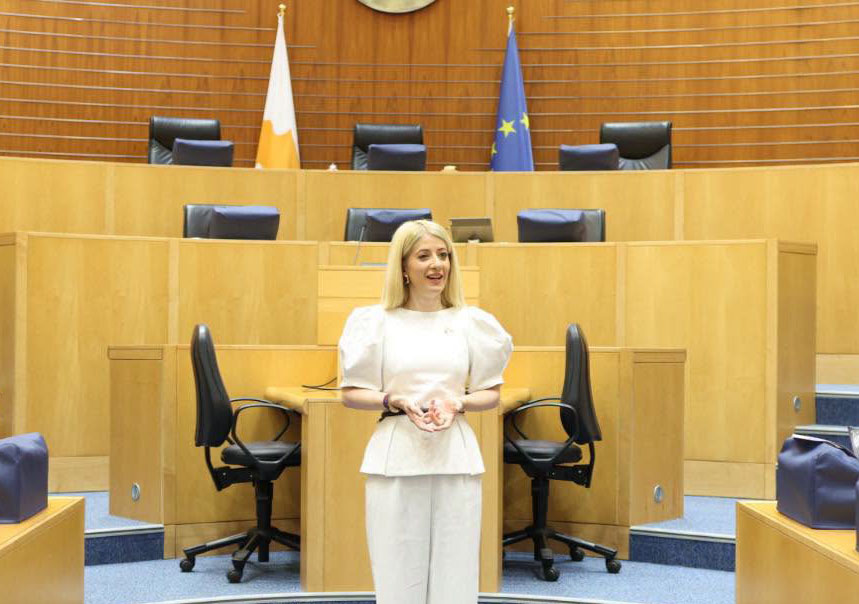
House president Annita Demetriou said on Wednesday she no longer considered the implementation of pension reform on January 1 feasible, criticising the tight deadlines imposed on parliament and warning that its institutional role was being undermined.
“Parliament is being ‘blackmailed’ and pressured in a way that restricts its role. As a result, we either fail to achieve the desired outcome or are forced to revisit legislation when we have not had the time to examine it in depth,” she said.
Speaking at a press conference reviewing the work of the previous parliamentary period, Demetriou recalled that she had previously described the situation surrounding pension reform as a “déjà vu” of the tax reform process.
“Today, I would say the situation is worse. At least the tax reform legislation had been submitted by this point, and we passed it through extraordinary sessions right up until December 24 last year. At present, we have nothing before us.”
She added that she had met with all parliamentary parties and established that efforts to reach consensus with the social partners were not even at an advanced stage.
“This in itself, as you can appreciate, creates an enormous problem. I do not know when the pension reform bill will be submitted to the House of Representatives. What I do know is that we are at the end of November and approaching the budget vote.”
Referring to announcements that pension reform would come into effect on January 1, Demetriou said she no longer believed this was achievable.
“However, I assure you that whenever [the bill] is submitted, the House of Representatives will do everything possible to move it forward, always with respect for its right to ask questions and receive the necessary answers.”
She explained that parliament’s objective was not simply to announce a reform or an amendment to existing legislation, particularly given that it remained unclear what would ultimately be submitted.
“Our aim is to deliver an outcome on something that citizens are rightly calling for and that we, too, are seeking alongside them.”
Annita Demetriou stressed the need for institutional respect, saying that legislation of such importance, which would also affect future generations of workers, could not be submitted at the last minute.
Asked separately about the large number of bills approved by parliament during the previous parliamentary period, Demetriou said an MP’s role was not to reject legislation outright, but to shape it in a way that could secure majority or even unanimous support and benefit the public.
She noted that parliament invited organised groups and officials to express their views, often having to assume responsibilities that did not fall within its remit because bills were submitted without prior consultation.
This, she said, accounted for delays and explained why parliament sometimes decided, rightly in her view, to return bills so that the required procedures could be followed.
“Posting a bill on a website does not constitute public consultation,” she said.
Public consultation involved specific procedures, she added, and the more thoroughly these were followed by the executive, the more easily parliament would be able to carry out its work without deviations from the process.




Click here to change your cookie preferences