
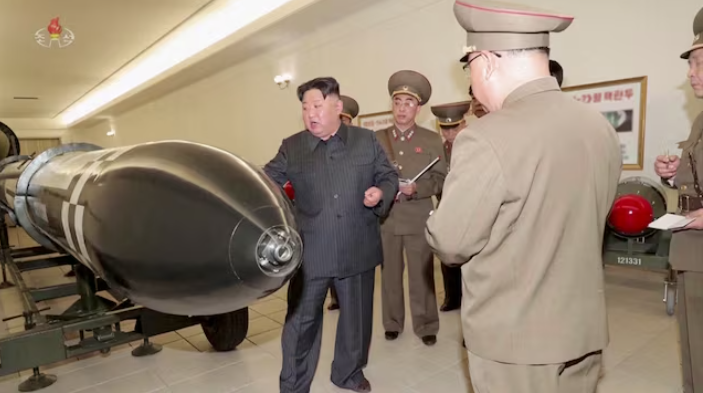
North Korean leader declares the country’s nuclear status irreversible as Pyongyang expands weapons production and signals further advances in its naval nuclear programme.
North Korean leader Kim Jong Un said his country should focus on deploying tactical nuclear weapons across multiple domains and that its nuclear material production capacity was being systematically expanded, state media KCNA reported on Thursday.
Kim, during an inspection on Wednesday of nuclear material production and weapons research facilities, also said North Korea’s status as a nuclear weapons state was “absolutely inviolable”.
KCNA did not identify the facilities or their locations.
“Our nuclear capability is now a reality,” KCNA quoted Kim as saying.
Kim said North Korea should “focus on utilising tactical nuclear weapons across multiple domains for different missions” and called recent achievements in nuclear weapons production a major success.
Pyongyang pushes to expand nuclear arsenal
The tour of facilities underscores Pyongyang’s push to expand and diversify its nuclear arsenal in defiance of calls for denuclearisation, as questions persist over prospects for renewed dialogue with the United States.
Photographs released by KCNA showed Kim and officials inspecting objects that analysts said looked like gas centrifuges, used to enrich uranium, and miniaturised, standardised tactical nuclear warheads such as the Hwasan-31.
Tactical nuclear weapons are generally lower-yield warheads meant for battlefield use, unlike strategic weapons intended for longer-range strikes.
In 2023, KCNA published images of what it called the Hwasan-31 tactical nuclear warhead, saying it could be fitted to delivery systems, including short-range missiles.
North Korea advances naval nuclear ambitions
KCNA said Kim also toured a “nuclear-powered equipment production base,” which analysts said may be the first showing of equipment for a naval nuclear reactor programme.
Ankit Panda, an analyst at the Carnegie Endowment for International Peace, wrote that the images from the base, which he described as a naval reactor facility, were “a very notable disclosure.”
Shin Jong-woo, secretary-general of the Korea Defence and Security Forum, said the facility was believed to be producing submarine reactors and parts, adding that the pictured equipment could be used for a nuclear-powered submarine planned for next year.
Kim also said any attempt to deny North Korea’s nuclear status would be regarded as “an open declaration of war”.
“Our possession of nuclear weapons is an absolutely irreversible choice as long as malicious forces exist that use nuclear weapons as a means of achieving hegemony,” Kim said.
Kim accuses US of fuelling nuclear tensions
Kim justified the buildup by citing growing nuclear threats from the United States and its allies.
The United States had “incited its vassal states” near North Korea to acquire nuclear-powered submarines by introducing the “dangerous precedent of nuclear proliferation through AUKUS to Northeast Asia,” he said, referring to the security pact also involving Britain and Australia.
He also accused Washington of building a “nuclear military alliance system” by trying to share and use nuclear weapons with its allies.
South Korea is pursuing nuclear-powered submarines after US President Donald Trump approved the plan in October last year.
South Korea’s Defence Ministry said its military was taking seriously North Korea’s stated intent to expand tactical nuclear weapons and urged Pyongyang to “immediately stop trying to justify its nuclear development” and implement UN Security Council resolutions.
Seoul’s military would strengthen deterrence through consultations with the US and upgrade its response to nuclear threats, it said.
Prospects for renewed US-North Korea dialogue
Analysts said the visit carried a message for Washington amid speculation about US-North Korea contact.
“This is not so much North Korea permanently closing the door to dialogue with the United States as a strategy of raising the bar: ‘denuclearisation talks’ are over, and if talks open in future, it will deal only on a ‘nuclear state versus nuclear state’ basis,” said Lim Eul-chul, a professor at South Korea’s Kyungnam University.
Shin said Kim’s reference to “multiple domains” could signal targets beyond the Korean peninsula, including the US mainland.
North Korea has conducted six nuclear tests since 2006, with its last and most powerful test in 2017.
South Korea’s defence minister said in August that Pyongyang was believed to possess between 80 and 120 nuclear warheads, but said the estimate came from private research organisations and could not be officially confirmed.



Click here to change your cookie preferences