
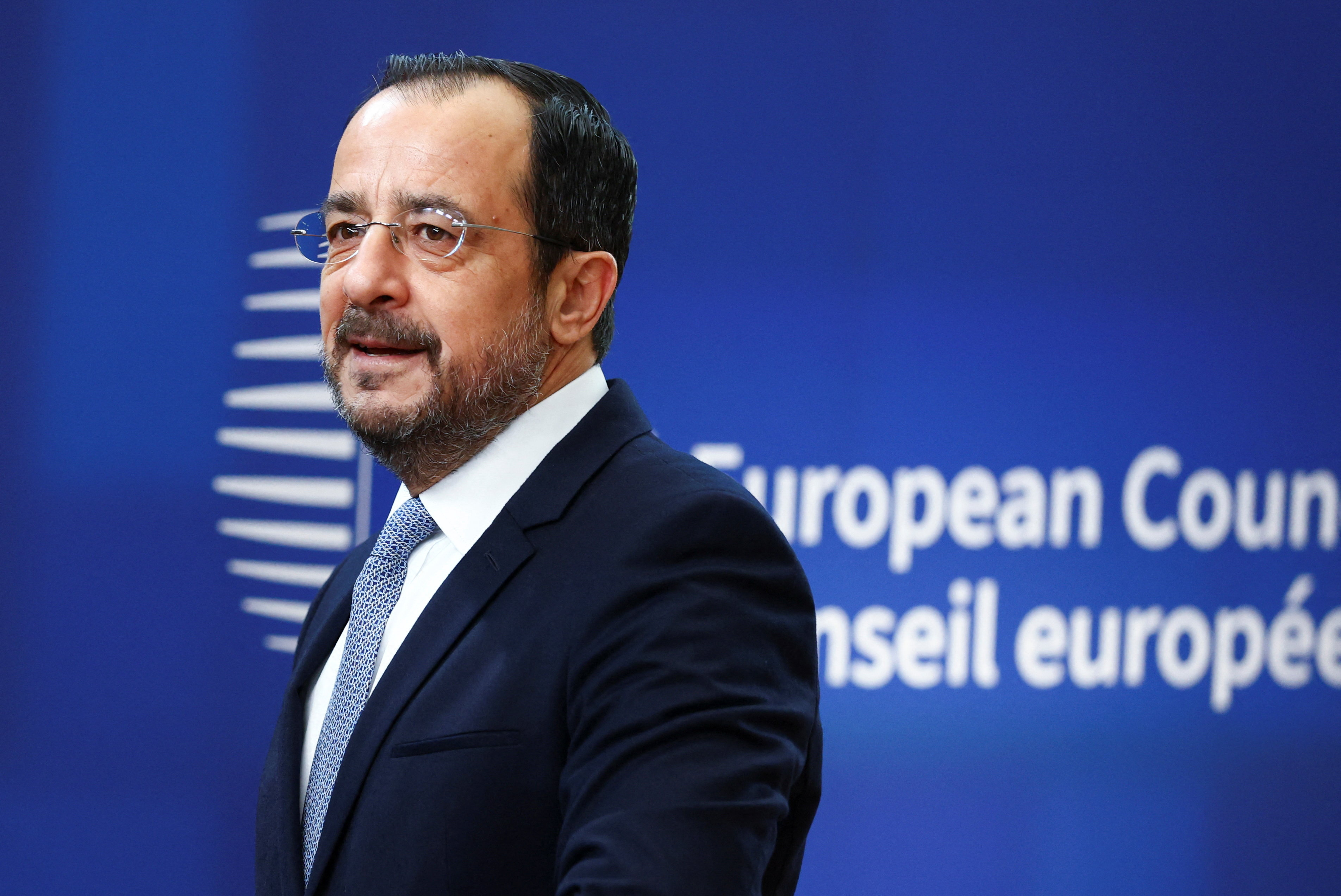
President Nikos Christodoulides on Thursday cautioned against German Chancellor Friedrich Merz’s threat to veto the entirety of the European Union’s next long-term budget unless every one of the bloc’s member states commits to financially support Ukraine in the coming years.
“I do not agree with this linking, because the more issues we introduce to the process of reaching a viable negotiating framework … the more issues we link together, the harder it will be to reach a political agreement,” he said upon his arrival at an extraordinary European Council summit called to hash out the budget for the years between 2028 and 2034.
He said that he “fully” understands Merz’s approach, and suggested that the threat to block the whole budget may have been made “because he comes from a group of countries which favour further cuts to the European Union’s budget”.
However, he said, “I reiterate the position, which I believe reflects the view of the majority of member states, that the more issues we bring to the table, the more difficult it becomes to secure a political agreement”.
The Financial Times had reported earlier this month that Merz had penned a letter to European Council President Antonio Costa promising to block the whole multiannual financial framework – the name given to the EU’s long-term budget – unless all 27 EU member states sign up to fund Ukraine amid the ongoing war in the country.
“A collective commitment that all of us, without exception, will contribute fairly to closing [Ukraine’s financing] gap is an essential prerequisite for resolving this issue and for discussing any further matters, particularly those with financial implications,” he reportedly wrote.
Commission proposed €45bn of loans for Ukraine next year
Last week, the European Commission proposed the provision of up to €45 billion worth of loans to the Ukrainian government, of which €20 billion will be allocated to military assistance for the country’s war effort, and the remainder will be provided as general support to its state budget.
Of the plans, commission President Ursula von der Leyen said that “Europe will continue to ensure maximum support to Ukraine and maximum pressure on Russia”.
“We will continue to help Ukraine protect its people and infrastructure from Russia’s attacks, and keep schools and hospitals open as Russia rains drones and missiles on Ukrainian cities,” she said, with the €45bn expected to plug the majority of the projected €70bn funding gap the country will face next year.
However, Bulgaria, the Czech Republic, Hungary, and Slovakia are all known to be opposed to the prospect of funding military aid for Ukraine, with Czech Prime Minister Andrej Babis on Thursday saying that “financing of Ukraine is not possible to link to the financing of cohesion”
“Cohesion” is the word used to describe efforts to reduce regional inequality across the continent.
Bulgaria offers to join non-military parts of loans
However, Bulgarian Prime Minister offered something of a compromise, offering to pay a share of the €20bn which is to be allocated to non-military spending.
“We have a huge historical diaspora of 300,000 Bulgarians living in Ukraine, and our wishes and are request [are] to concentrate our support in the areas of the Bulgarian population in Ukraine. So, we are going to contribute, but again, no money from Bulgaria for weapons, no money for [the] war in Ukraine,” he said upon his arrival at the day’s summit.
At the other end of the scale, Danish Prime Minister Mette Frederiksen warned that “if we let Ukraine fall, we have almost opened the door for Russia to move further into Europe one way or another”.


Click here to change your cookie preferences